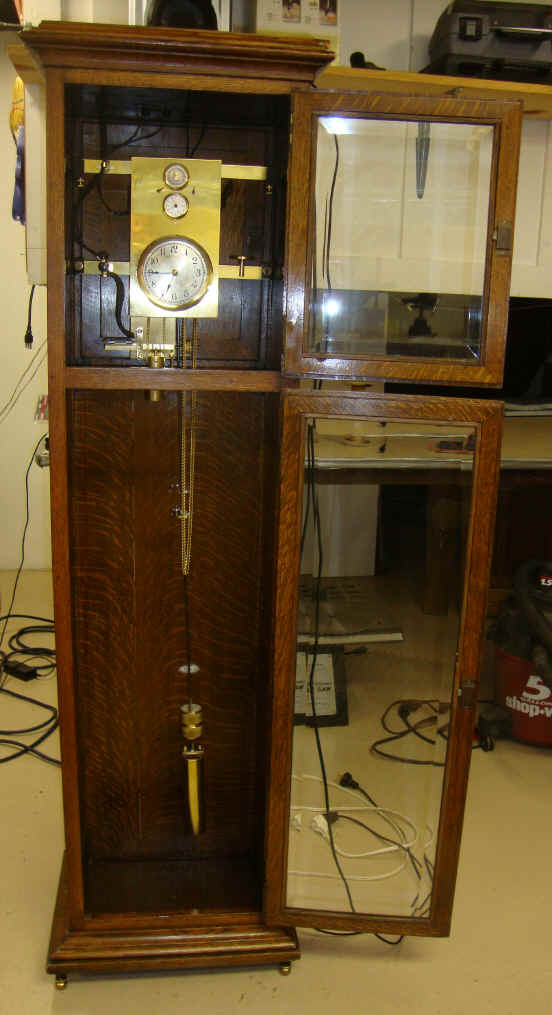
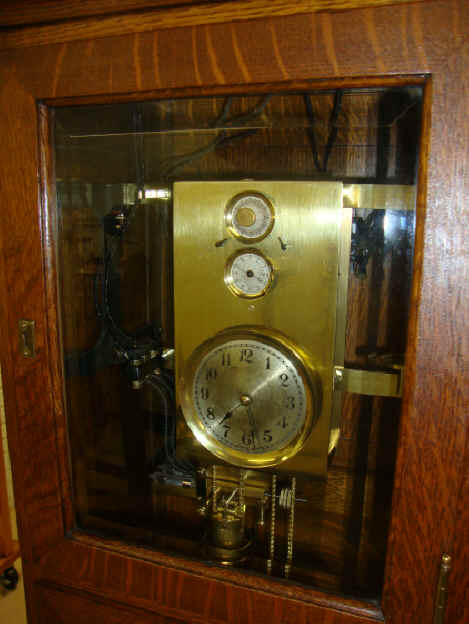
   Maker, Warren Clock Co. (later known as Telechron, Inc., Ashland, Massachusetts, USA. Model Type C, 1926, serial no. 7. Probably from a a location in New York, or possibly Boston or the state of California, three of the larger locations in the US that widely used DC current at the time. One second compensated pendulum (Invar). 58"h x 16"w x 12"d. Tiger oak case. On the serial number tag it also states that it was designed to provide 25 Hertz frequency. This clock is different from the one other extant example as well as two others described in literature, those are designed to provide a more conventionally expected 110 Hertz. It is known that the New York subway ran on 25 Hertz at the time. The word Telechron is a composite pair of words from the ancient Greek: Tele = to or at a distance, and the Latinized Greek word Chronos, chron = time. Time over distance. The perfect description of a master clock. This master clock introduced in 1920 by the Telechron company shares the same cabinet that housed the company's most successful model the Type A. This, however is where the similarities end. Whereas the Type A was designed to work in the more conventional and familiar electrical environment of 110 volt AC, 60 cycles, this device was used in the few areas of the country which at the time used DC current or was in an istallation that needed close control over their DC power supply like in a large electrical commuter train power station. At the time this was made, the electrical grid in the United States was not yet interconnected to a single standard as it is today. Even so, very few areas were using the DC standard. Therefore few of these units were made. To the best of my knowledge there are only two examples extant, this one being the only one that is functional. A discussion on how this clock operated is in section six and a short history of the Telechron company and it master clock product line is in the page describing the Type A. Click on the picture to go to a page for more detail of the restoration of this clock to full working order.
The Type C was first introduced in 1920. Yet we have a unit of serial #7 being put into service in 1926. The Telechron company used a sequential serial numbering system on their master clocks. The motor tag would preclude anything earlier than 1924. Given the unusual frequency of 25 cycles and that they match up between the motor tag and the case tag it's safe to say the motor is original. This would seem to indicate that only seven of the Type C were produced from the introduction in 1920 through 1926, about one per year. This is in sharp contrast to the company's highly successful Type A which by this time had a production of somewhere around 400 and would explain the fact that there is only one example of the Type C, while dozens of the the Type A are known.
|