|
| |
Master Clocks
  
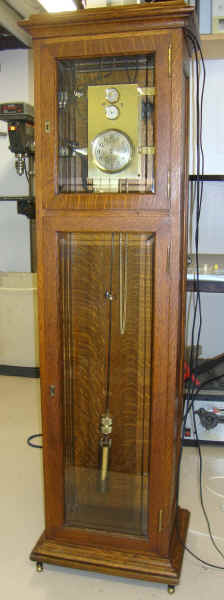
| Below are five master clocks used to control a series of slave clocks or
other mechanisms like bells or dynamos. These clocks do not fit into the main part of the
collection of tower or skeleton clocks or time locks. However, they still, with the
exception of the first two, share the general theme of being able to see the movement
works. The first photo is a Telechron Type A from the mid 1930's. Second a rare Telechron
Type C, the only complete working example known, and was used in systems that operated in a DC voltage
environment. The next photo shows a side-by-side comparison of the Type A and Type C
(pendulum not shown on C). The third clock is a Telechron Type E from
the early 1930's meant to run in a partial vacuum. Very rare, and only
one of five examples known, again this being the only operational one.
Fourth a Collin Wagner, 1886, France. A beautiful example of the
horological art. Jeweled movement with Wagner's rocking frame
remontoire. One of two examples known. Fourth a Hahl pneumatic, 1913 with spring remontoire and extra
electrical bell actuating complication. This clock used air pressure rather than
electricity to control the slaves. This mechanism is Rube Goldberg device to see in
operation. The Telechron Type A helped bring about the standardization of electrical
frequency control throughout the United States allowing for clocks of all types to be
controlled by small, cheap synchronous motors which lead to the demise of pneumatic
systems like the Hahl in the United States.
Click
on the picture to go to a page for more detail.

The complete line up of the Telechron Company's floor
standing master clocks, from left: Type A, Type C, and Type E.
 
Collin_Wagner, Paris, France 1886.
▲ Hahl Automatic Clock Co., Chicago, Illinois, c. 1913
 |
|
|