Sargent & Greenleaf, Rochester New York - 2 movements - modified by Andy Kotas, Model #2, #3, #4 and #6
Sargent and Greenleaf Model #2 modification by Andy Kotas.
Model #2, top unmodified, bottom modified.
Model #3 modification
Model #4 modification
Model #6 modification
First photo Model #6, original and modified. Second photo the Andy Kotas modification.
This photo shows the interior of the Model #6 case with the movements and mounting plate removed. Compare the drop bolt with the others in Models 2 through 4 and one will see the evolution in the design from the introduction and the largest lock configuration, the Model #2, and the changes made to that part as the lock design began to shrink. S&G's drop bolt was one of the most successful designs in the time lock industry and contributed greatly to the success of that company. In the Model #6 the release of the bolt to bring the lock "off guard" is still driven by gravity, but the bolt is spring loaded for the "on guard" function and is activated by the button at the top of the case. Notice how well finished the screws are and the drop bolt escutcheon still retains the same design throughout the evolution of the drop bolt. The finish here is notable since unlike all the other models, these components are never visible to the operator.
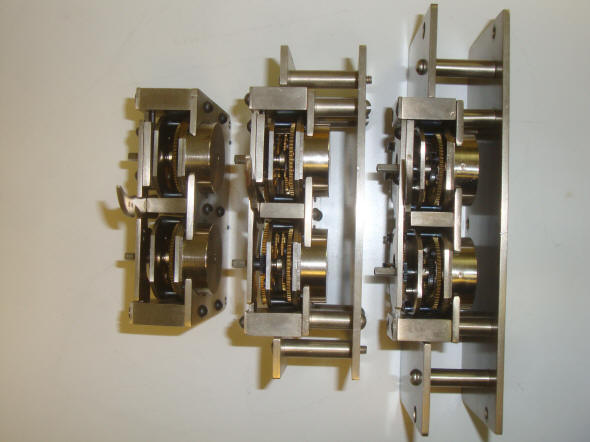
Models 2, 3 and 3. I did not have the #6 example when these photos were taken.
Movements of Model 2, 3 and 4 A. Model #2. Sargent and Greenleaf invented the first commercially practical time lock and made their own movements. Most other firms, notably Consolidated, Yale, and Diebold used movements from outside suppliers mainly E. Howard & Co. Around 1902 Howard exited the time lock business and Seth Thomas filled much of this. Other makers who arrived later, such as Bankers Dustproof and and Mosler Safe Co., used Illinois Watch Co. pocket watch movements. However, there were exceptions such as Yale's models D and E which used Waltham pocket watch movements. Beginning around the 1950's movement production shifted from the United States to Switzerland. Sargent and Greenleaf ceased production of their own movements due to high domestic costs in 1953. This is an example of an expertly modified time lock. It probably was done sometime between 1950's and 1960's. The substituted movements are the standard ones made in Switzerland for the Yale and Towne Co. and were the same as used in theirs and other contemporary locks of the time. See how the modified time lock compares with the same model as originally equipped with a set of Sargent movements contained within a single set of movement plates. All of Sargent's early time locks had this type of movement construction before they adopted modular movement designs in 1889. It is obvious that as parts became difficult to obtain, this would cause the entire unit to malfunction. According to John Erroll, author of the definitive book on time locks, American Genius Nineteenth Century Bank Locks and Time Locks this was the work of Andy Kotas, Stamford, Connecticut (same city as Yale's headquarters) and a former Yale technician. His work is quite recognizable. Firstly he uses Yale replacement movements, secondly the design of the entire snubber and drop bolt parts are of an identical design as well as the the parts that hold these assemblies, except for the Model #6. The finish of his components are consistent. Lastly, he always numbered his work. Assuming his numbering system was sequential, it would appear that he had modified a large number of movements. I have only seen Mr. Kotas work in connection with the early S&G locks that were made before the company's introduction of modular or interchangeable time lock designs. One can see these parts are used consistently throughout the first three examples illustrated on this page over the three different S&G time lock models. Mr. Kotas appeared to have always used sequentially numbered movements in keeping with the OEM time lock industry standards. Compare how these differ in design from the modifications made on the two single movement S&G models which are presumably done by a different person. The last three photos show the movement cluster removed from the time lock cases. Notice the strong similarities in their construction. The Model #6 required an entirely different approach because the original lock was so different from the earlier models. Retrofitting of time locks occurred when there was a lack of parts or personnel to service older time lock units. Modified time locks were done by a few experts whose work was respected and trusted. Probably these conversions, if known to the bank's insurance company, would have had to have been done by a sanctioned firm in order to retain coverage. After all, if the lock were to fail completely, the door could not be opened. While a regular time lock had redundancies built in from the factory and thus a very low probability of total failure, a modified lock with altered parts common to all the movements for example, the snubber bar, drop lever or bolt could, if made poorly, cause a total failure. In the entire history of the use of factory installed time locks with redundant movements, when the lock was properly used and serviced and in the absence of tampering or efforts at forced entry to the safe, there has never been a total failure of an OEM mechanical time lock resulting in the door being unable to be opened. This was not the case with some later-made electromechanical and electronic time locks. For this reason time locks in use to day are still controlled by mechanical clock movements. Case #1623, modification stamped #618, movement #52247, 52248. See photos below for a modified Model #2 in situ in a vault door. file 2 Most time lock modifications were performed on S&G locks since this company made their own uniquely configured movements. Early locks that used less commonly available movements, particularly those before the introduction of S&G's modular style movement lines after 1890 were candidates. However, there are exceptions. Even so, modified locks are quite rare. It was an expensive procedure done from absolute necessity, and the risk of a catastrophic failure, while remote if done properly, was still a deterrent to the conservative banking community and their insurance companies. Modified locks are an interesting subgroup of time locks. Other modified time locks page one, page two. B. Model #3. Same conversion by Andy Kotas as in A, above. Case #1685, modification stamped #312, movement #50431, 50432. file 156 C. Model #4. Another conversion by Andy Kotas. The main difference in this modification from that shown for the S&G model #3 shown in 'B' is the elimination of the metal surround covering the upper and two sides of the time lock assembly. This is necessitated as the case of the Model #4 was smaller than that of the #3 and so dispensed with this surround. Mr. Kotas' conversion also necessitated the elimination of the two lower movement attachment points that were present in the original S&G movement configuration making this a bit less resistant to the effects of external trauma such as explosion. On the other hand it also was using a much more modern movement which may have been better to withstand shock. Case #2668, modification stamped #454, movement #50408, 50409. file 169 D. Model #6. This Andy Kotas conversion required an entirely different approach since the lock configuration was so small and the original snubber design was unlike the predecessor model of locks. The snubber bar as well as the drop down levers depart from the standard design. One movement was damaged and has been replaced; so are not sequential. Case #360, modification stamped #588, movement #51003, #60053. file 322
Vault door and close up an Andy Kotas conversion of a S&G Model #2.
These two photos show an Andy Kotas conversion of a S&G Model 3A, mounted to a Diebold bolt motor within a Diebold safe. The 3A is the automatic version of the Model #3 for use in manual safe bolt operated systems.
|





 A
A
 B
B
 C
C


 D
D