|
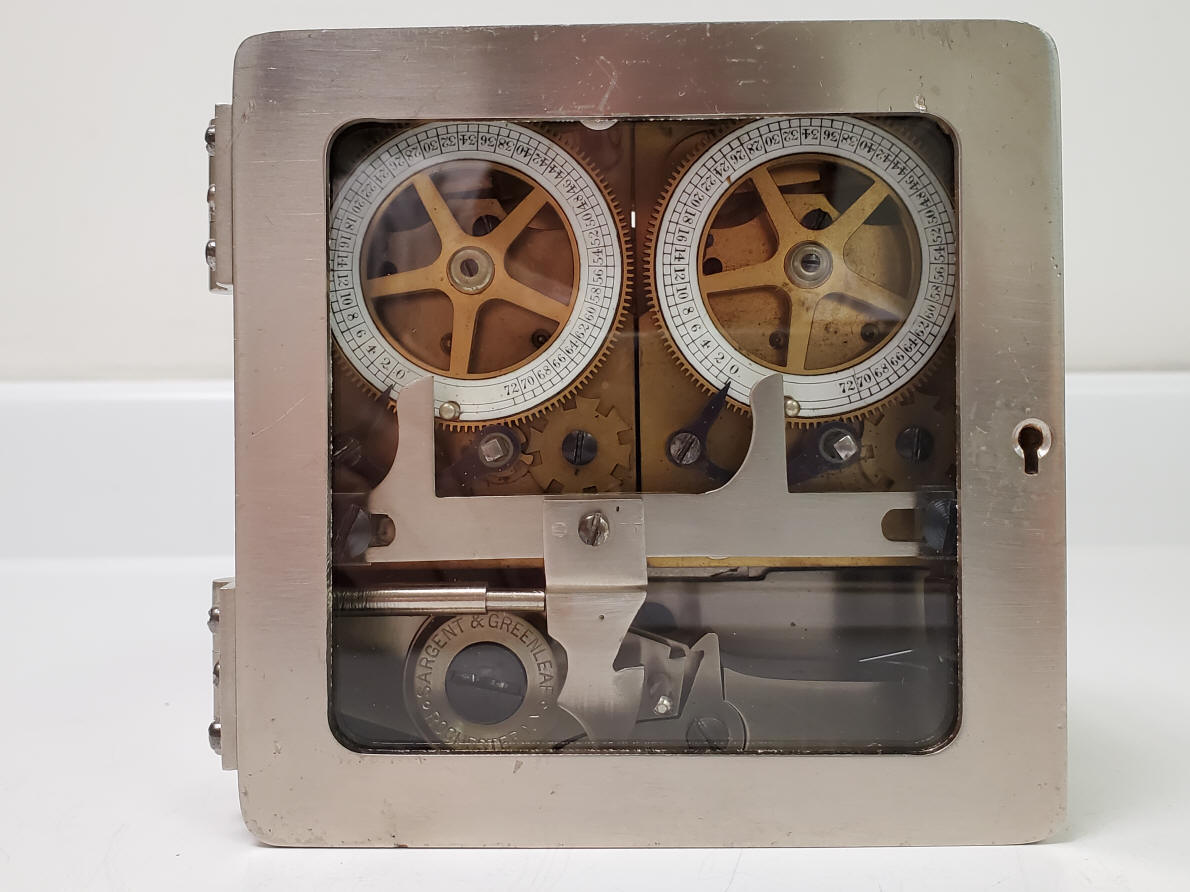
Sargent & Greenleaf, Rochester, New York - 2 movement, S&G original OEM replacement for Model #4
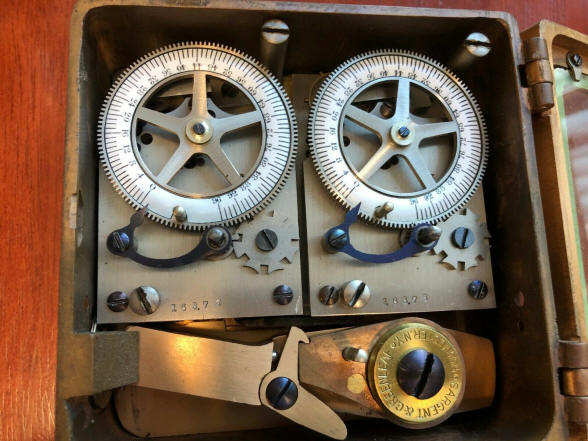
This is an example of a S&G Model 4 replacement for their older Model #4 rather than conversion. What makes this special is that it was carried out by the Sargent & Greenleaf Company. This author has seen many S&G Model 2, 3, 4 and 6 conversions, (the Model #5 saw little production), usually carried out by Andy Kotas who had a signature style of conversion, see example bottom of page; but has never seen a conversion by S&G. The safe tech from whom I obtained this said he had only seen one other, but certainly others exist. There is one in the Harry Miller collection and I have seen one incomplete example, see below. One can see that by this time S&G had abandoned all all efforts at making their locks other than functional. The screws are no longer nicely polished and blued, but are rough off the screw machine leaving rough machine marks on the screw heads. Bluing was merely heating the screw without regard to color allowing the bluing to go far past the correct temperature where a grayish color occures. In this example S&G used a pair of their 'L' sized movements to replace the original Model #4 movement which had a single rear plate for the two movements. Originally their Models 2 through 6 had movements designed this way, before the advent of modular movement design first introduced in the company's Triple B in 1888, which used the same style 'L' movement. Modularity greatly reduced servicing costs. Most conversion I have seen involve S&G time locks because they had this single rear plate design which lead to their obsolescence after the introduction of modular movements. Yale also had conversions of their movements made by E. Howard and after 1902, Seth Thomas until until production moved to Switzerland in the 1960's. Many of those conversions were to replace their larger 'M' sized movements as well as their standard 'L' types which by the 1950's were no longer supported with parts from Yale.
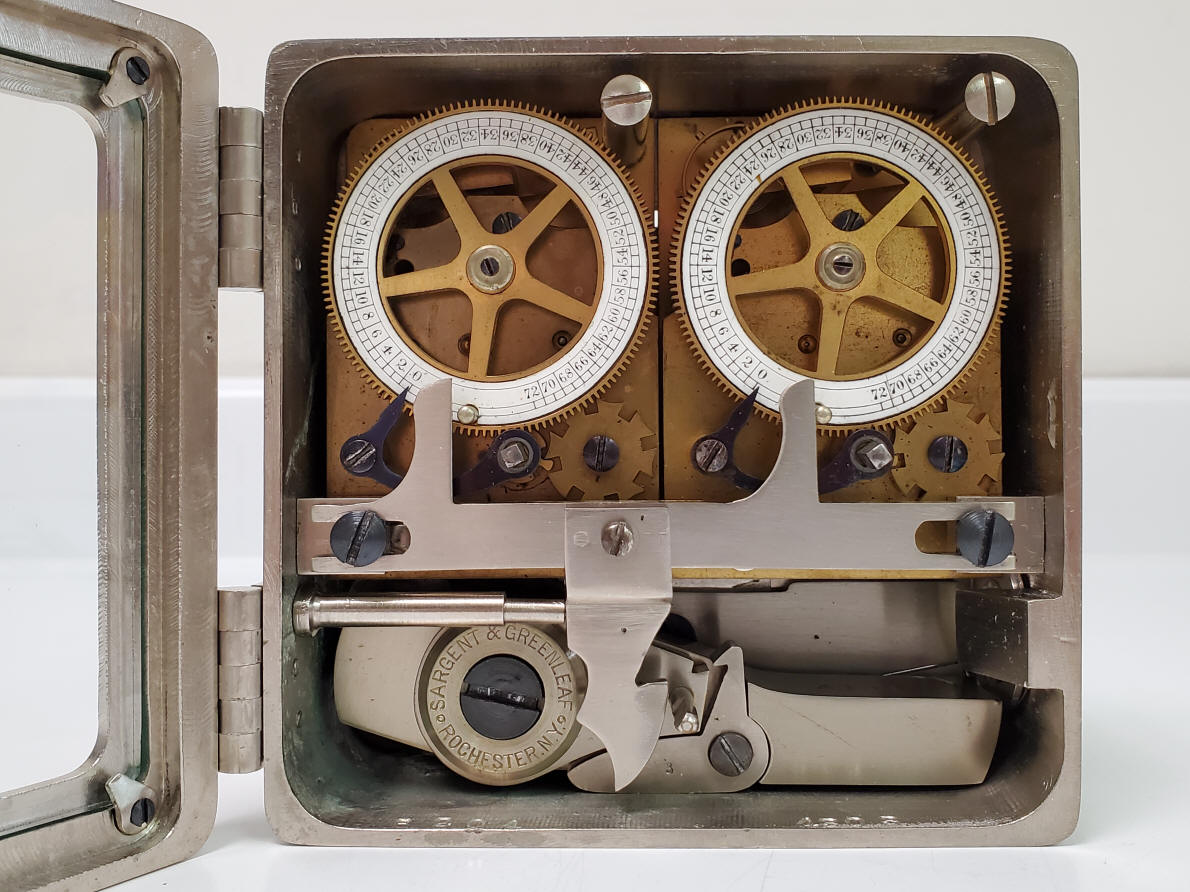
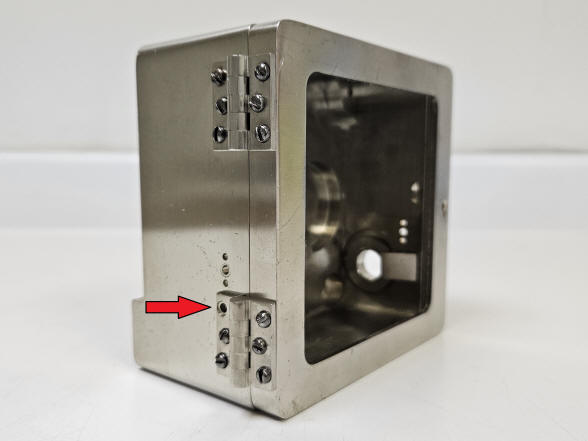
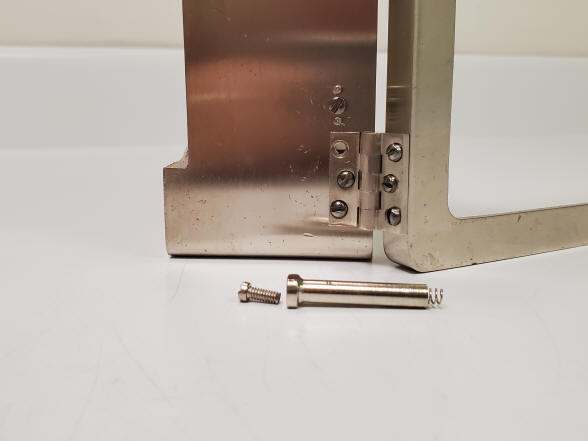
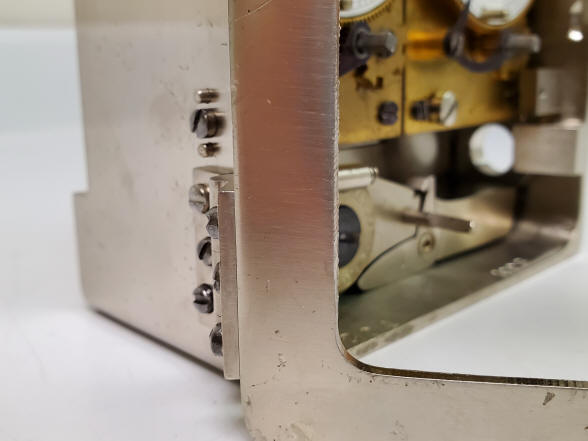
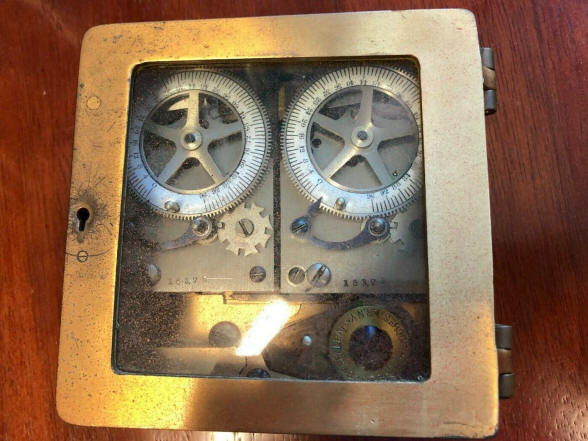
Most conversions kept the original case making as few modifications to it as possible to save costs and tried to achieve a "drop-in" design for the new movements used in the conversion. Here S&G created an entirely new time lock. They replaced their cast hinge with a butt hinge, making a poor presentation in my view. The reason becomes clear in the second photo. One of the hinge holes is slightly larger and not threaded. This is where the spring loaded snubber bar casing is attached.
Snubber bar spring loaded casing mounted to case.
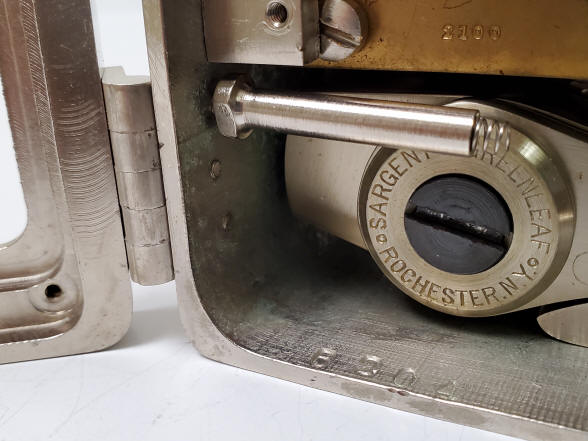
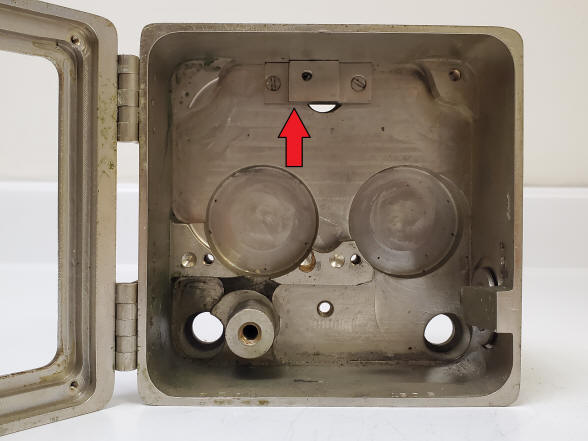
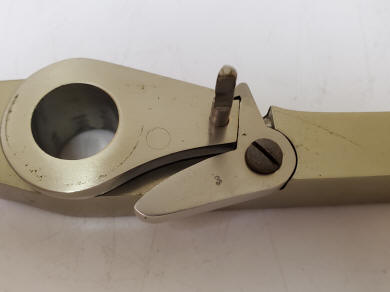
The case is custom made and milled to accommodate the 'L' movement pair. The two recesses for the spring barrels are closer together than those on an original single rear plate style, see below. The red arrow shows a piece that bridges the upper case mounting hole and is used to secure the upper left-hand movement's mounting bolt. S&G had to keep the original rear case hole configuration to allow the new lock to be mounted back into the safe. The second photo shows the left-hand movement and bolt dog. The bolt dog is the only component that is identical to those found in the original Model #4 locks. The serial number 4303 is stamped on the top of the main body of the bolt dog as well as the bottom of the case. This number is the highest I have seen for this model.
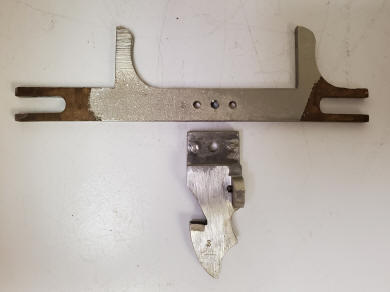
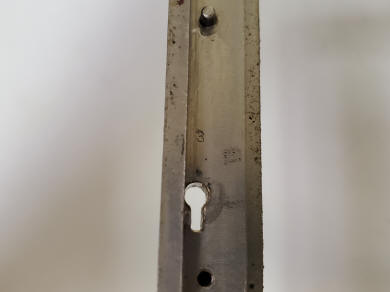
Most of the case components are stamped with the number "3". These photos show the snubber bar, inside door and bolt dog component. This was probably done so as to not confuse parts with the older Model #4 cases. But it is also possible that these were the actual production numbers and this was the third one of this type made, but is a less likely possibility.
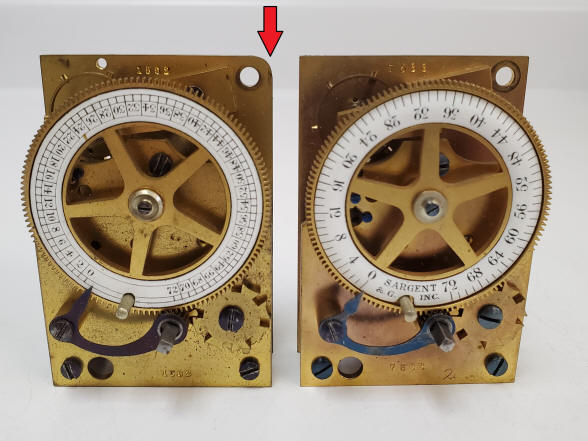
The movements themselves, left, had to have a slight modification on their outer rear plate corners to fit within the case, red arrow. To the right is a regular S&G 'L' movement. These had all four corners of the rear movement plate squared off.
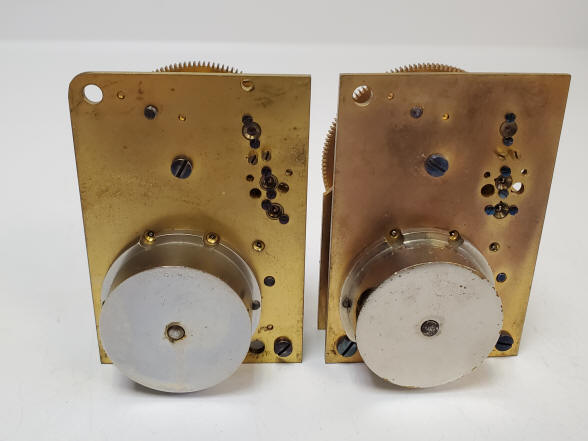
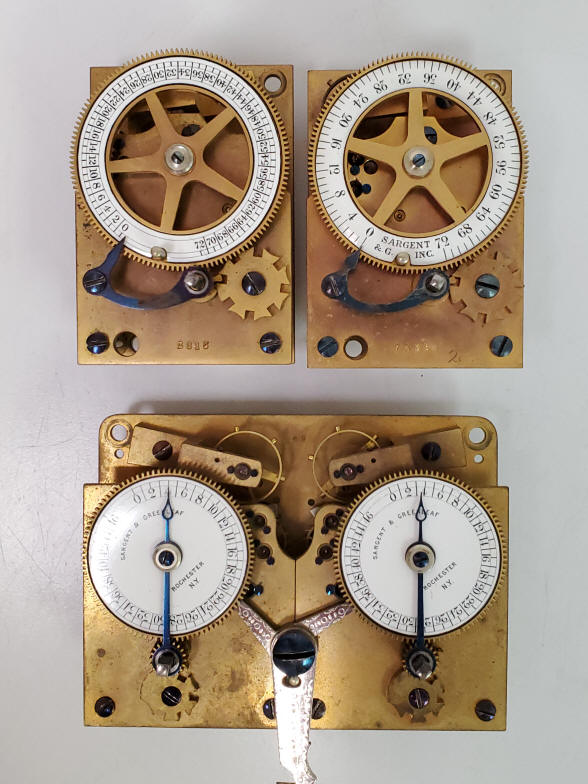
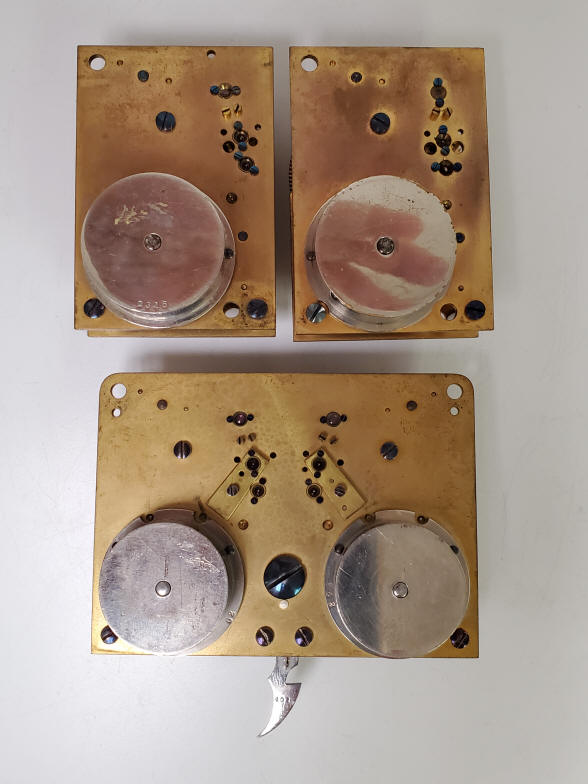
These two photos show the front and rear views of a 'L' movement pair above the original Model #4 single rear plate. When the two 'L' movements are touching, they are the same width as the single plate, these are also the regular 'L' style as the modified ones were already installed when this shot was taken.
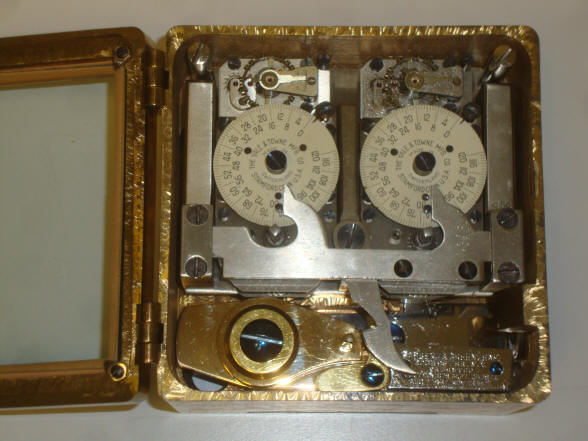
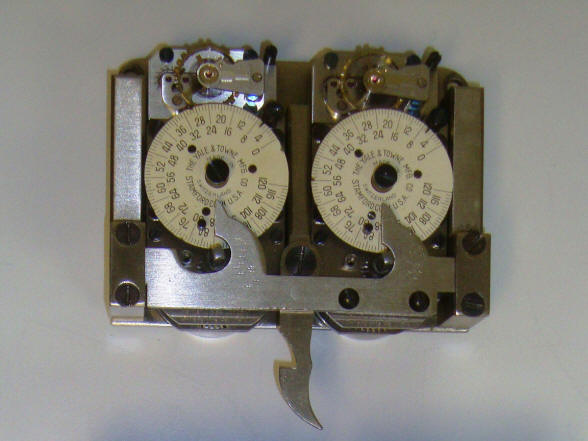
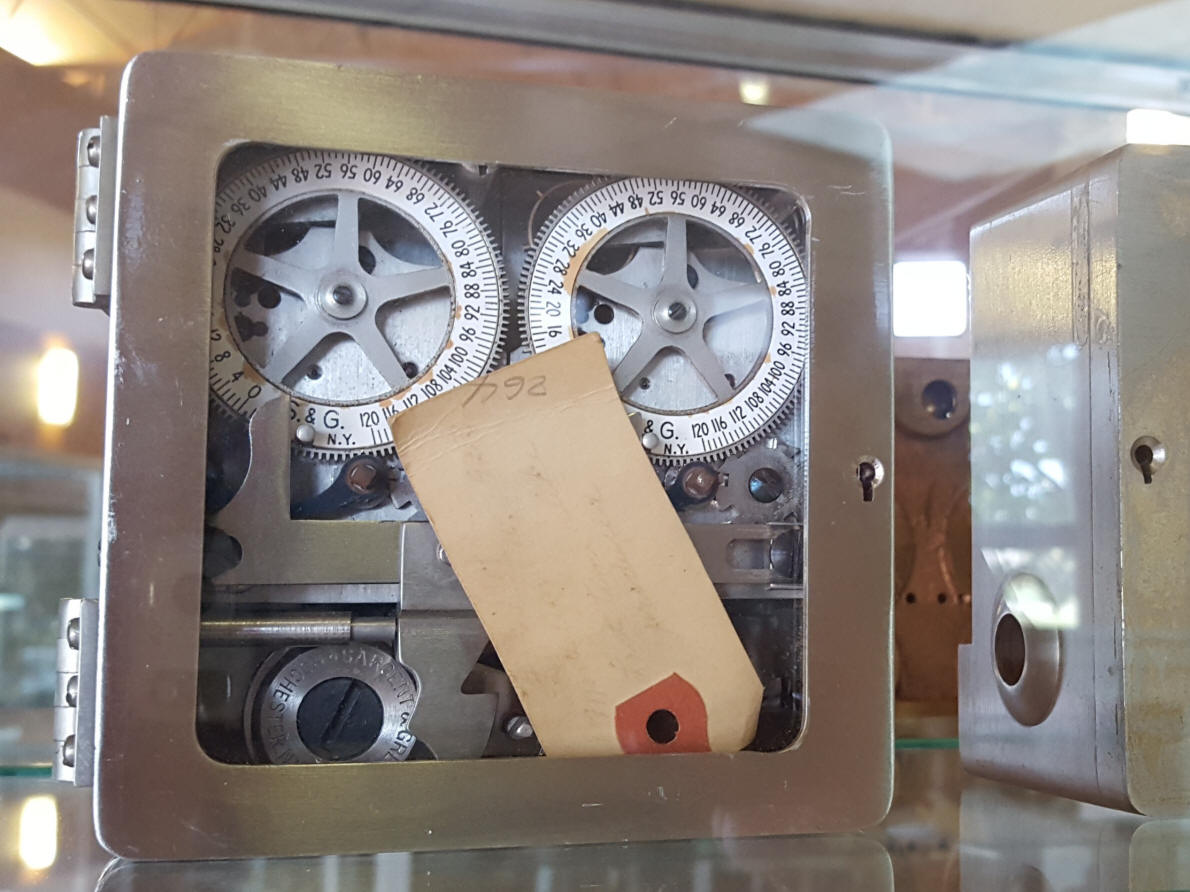
The first photo shows a S&G Model #4 conversion by Mr. Andy Kotas. He invariably used later, readily available Swiss-made movements made for Yale dating from the the early 1960's and a drop-in design when these conversions took place. By this time all of S&G's original Model #2 though #6 were not supported with parts from S&G and even obtaining working replacements were becoming very difficult making servicing expensive and the lock unreliable. Model #4R (later no. 6204), late 1920's. The 'R' designation after the model number is completely my own interpretation so as to give this a different designation from the Model #4, #4A and #4B. The 'R' stands for replacement. This lock should have a unique designation since it is a completely unique design apart from its predecessors. This was a replacement time lock made by Sargent and Greenleaf using their modular 'L' sized movements to replace their earlier Model #4 that used a single rear movement plate. That older design made servicing more difficult and expensive. So why were so few of these made? My opinion is that this replacement was a far more expensive alternative to the conversions offered, as demonstrated by those available through Andy Kotas. The S&G replacement was an entirely new time lock, while the conversion methods reused the case and bolt dog; these also offered up to date less expensive and more easily available movements. Judging from the very high serial number on the bolt dog and case, #4303 which is the highest I have seen for a Model #4, this would have been from the late 1920's, perhaps even very early 1930's when safe and vault, and therefore time lock production ceased at the beginning of the Great Depression. The need to upgrade from an older design would have been deferred until after WWII. By this time alternative, cheaper replacement time locks were being made and S&G's line of modular time lock movements first offered in 1889 would have been obsolete. The Model #4R was simply too expensive and too late to have been a viable solution. It is interesting that the lock is fitted with fairly early 'L' movements, the correct movements for the time period would have had Sargent & Greenleaf, Inc. on the dials and may have been in their brushed silver color to match the case and bolt work. 4 7/16 h x 4 1/2" w x 2 13/16 d. Case, bolt #4303, movements #1532, #2100. file 363 Below is another example I have seen, The snubber bar assembly is missing. Interestingly, the case is an unmodified Model #4 case with the original style door hinge. Also the two separate movements share the same serial number 16378 so these were made specifically for this lock. Further evidence that this was an OEM conversion.
An incomplete example.
An identical lock to the one illustrated in the Harry Miller Collection, Nicholasville, KY. |