Sargent & Greenleaf, Rochester, New York - 2 movements, Model #2, version, 3 with later version 13 case, versions 6, 8, 11, 14
See restoration page of this lock.
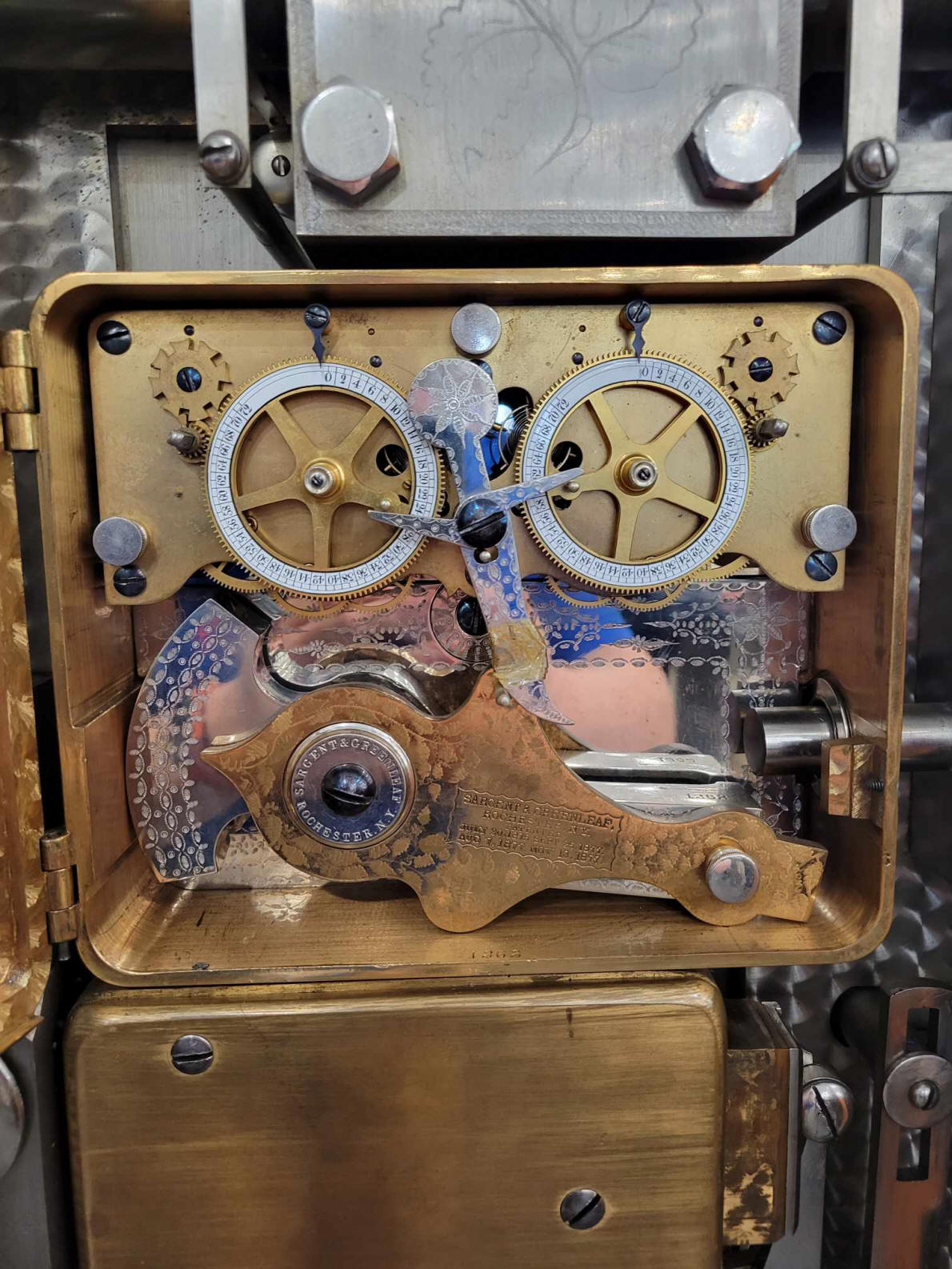
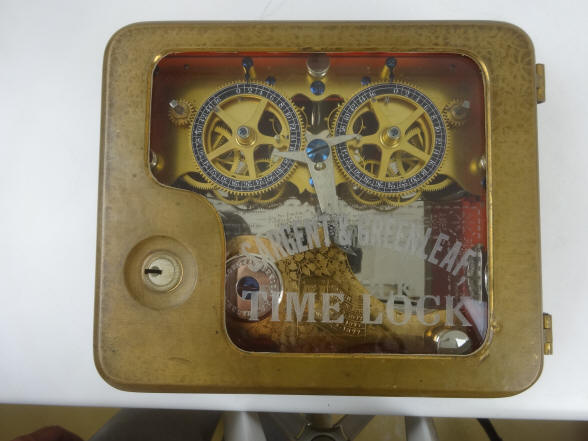
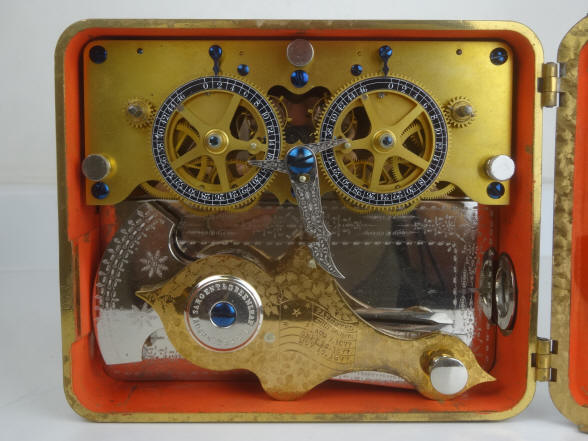
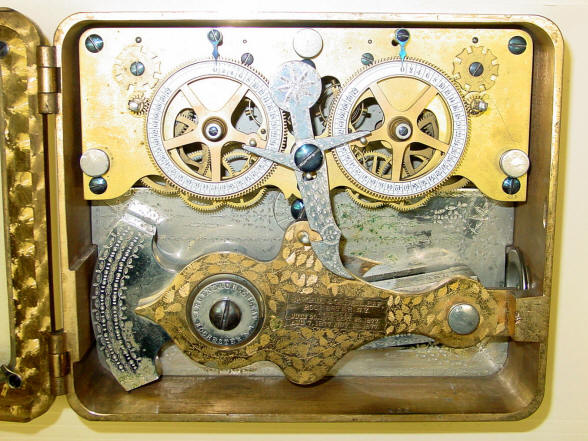
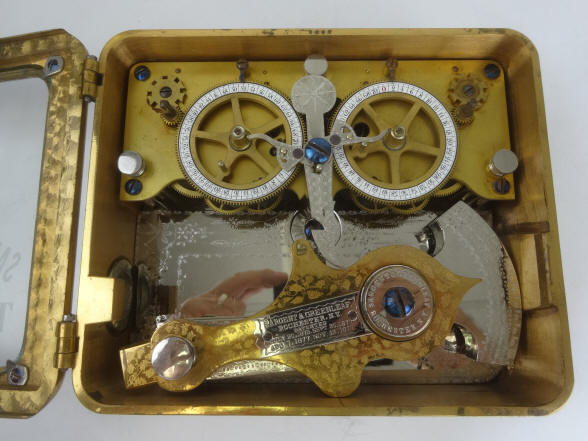
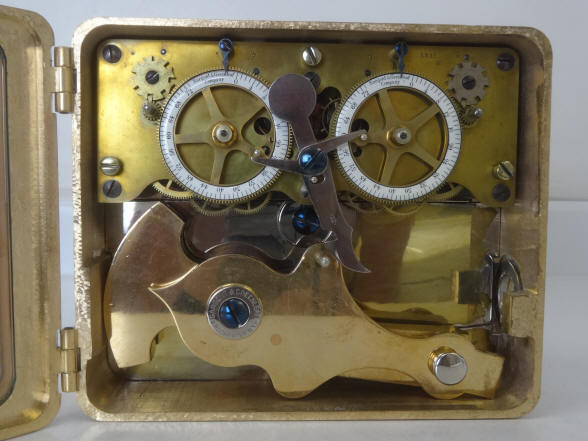
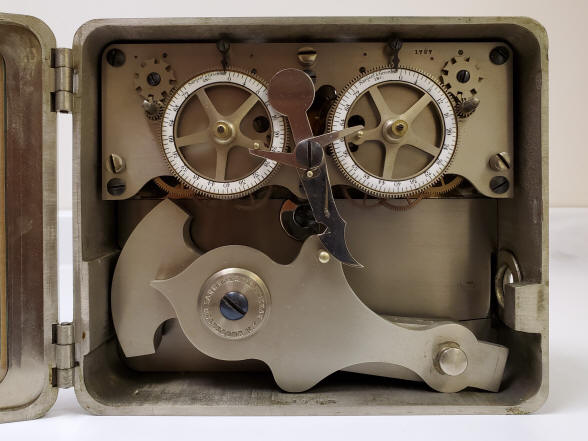
These time locks, as were most made before 1900, did not have interchangeable individual movements (except examples E and F which are the same design but made after 1900). So if one movement needed service, the entire lock had to be pulled leaving the vault without protection. A. Model #2, (later no. 6206), version 6, with 46 hour black dials. 1877. This model marked a significant change from the earlier round roller bolt to the cello shaped drop bolt (cello-bolt) which was used with great success in subsequent models. The cello-bolt's two piece spring loaded mechanism allowed this model to do away with the auxiliary bolt that was needed in the earlier roller bolt designs. The operator need now only wind the time lock, latch the bronze fore-piece of the bolt to the hook lever, and close the door, the two piece leaf-sprung design allowing the cello-bolt's fore-piece to be latched while leaving the nickel plated aft-piece below the bolt extension. When the bolt work is closed, the extension withdraws from the case and the spring between the two cello-bolt parts lifts the aft-piece, blocking the case opening. This was the first lock to incorporate patent dates on the bolt after the company won its initial patent interference victory and the last to use the black dial design, later replaced by white.¹ The case interior still has the "Security Red" interior case paint. Note the extensive movement plate cut outs between and under the dials of this lock and the model #2 on the prior page; giving the movement a beautiful, skeletonized look. Compare this with lock (C) and (D), that has eliminated this feature under the dials. This change was made a few years into production to give additional strength to the movement to better withstand shock due to inadvertent door slams or blows/explosions from an attempted break in. The red-orange interior was a trademark color Sargent applied to their high security locks. This carried over to their early line of time locks and was discontinued around 1879. Ultimately the model 2[6] was made for less than a full year with production numbering around 200. Today six are known to survive. Case #770, movement #778. See a series of photos and videos of the cleaning and restoration of this lock. file 114 B. Model #2, case version 13, movement from a version 3, 1875. The time lock was extensively altered sometime c. 1889, and the movement was updated to increase duration resulting in a change from the original 46 hour black dials to 72 hour white dials, addition of Geneva stops to insure enough spring power to open the lock, the change from roller bolt to cello-bolt and updated case with hand-cuff key lock. The movement retains its original grape leaf damascene on the movement top plate which was discontinued with the Model #2[4] in 1876. This movement was the first to replace the fixed arbor dials with dials attached to the front by a screw and washer assembly making accurate servicing easier. Note etched glass. These were more often than not broken at some point. Apparently the company felt the need to make the case and bolt serial numbers look like a close match to the original movement number - perhaps some sort of marketing gimmick to make it appear as if the time lock was produced as a whole. This is not so strange when one remembers that these locks were extremely expensive and produced in small batches with all of the movement parts individually marked with matching serial numbers and the cases often with the identical or close to serial number in the production run. Case # not indicated but bolt is #426, movement #423. file 46 C. Model #2 version 8, c. 1878-1879 with 46 hour dials. White dials were introduced in 1878 and later that same year a longer duration of 66 hours, so very few locks were produced with the old shorter duration dials. One of two known to exist. Case #985, movement #992. After 1900 it is known as model #6206. file 100c D. Model #2 version 11, c. 1886. This example has a twin pivoted drop lever, a feature introduced to overcome fears generated by competitors that the model 2 was vulnerable to external dynamite charges. Case#1087, movement #1094. file 89 E. Model #2 version 14, c. 1910. Around 1896, Sargent introduced the full glass rectangular door for the Model 2 with the less expensive handcuff key style door lock. By 1910 the company in what seem to be primarily cost-saving changes, introduced this model, the first to have no engraving at all and the first without patent dates since the 1877 advent of the cello bolt. About a dozen are thought to survive today. Case #2-1656, movement #1711. file 237 F. Model #2 version 16, c. 1924-1927. After 1924 all Model 2 time locks were made with a satin nickel finish although the raw bronze was still available as a custom order. These very last of the Model 2s seem to have been sold primarily to Canada and possibly overseas, and though there are most likely some few of these survive, no current examples are currently known, (until this one), making it impossible to say for certain whether these twilight numbers deserve their own sixteenth type. I have added this designation. According to surviving shipment records, S&G, Inc., discontinued production of the Model 2 soon after 1927, a year when Sargent was making fully twelve different styles of time locks in eighteen sizes. Not surprisingly, the beginning of the Great Depression put a halt to new bank construction and, by extension, to almost all new time lock production. ² Case #1753, movement #1787. file 328 1. American Genius Nineteenth Century Bank Locks and Time Locks, David Erroll & John Erroll, pg. 157 2. American Genius Nineteenth Century Bank Locks and Time Locks, David Erroll & John Erroll, pg. 161
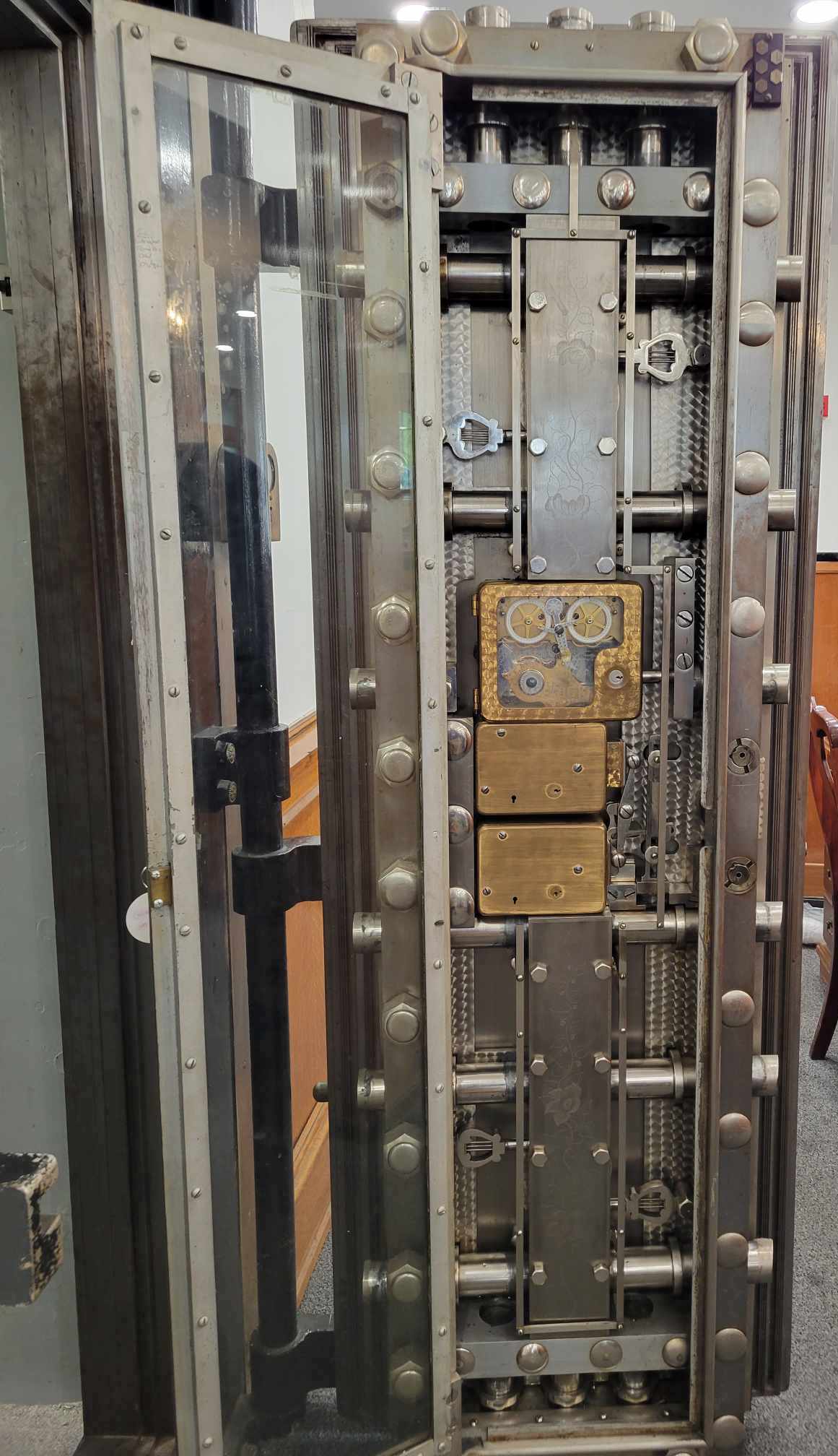
I do not know the maker of this vault. But take a look at the four lyre-shaped parts along the longitudinal sides of the door. These could have been designed as a plain circle or rectangle. Instead they are made for pure fantasy and fun. I assume the vault designer was a classical music aficionado, how else would he have gotten this idea?
S&G Model 2 v.11. It's unknown if the timer is still in actual use after 127 years. Photos courtesy Michael Schiavone
|



 A
A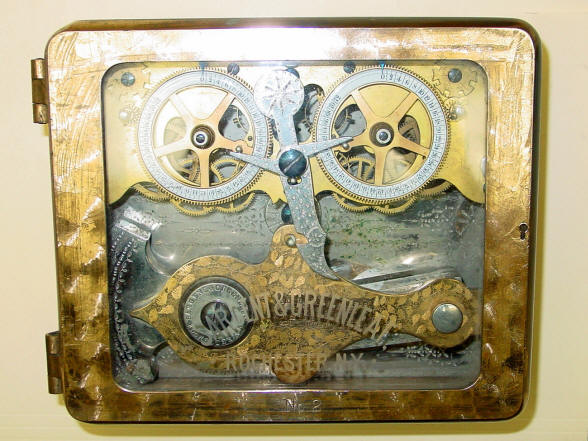
 B
B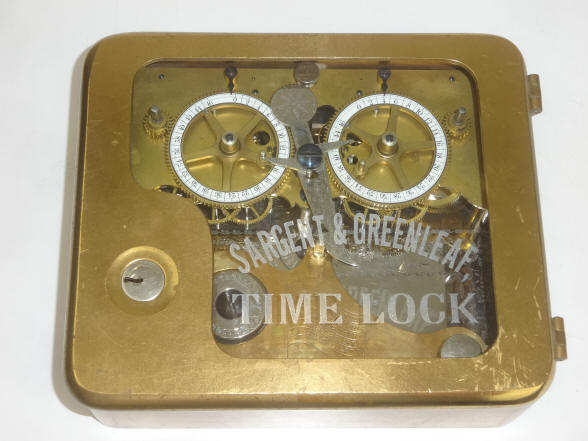
 C
C
 D
D D1
D1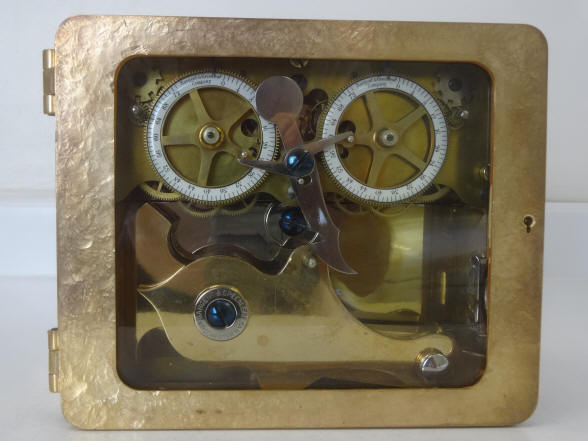
 E
E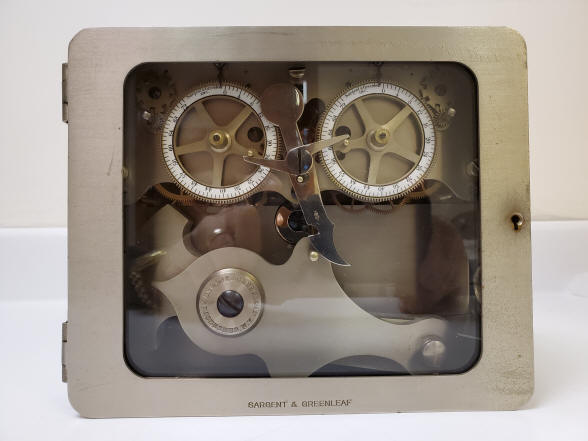
 F
F