Diebold Safe & Lock Co., Canton, Ohio - 3 movements, Type 1
A possibly unique example of a Diebold case finish done in nickel plate. The early locks featured the company rosette logo on the snubber plate as well as cases that had custom floral designs. Later versions lost the rosette logo on the snubber plate and the case design was supplanted by a standard geometrical deco design. Look closely at the upper horizontal case edge, there are the numbers 1, 2, and 3 stamped above where each movement is mounted below. Other examples of specialty finished time lock cases for Hall, Consolidated, Dalton and Sargent & Greenleaf.
The photo above shows the ordinate nature of the movements. The pins are staggered to match the mating holes on the rear movement plate so as to keep them in a particular order. Sargent and Greenleaf first introduced modular movements on a production-scale in 1889 and they too had their movements uniquely pinned and arranged in a non-interchangeable fashion as in this Diebold example, however they introduced interchangeability between movements by 1895, the year Diebold introduced this model. To drive this point home the upper case lip also had numbers 1, 2, and 3 above each movement's location, see second photo. In other words, these time locks did not yet have truly interchangeable movements. Later in the production run, movements became interchangeable, see last example below, and the pins were removed, however Diebold did not remove the now unnecessary numbering on the upper lip for the production life of all of their decorated cases. Only after the introduction of their plain satin bronze case after WWI were these markings removed. The type of font the company used for their name on the acid-etched glass changed over time. Compare this to the other examples on this page. Model - Type 1, 1895. This was the style first type of lock introduced by Diebold. As with many of their other locks this company took case design to a high level. Diebold used an acid-etching method instead of the conventional milling technique to make their intricate case designs, which otherwise would be cost prohibitive. These cases were also gold plated. (see other two, three and four movement Diebold cases). However this lock has a nickel finish and is the only one known to this author. Unlike many other time lock makers, Diebold was an established safe and vault maker. Their time locks were made to coordinate with the rest of the design theme that would be found on the inside vault door surfaces of Diebold designed products. Imagine how beautiful this must have looked, industrial form morphing into art! These early models had no internal bolt dogging mechanism, but used a bottom release lever. Usually this configuration would be used with an automatic bolt motor, where the time lock would simply trip this motor. However, in the case of Diebold it could also be used to simply move a lever that released the bolt works. This was possible for the firm as their locks were used with their safes and vaults so they could design the strength needed to move the bolt precisely to the time lock. This example has the very early 'rosette' logo on the snubber mounting plate and earlier style floral design on the case. Equipped with signed E. Howard movements. In 1902, when E. Howard exited the time lock business, Diebold switched to identical looking, unsigned movements made by Seth Thomas. The low case and movement numbers indicate this example to be very early in production. Case #14, E. Howard movements #51, #127, #161. file 194
Model - Type 1, c. 1895. This was the style first type of lock introduced by Diebold and features their gold plated floral case finish along with the company rosette logo on the snubber mounting plate. This example retains its original nickel-plated mount. While the movements in this lock are not consecutively numbered, these are likely the original installed from Diebold since each movement number is close to each other. Case #141, E. Howard movements #516, #526, #533. file 357
|


Model - Type 1, c. 1898. The early rosette logo is replaced by the hand engraved patent date of May 22, 1894 on the snubber mounting plate. This and the geometric 'X' deco case design became the standard motif for Diebold by 1894. The glass etching differs slightly from the block lettering in the first example above and greatly from the second example. Equipped with E. Howard movements and the close proximity of the serial numbers again indicates that these are all the original movements. Etched glass removed for photos. Case #2267, E. Howard movements #5832, #5838, #5859. file 40


Model - Type 1, c. 1920's. By this time the geometric 'X' deco case design was eliminated and a less expensive plain satin finish became the standard case style for Diebold. A plain satin bronze finish was also produced in smaller numbers. Some models with this style of case retained the blued screws while others could be ordered, as this example, with matching silver colored screws. The bronze colored satin cases always came with blued screws. The glass etching differs slightly from the block lettering in the first example above as well as the other two examples. It appears Diebold changed the fonts on their glass logo from time to time. Equipped with Seth Thomas movements. Case #4801, E. Howard movement #A2295, A2473, A2474. file 317
Below are photos of a Diebold 3 movement time lock in a two different Diebold safe doors. Notice the decorative acid etching on the door components. The first example is the only Diebold I have seen equipped with winding holes through the glass and is probably not OEM. The eyelets look like those found on Sargent and Greenleaf products. All of the bolt motors are of Albert Kirks patented design. Another Diebold safe with a Sargent & Greenleaf lock of similar configuration.


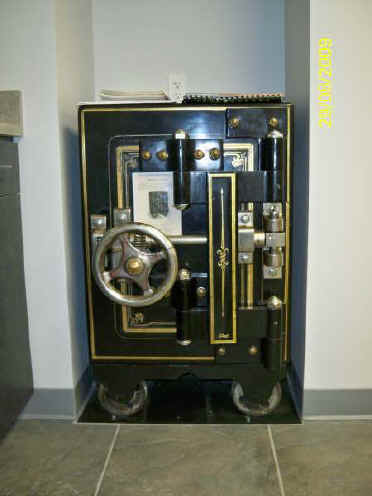


This safe has a Diebold time lock with newer Swiss made movements substituted for the original Seth Thomas movements. This was often necessary since the original movements that would have dated from around 1900 would no longer be economically serviceable today.