|
Diebold Safe & Lock Co., Canton, Ohio - 2 movements and Tisco model time lock
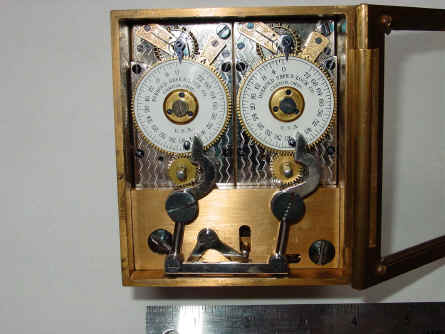
A Model ? , c. 1895 with earlier acid etched art deco-design case and original E. Howard movements. The lock case must have come from a custom installation due to its' unusual rounded upper corners. I've not seen this feature on any other two movement Diebold time lock. These two movement locks were this firms earliest design for use with bolt work. The door has the original etched and bevel-edged glass. Click here for a similar deco design in a three movement version or a floral designed case. This example uses E. Howard movements. Diebold used Howard movements until 1902 when Howard was taken over by the Keystone Watch Company and ceased their time lock movement production lines. After this time movements were supplied by Seth Thomas and were made to look nearly identical to the earlier Howard movements, they did, of course lack the Howard script signature on the lower front movement plate. These movements were generally decorated with the characteristic zig-zag damascene seen on the movement's front plate. 3 7/8w x 4 1/4"h x 2 1/2"d. Case #1878. file 33 B. Same as above but later in the production run exhibiting the plain brushed brass case and Seth Thomas movements. Notice how indistinguishable these look from those by E. Howard in example A. Case #9229. file 39 C. Same as A & B but in a plain silver case, c. 1920. Notice the bolt dog linkages located below the movements in all three of these examples. Example A and C both have the same configuration. Example B is different and also the same as D, the most modern example. Seth Thomas movements. Case #1690. file 178 D. A modern, post 1960's, version with plastic front and using movements from Switzerland. file 74 E. Same as D, but mounted on a custom stand to hold calling cards. A neat item to take to shows. file 336 F. Tisco model, c. 1897. Beginning in 1895 and continuing through 1900 Diebold produced several time locks for use in their Tisco line of safes. TISCO stands for Taylor Iron & Steel Co. The Taylor Iron & Steel Co. was based in New Jersey between 1891 and 1912. They had acquired the American rights to manufacture manganese steel in 1892 and built those safes for Diebold. The safe that this lock was used in was similar in appearance to the Cannonball style of safe, but not in design. Unique to the Tisco line, the time lock was designed to be mounted upside down, with the case door opening from the top down and the movements releasing when zero hours reaches the bottom of the dial. This may have minimized mounting space in the small area of the Tisco door. (1) About 40 examples of this lock are known to survive. 3 5/8"w x 3 3/8"h x 3 3/8"d. Case #3727. file 140
Two movement Diebold lock mounted to a Diebold safe door.
Two movement Diebold time lock mounted in what appears to be a partially disassembled TISCO or Cannonball-type door. Note the square bolt work which mates into the square cutout in the case. Few if any other makers used this square profile, preferring the conventional round rod shape. The position of the lock near the inner circumference of the door accounts for the sloping shoulders of the top of the case in this page's example. (1) American Genius Nineteenth Century Bank Locks and Time Locks, David Erroll & John Erroll, pg 288.
|





 A
A
 B
B
 C
C D
D
 E
E

 F
F

