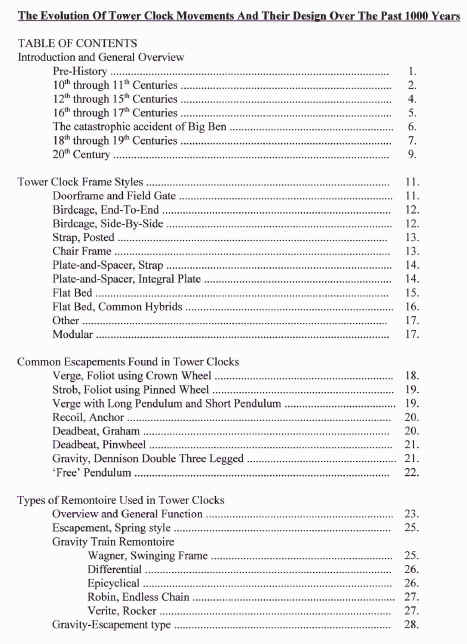
This is a general overview of the various mechanical developments as they
relate to tower clocks. Specific categories include, frame design, escapements,
remontoire, strike systems, winding and maintaining power systems. All accompanied by
photographic examples. Paper ends with a brief description of a small tower clock
restoration project.
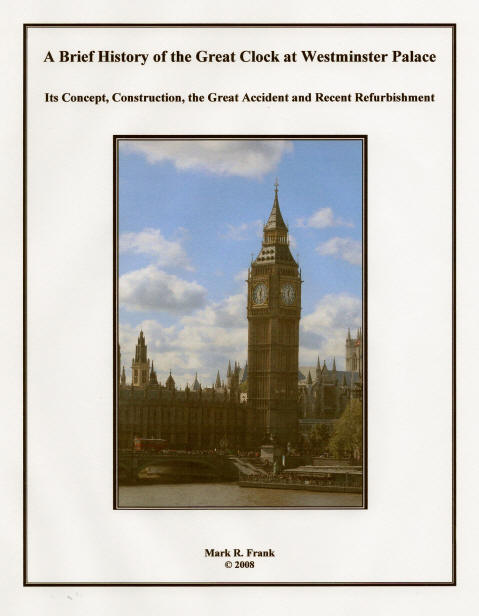
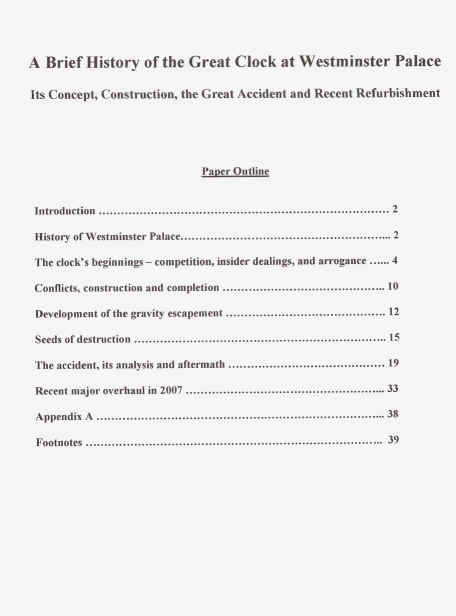
This paper starts with a history of the clock's
antecedence and
the fire that destroyed the old Westminster Palace. Next we look at how the clock was put out for bid and
the intrigues between the competitors and the referees. The conflicts between the
clockmaker, Edward Dent and the chief architect for the new Palace, Charles Barry
are explored which lead to a design compromise that was the proximate cause of the great accident which
would occur to the clock 114 years later. The heart of the paper is an analysis
of the accident itself as conducted by official British forensic scientists. The paper
finishes with a description of the recent major overhaul conducted in 2007 for the clock's
150th anniversary.
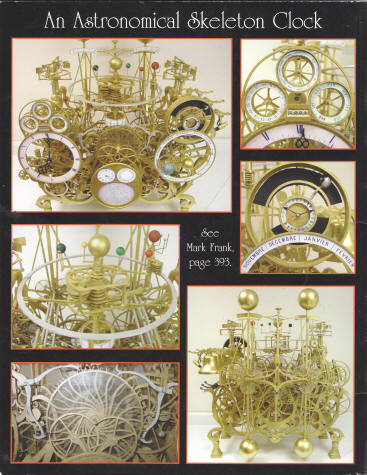
The astronomical clock by Paul Pouvillon was
considered the most complex small domestic skeleton clock made up to that
time. This paper starts with a brief biography of Mr. Pouvillon. Next is an
exploration of the methodology of its construction. The majority of the
paper is devoted to the extensive restoration the movement needed to bring
it back to full functionality with many descriptive photographs. At the end
there is a discussion of the tensions between conservation and restoration
that every owner of a significant artifact must address. The appendix
contains a set of schematics. A three-part article based on the on line
paper about the Pouvillon astronomical clock (above) appeared in the National Association of Watch and Clock
Collectors Bulletin, in the July/August,
September/October, November /December 2013 issues.
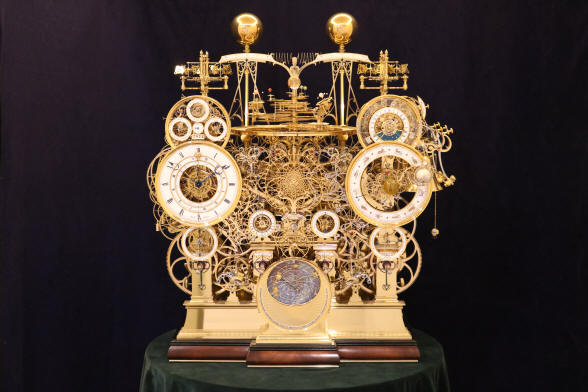
Papers I have written on
the Astronomical Skeleton Clock project,
from its inception in 2006 to completion in
2021
An
introduction to the Astronomical Skeleton
Clock project. This paper explains the
concepts and design of a very complex
skeleton clock I am having made to my
commission through the presentation of the
full scale wooden mockup made in July of
2006 before beginning on the actual
fabrication in metal a year later. This
device will have 21 complications, 3
remontoire, over 300 wheels, and 8000 parts.
While it will not be the most complex
horological artifact made in the past 200
years, I hope it will be one of the more
interesting. Where this device will
distinguish itself is in its visual
presentation in the form of intricate
design, the frequent and fascinating dance
of various components, and the attention to
detail in the form of superior fit and
finish compared to anything that has been
done before on this scale. This paper was
published in the August 2007 issue of the
National Association of Watch and Clock
Collectors Bulletin,
August 2007.
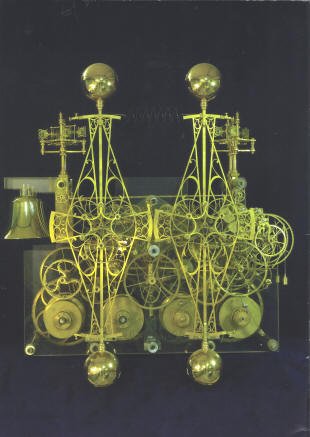
In August of 2010 I had written this paper commemorating the third
year of fabrication and what was thought to be the half-way point in the creation of the Astronomical
Skeleton Clock but was actually about one-third. About 150 of the over 400 wheels had been completed. The time train was
finished and working on and off for about a year. A major redesign of the movement was
initiated in December of 2008 and completed with a new mockup in March of 2009. By this
time nearly all of the components that would reside between the main movement plates were
complete and had been transferred from the temporary plastic main plates to their metal
counterparts. In January of 2010 the project appeared on the front cover of the British
Horological Society's Horological Journal. The bulk
of the clock to the casual observer would look to be mostly complete at this point.
However, the same number of components are yet to be fabricated in the form of all
of the sixteen celestial complications, behind-the-dial-work, polishing, gold plating and
fabrication of the stand and case yet to be tackled. The adventure continues...
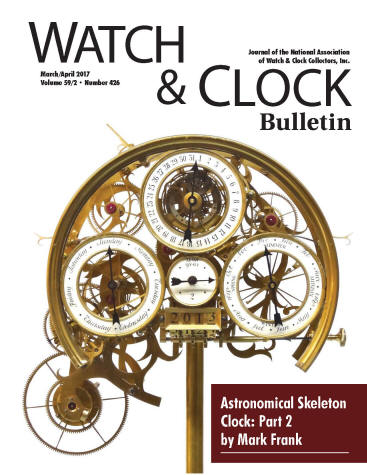
In October of 2016 I had written
this paper describing where the Astronomical
Skeleton Clock project is as of March 2016.
Since the August 2010 paper we have
completed all of the machine's four main
trains and have moved onto the nearly fifty
complications. Many of these are now
complete. We are now about 80% complete for
the movement itself. Then we move onto the
final surface finishing of all of the nearly
400 wheels and 8000 parts and then the case
and stand. The August 2010 paper was title
as 'The Halfway Point' and this was a bit
optimistic. We could not know at the time
that we were actually about one third
complete. Completion is now estimated to be
in 2020. Actual completion was early
2022. This paper served as a basis for
an article published in two parts in the
January-February and
March-April 2017 issues of the NAWCC
Bulletin.
In July of 2020 this paper was written to
document the construction of the
Astronomical Skeleton Clock as of July 2019.
At this point the machine was basically
mechanically complete. By the time this
paper was finished in July of 2020 the
decision was made to change the clock from a
weight driven to a spring driven movement.
Also by this time the process of final
finishing of some small uncompleted tasks,
then the huge process of debugging and then
the polishing, lacquering, bluing and change
out of conventional steel ball bearings to
ceramic (requiring no lubrication) was
underway.
The clock will be done sometime in 2022,
but since this is a fairly long article, and
would be published in the NAWCC Bulletin
over three parts; the magazine is published
bi-monthly so it would cover six months in
addition to the three to six months for the
article to reach its publishing cue, I
wanted to bring this out to be more timely
than over a year or more after the fact.
I may either add to this article when the
project is complete, or make final
presentation. But one could combine all four
of these papers to get a good overview of
the design, construction and characteristics
of this monumental project.