|
Consolidated Time Lock Co., Cincinnati, Ohio - 1 movement with hand engraved folk-art case, restoration
This platform escapement was in the worst condition as far as dirt as I had encountered. Fortunately all of the issues were in connection with dirt, which can be removed and the original material restored rather than corrosion which cannot be fully reversed and restored. Within this dusty mess were the carcasses of two multi-legged bugs, red arrows. I guess one could say at this point the movement was 'buggy'!
In the past someone had drenched the entire mechanism in heavy oil. It was everywhere, even behind the dial as well as behind the lever that holds the combination lock fence. The oil was so think that the fence lever could not function. It must be able to fall under the influence of gravity when released in order to allow the safe to be opened when the time lock has gone off guard and the correct combination has been dialed in. On the bright side the fact that this oil covered everything probably was at least in part responsible for the absence of corrosion.
The first step in the restoration of the platform escapement involves freeing the balance wheel. The tiny and very delicate spiral hairspring must be freed from the taper mount which is, in turn, is mounted to a cock upon the rectangular platform. That spring is threaded through a tiny hole and is held in place by a minute taper pin. The first photo shows this pin within the tongs of a fine watch tweezers. Next the hair spring is seen through a jeweler's loupe with the taper pin removed. This removal and later after re-insertion of the taper pin is the trickiest part of the restoration of this platform escapement. One must be very careful when removing the pin to avoid it popping out when pressure is applied. If this happens the pin will never be found! Reinsertion requires a steady hand. The Hall and later Consolidated carriage clock type of top-mounted escapements are particularly difficult to work on because of this design. One might be tempted to simply release the taper mount by removing the screw that secures it, second photo, but the mount is quite large in relation to the spiral balance spring and cannot be safely left attached to it. It is heavy enough that if it were left to hang on its own it likely would distort the spring; permanently ruining it and any hope of repair without replacement. All other time lock makers that I have worked on including Sargent & Greenleaf's proprietary movements as well as Yale and other makers that used E. Howard and Seth Thomas designs and those time locks that used commercial pocket watch movements such as Waltham, Illinois Watch, Elgin National, South Bend Watch Co., all without exception had the hairspring attached to a small stud that was attached to the upper balance wheel cock with a set screw. This allows one to release the hairspring from the main platform component by loosening the set screw and then only a tiny stud remains attached via a taper pin to the hairspring. The stud can be safely left attached as it is very light and cannot deform the spring on its own. The detachable stud solves another issue, the poising of the balance wheel in relation to the escapement lever fork. When the hairspring on the Hall and Consolidated movements is ready for reattachment, the correct length of spring must be threaded through the taper mount hole and then secured by the pin. The process of pushing the taper pin in tends to move the hairspring in the taper mount; altering the length of the hairspring that is pinned in. Any minute shift will change the position of the balance wheel at rest thus adversely effecting the correct poising of the wheel. When balance wheel is at rest, the impulse roller jewel should be dead center within the escapement fork slot, and the balance wheel spokes should be perpendicular to the neck of the fork. See illustration below. However, this is not always the case. One should never need to readjust the banking pins.
It's hard to see in the first photo, but the escape wheel arbor is entangled in tiny hairs. Note the oil splotches nearby. The second photo shows the underside of the platform with the same thick oily residue along the edges where the platform was mounted to the rest of the movement.
These two photos show the before and after shots of the platform background, escapement cock and fork as well as the balance wheel bottom jewel chaton and securing screws.
The first photo shows the underside of the lower potence and securing screws holding the the escape wheel lower pivot. Next the escape wheel. Both are after cleaning.
First photo shows the escapement lever (fork), next the balance wheel underside with the tiny roller jewel to the right of the wheel arbor. That jewel is positioned into the tail of the lever. Both parts are after cleaning.
The first photo shows the underside of the balance wheel and escape wheel cocks these have the serial number 925, the same as is stamped on the underside of the platform. The numbering of parts within the platform is quite common. In E. Howard platforms every part is stamped including the balance and escape wheel. The only exception being the lever as there is no area large enough for a number. The theory behind a platform escapement is to provide interchangeability between the platform containing those components and the rest of the movement. The parts within a platform were never interchangeable with those within other platforms, hence the numbering. In practice true interchangeability of platforms in the time lock industry was not achieved until the early 1900's.
The main movement before and after cleaning. The Consolidated company did a marvelous job of bluing their steel levers. It is not easy to get an even color on such large parts. The temperature has to be kept consistent throughout the piece. The larger the part the more difficult this is to do. Modern furnaces have fine temperature controls and insulation to keep the entire interior within tight tolerances but in the early 1880's this was not the case.
The first photo shows a stainless steel wire mesh 'tea ball' used to hold parts while in the ultrasonic machine. The next photo shows that machine. Here there is a separate beaker containing a special solution that will not dissolve the shellac used as a glue on parts that have inserted jewels: the balance wheel roller jewel and the jewel pallets in the escapement lever. The rest of the pivot jewels located within the movement plates are friction fit and do not need that special solution. The regular solution fills the machine and the beaker is put into that solution but contains the non aggressive solution for the shellac. The vibrations are carried over into the beaker with no loss. In this way one can use the machine with multiple solutions without the need for time consuming change out between solutions.
Part of the Hall's Infallible Lockout Protection™ system was a feature that would disable the time lock should the time lock ever need the activation of this feature. Once activated a lever would rest upon the contrate wheel the fifth wheel up the movement train, stopping the time lock from running. This prevented the safe's owner from simply reactivating the time lock after the "secret combination" was dialed in to override the lock. This prevented repeated calls to the firm for the combination, and made sure that the time lock would receive the proper servicing to ensure reliable operation after a failure. Restored time lock below.
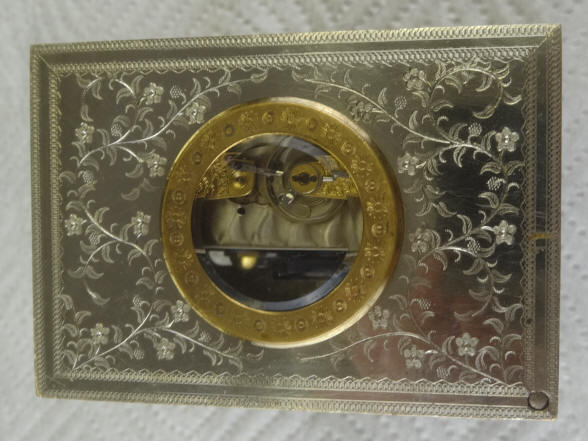
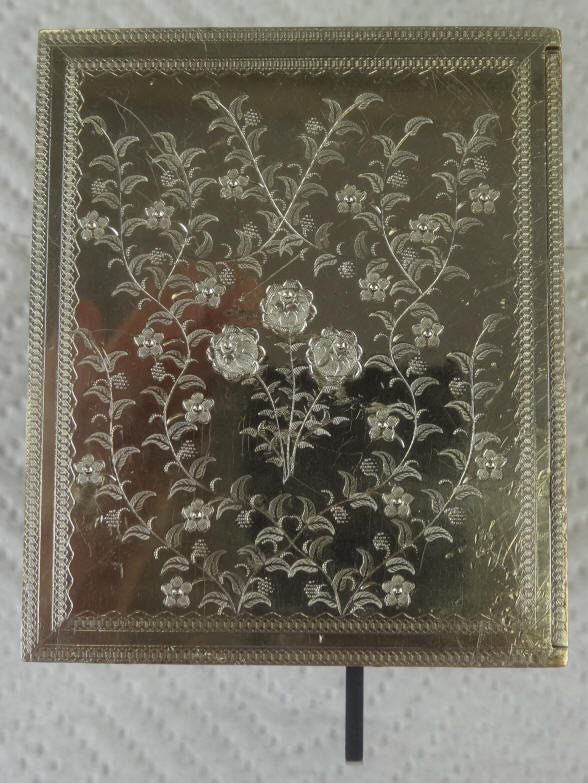
This type of engraving was found sporadically on other Hall, Consolidated and Dalton (also part of Hall's Safe & Lock Co.) cases from this period continuing though about 1886. The theme to the engravings may be the Ohio River region with subjects known to include sail boats, ducks, cranes, hunting dogs, people fishing. One can easily imagine that Mr. Hall was an avid outdoorsman and had his favorite activities immortalized on a few of his special time lock cases. The work may have been done by the same artist given the consistent appearance of the associated floral vine engraving. Eight folk art engraved examples are known. Later side panels were machine engraved in a circular guilloche pattern. This lock is a fairly early in the production run under the Consolidated name since the E. Howard name appears on the dial. Joseph Hall separated the time lock business from his safe business by creating the Consolidated Time Lock Company in January 1880. At this time the E. Howard name still appeared on the dial. But because of the ever increasing litigious nature of the time lock business and in particular a lawsuit brought by Yale against Holms which also entangled E. Howard in 1882, the Howard name was removed at that time from the dial and replaced with Gothic type-face embossing on the front plate behind the dial to obscure it from view. One has to wonder just how effective this would be in 'fooling' a potential adversarial lawyer. Single movement Consolidated time lock c. 1882. Case with hand engraved folk art design of a dog within a star background on right side panel. Left side panel, door and top of case decorated in floral pattern. Case door #920, case back stamped #2874, movement #2874, 3 5/8" w x 3 1/8" h x 2 5/8" d. file 225
|