|
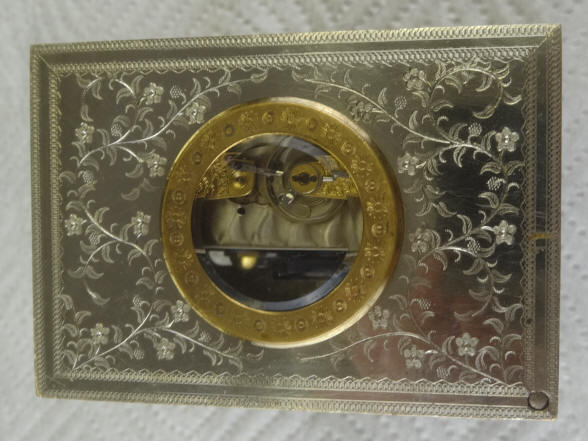
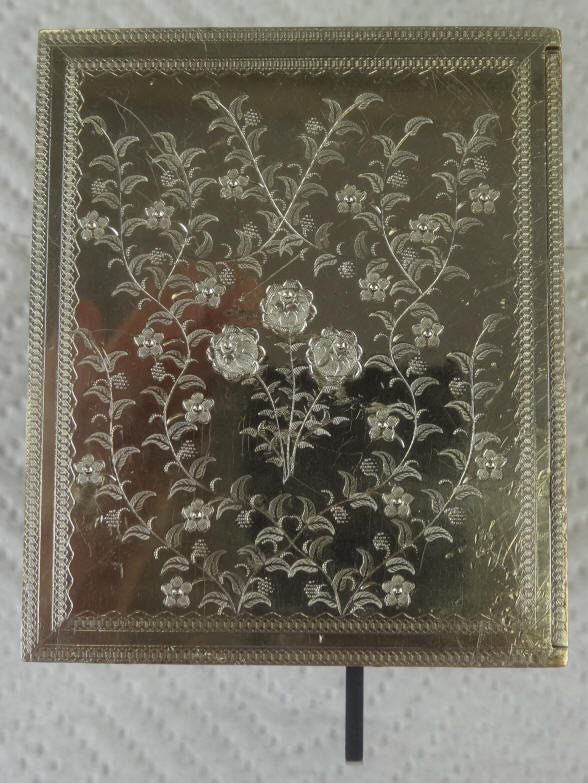
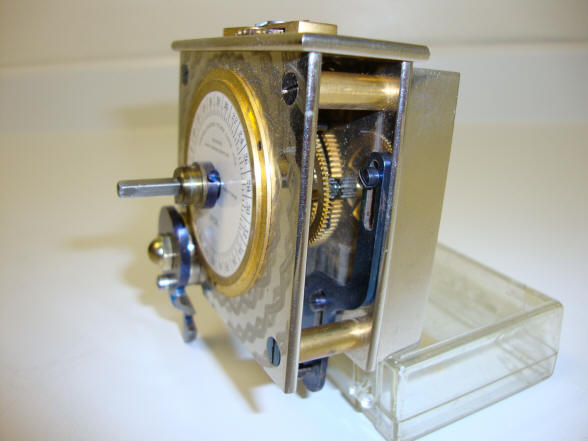
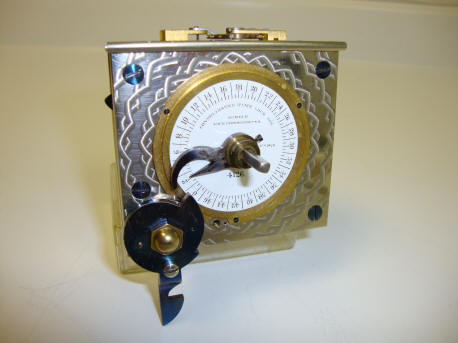
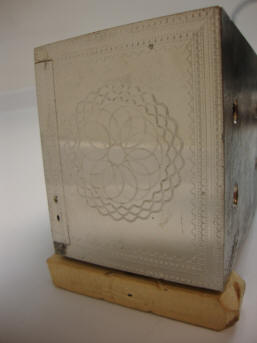
Consolidated Time Lock Co., Cincinnati, Ohio - 1 movement with hand engraved folk-art case, guilloche case
This type of engraving was found sporadically on other Hall, Consolidated and Dalton (also part of Hall's Safe & Lock Co.) cases from this period continuing though about 1886. The theme to the engravings may be the Ohio River region with subjects known to include sail boats, ducks, cranes, hunting dogs, boys fishing, and a country gentleman with a fishing rod. One can easily imagine that Mr. Hall was an avid outdoorsman and had his favorite activities immortalized on a few of his special time lock cases. The work may have been done by the same artist given the consistent appearance of the associated floral vine engraving. Eight folk art engraved examples are known. Later side panels were machine engraved in a circular guilloche pattern. This lock is a fairly early in the production run under the Consolidated name since the E. Howard name appears on the dial. Joseph Hall separated the time lock business from his safe business by creating the Consolidated Time Lock Company in January 1880. At this time the E. Howard name still appeared on the dial. But because of the ever increasing litigious nature of the time lock business and in particular a lawsuit brought by Yale against Holms which also entangled E. Howard in 1882, the Howard name was removed at that time from the dial and replaced with Gothic type-face embossing on the front plate behind the dial to obscure it from view. One has to wonder just how effective this would be in 'fooling' a potential adversarial lawyer. This example had undergone a complete restoration and is in excellent condition. Restoration page. Single movement Consolidated time lock c. 1882. Case with hand engraved folk art design of a dog within a star background on right side panel. Left side panel, door and top of case decorated in floral pattern. Case door #920, case back stamped #2874, movement #2874, 3 5/8" w x 3 1/8" h x 2 5/8" d. file 225
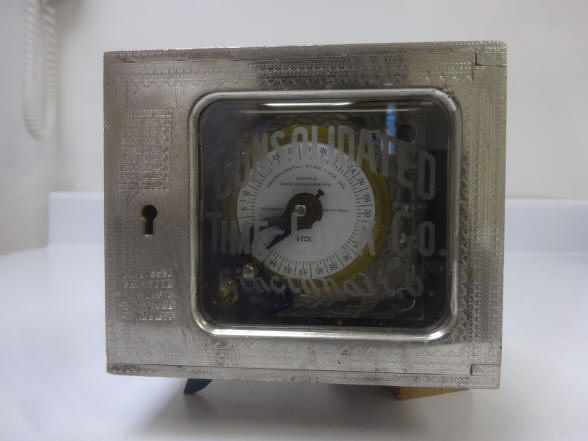
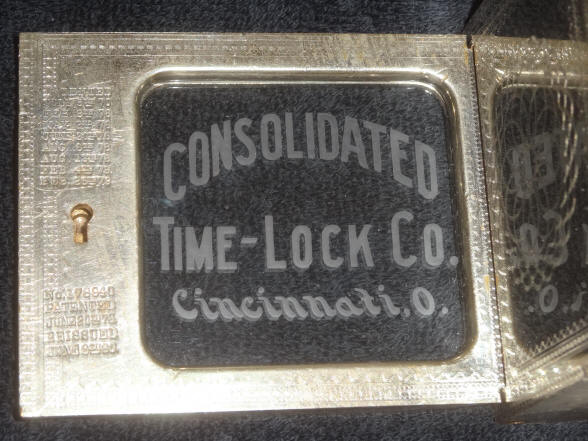
Single movement Consolidated lock, c. 1886. This is an example in very good condition and has an original rare etched door glass. The case nickel plating in very good condition. Likewise the movement is nearly pristine. Consolidated time lock cases were particularly prone to corrosion of the nickel plate and the movement plates are rarely as shiny as this one. All of the blued steel parts are intact with even color and no corrosion. Notice the circular damascene design on the movement plate contrasting with that on the single movement lock directly above it. Consolidated varied their damascene designs on both the movement plates as well as their cases throughout production. Case door #1436, case back stamped #4126 movement #4126, 3 5/8" w x 3 1/8" h x 2 5/8" d. file 124 These locks represent a variety of 'transitional' time locks. Early locks that used both a time lock movement as well as an integral combination lock that could be used to open the safe in case of a timer failure. This is an important example of a transition period that the development of time locks took. At first total control of the opening of the vault was not quite trusted to the time lock alone. The following is quoted from The Lure of the Lock, The John M. Mossman Collection, "This lock is of greatest possible interest as it contains a secret combination which can be used in case of "lockout". (Failure of the time lock). "This combination was held by the maker until an emergency arose when it would be telegraphed to the bank." Of course what's to prevent someone from inside the time lock company from performing an unauthorized entry? The answer is that the regular combination had to be dialed in after the emergency combination. So there would have to be collusion between the both parties. But this still seems to negate the entire purpose of the time lock in the first place. Soon, however, bankers realized the reliability of these locks, particularly when two or more movements were used to add redundancy. Notice that these locks used only one movement. The Hall / Consolidated company did this to create a less expensive product; the time lock movement being the most expensive time lock component. A single movement time lock is also very small giving it an advantage where space on the safe door is at a premium. To get around the advantage of redundancy that a second movement provided and to prevent the possibility of a lockout due to the time lock's failure, the firm used their Hall's Infallible Lockout Protection™ system. This involved a second fence within the combination lock that when a second "emergency combination" was dialed in and that second fence was activated, it overrode the time lock. Then the owner had to dial in the normal combination to open the safe door. This means that this type of time lock could only be paired with one of Hall's combination locks equipped with the infallible system incorporating the second fence and combination. Later the use of redundant movements obviated the need for all the complex and less reliable or secure backup approaches. It should be noted that in the entire history of the use of factory installed time locks with redundant movements, when the lock was properly used and serviced, and in the absence of tampering or efforts at forced entry to the safe, there has never been a total failure of a time lock resulting in the door being unable to be opened.
|