        |
Yale & Towne Manufacturing Co., Stamford, Connecticut - 2 movements, Type T221, T221 DAT, T321 (now T221), C-T274, T261 DAT intraday
Yale's T221 and T274 series of time locks used their 'T' sized movements. The T221 model was the smallest time lock Yale produced.
This video is a demonstration of a Yale & Town DAT (Delayed Action Timer)
time lock. These were used where the time lock needed to be put on guard
very quickly in the case of an emergency. This would generally be a day time
robbery where the cashier would want to lock the safe and put the time lock
on guard in one quick action.
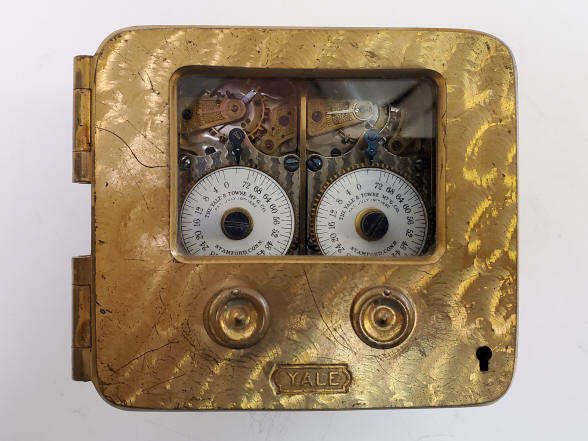
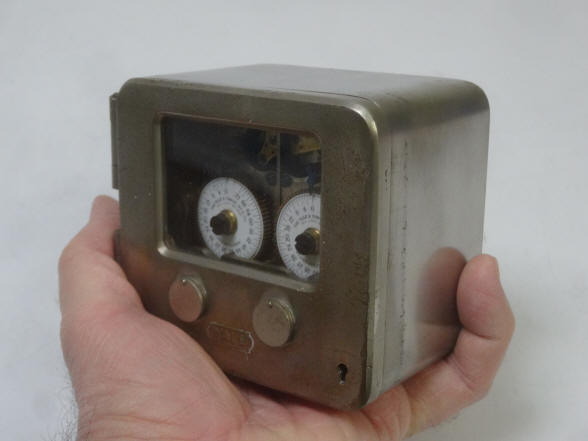
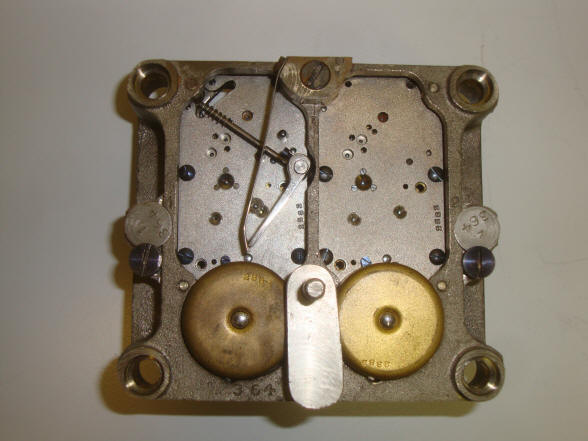
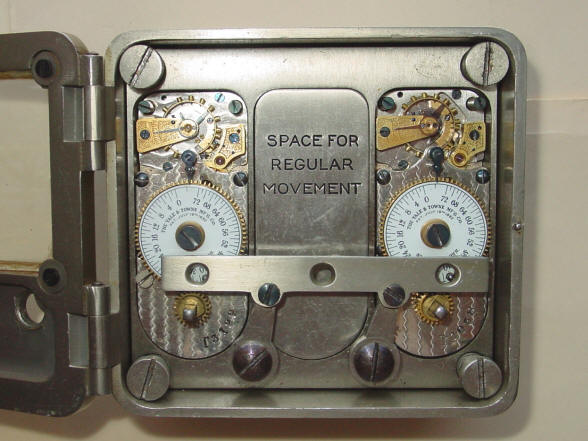
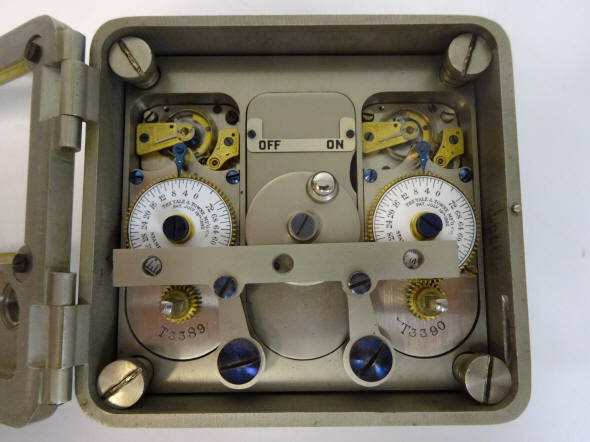
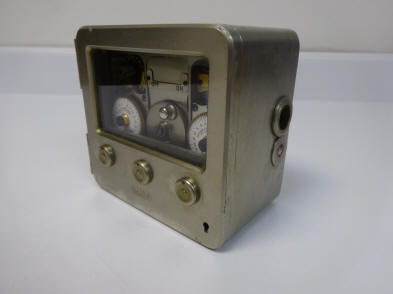
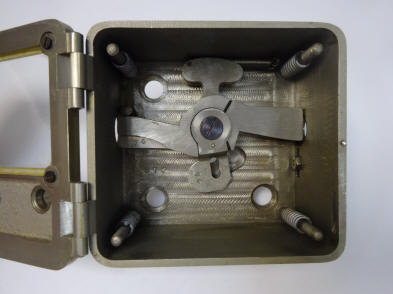
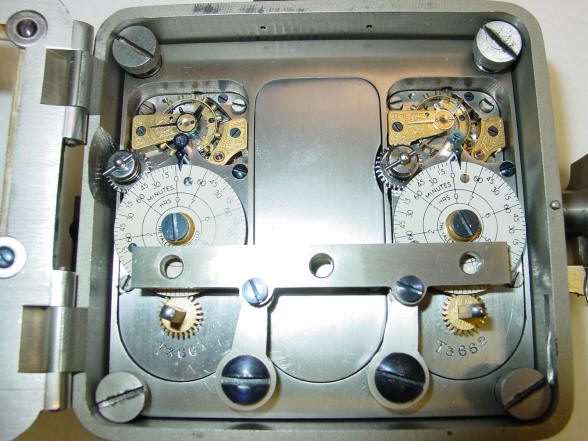
A. Type T221. c. 1900. This is the smallest time lock made by Yale and is smaller than Sargent & Greenleaf's smallest time lock, the Model #6. The only other two movement time lock that this author knows of that is smaller is the Chicago Perfection model time lock which was the smallest two movement lock made. This author has only seen a handful of these small Yale time locks over the years. It seems likely that no one thought them to be worthy of salvage when the safes to which they were attached were eventually scrapped and so few survived. 3.875"w x 3.4"h x 2.5"d. Case #299, movements #T1974 and #T2524. file 246 B. Type T221. c. 1900. This is the smallest time lock made by Yale and is smaller than Sargent & Greenleaf's smallest time lock, the Model #6. The only other two movement time lock that this author knows of that is smaller is the Chicago Perfection model time lock which was the smallest two movement lock made. This author has only seen a handful of these small Yale time locks over the years. It seems likely that no one thought them to be worthy of salvage when the safes to which they were attached were eventually scrapped and so few survived. 3.875"w x 3.4"h x 2.5"d. Case #299, movements #T1974 and #T2524. file 246 C. Type T221 DAT (Delayed Action Timer). c. 1910's. Timer contains a standard 72 hour Type 'T' movement as well as a modified Seth Thomas Type T movement that has a 7 hour duration. Type T movements were the smallest coffin style movements made for Yale. See close up last photo for F, below. The timers could be set for intervals as short as 15 minutes. This was an intra-day lock used to keep a small vault or cash drawer secured for short periods of time during the day primarily to thwart daytime holdups and was combined with the other regular lock for longer periods up to 72 hours. This results in a quandary, as for periods longer than the maximum of 7 hours on the inter-day timer the safe is controlled by only one time lock - a potential disaster if the door is locked and that one timer should fail. These modified movements were never popular and few locks equipped with them exist. The lock case has an unusual push-button door release rather than normal key lock. The third photo shows the interior of the case with the lock's snubber assembly. The fourth is a view of the rear of the movements mounted to the movement plate. When correctly assembled the spring loaded pin mounted on the snubber, when depressed by the safe boltwork, will engage the balance wheel lock and the short 7 hour intra-day timer allowing the lock to be controlled by the conventional 72 hour timer. (see explanation of balance lock in next example below). This must have incorporated some new design since on the inside of the door the words "Patent Pending" is stamped. It is the smallest Yale lock in a two movement configuration known and is the only known example of this type of lock without redundancy, excepting a few early examples from the 1880's by the Consolidated company. It is also only one of two models this author has seen to date that has a pushbutton door release in place of the handcuff key style. 3.875"w x 3.4"h x 2.5"d. Case #364, movements #T2881 and #T2882. To see another Yale with this rare type of combination of regular and modified movements click here. file 82 D. Model T374 (now a T274), staggered, c. 1910. A three movement case and bolt mechanism (hence the T364 rather than T264 designation. It is the case that determines the model number) with only two 'T' style Seth Thomas movements. The 'T' movements were Yale's' smallest in this style known as the "coffin" due to it's shape.4 1/4" w x 4 1/8" h x 2 3/4" d. file 16 E. Model C-T274, 1930's-1940. The 'C' designation indicates the manual control feature mounted in the center where the second movement of this three movement case would have been mounted. This is the first small lock I have seen with this style option but it is certainly an OEM feature and thus there must have been others so equipped. This lock is a type of delayed action timer, but does not employ the automatic functions nor a very short-term timer as in example B. It allows the operator to put the lock off guard even after the timers have been wound by holding the snubber bar in the off guard position. However, it is not the only Yale to have this function. The models Triple O and Quad M had what Yale called a "throw off device" that accomplished the same thing, but that device would automatically be deactivated when the time lock ran down; this one has to be manually disabled. One had to be careful to notice the position of center switch because if one left it on "OFF" and closed the safe, the time lock would remain off guard. Notice that both the right and left sides have holes for the safe bolt works. A view of the time lock bolt dog shows its symmetrical shape allowing for this feature; it allows the same time lock to be mounted in either a right or left handed hinged door without modification. Note the four springs that with the upper set of four, act to cushion the plate that holds the time lock movements from shock, movements #T3389, T3390. file 174 F. Type T261 DAT, later called DWC, (Delayed Action Timer), intra-day. c. 1920 - 1950's. This timer contains two modified Seth Thomas Type T movements that each have a 7 hour duration within a T361 case that would normally have three T movements. Type T movements were the smallest coffin style movements made for Yale. The bottom photo shows a small, delicate wire which is provided to engage the balance wheel and stop the movement (located within red square). When the bolt is in the open position the pins will engage the balance wheels. The timers could be set for intervals as short as fifteen minutes to as long as seven hours. As long as the door was open the timers would be stopped at whatever interval the timers were set to by the stop pins. When the door was closed and the bolt moved to the closed position, the pins withdraw from the balance wheel rims and the timers begin, hence the delayed action feature. The lock is also equipped with an auto pre-set of thirty minutes so that even if the operator were to forget to set the timers and they were wound down to zero, the action of the bolt moving winds the two movements up to the thirty minute duration. This was an intra-day lock used to keep a small vault or cash drawer secured for short periods of time during the day with no overnight capability. This could be especially useful in the event of a daytime robbery, where the cashier could lock the money chest with a simple movement, blocking the thief from making a quick getaway. These modified movements were never popular and the bolt mechanism needed a complex set of parts to control the stop pins and so few locks equipped with them exist. Case #2424. The movements are consecutively numbered T3661 and T3662. file 62
|



 A
A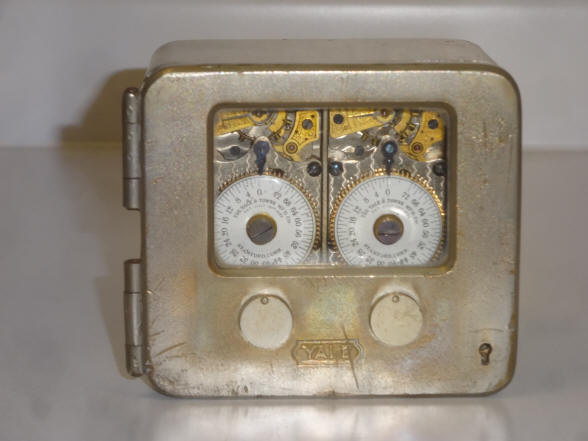
 B
B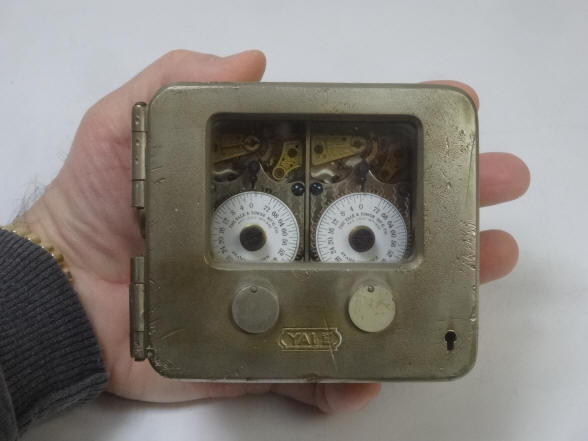
 B
B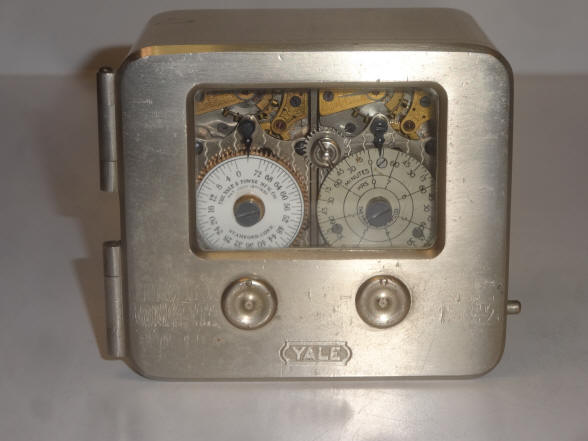
 C
C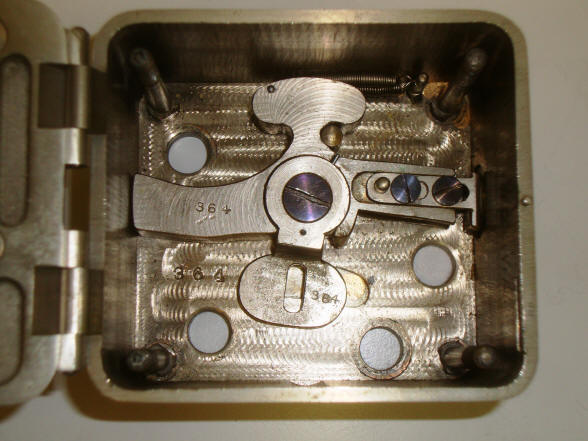
 C
C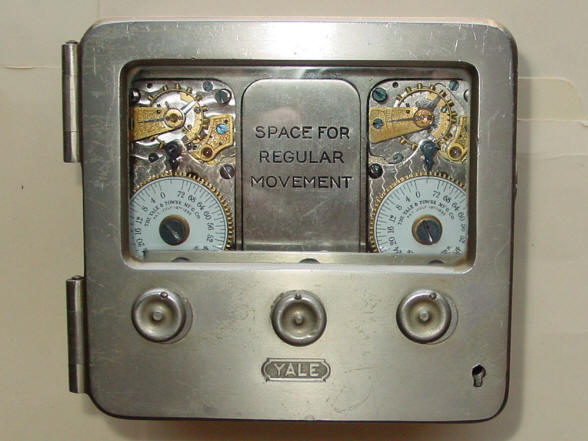
 D
D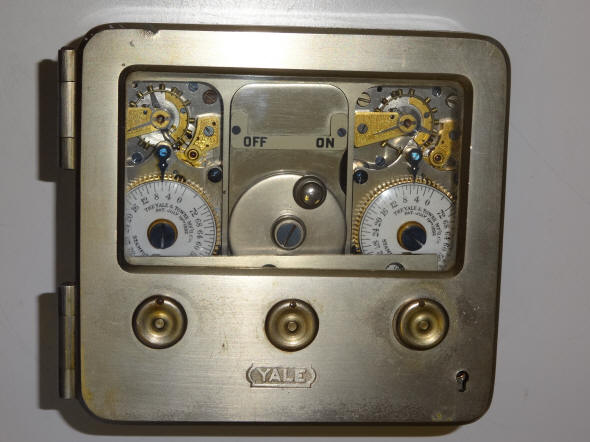
 E
E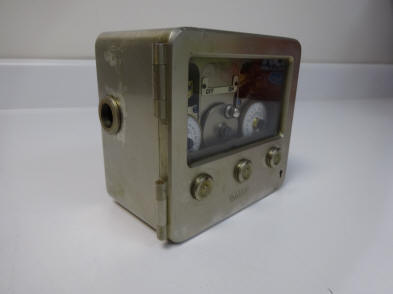
 E
E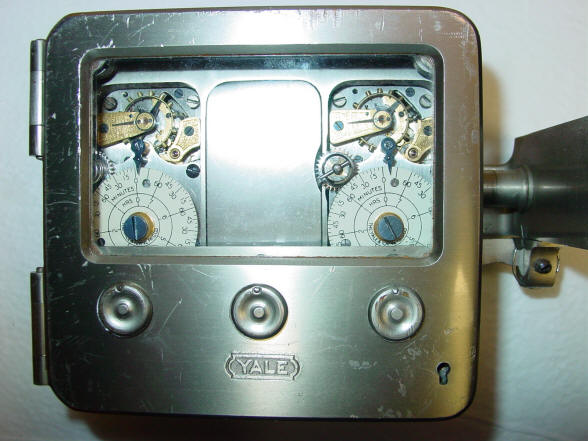
 F
F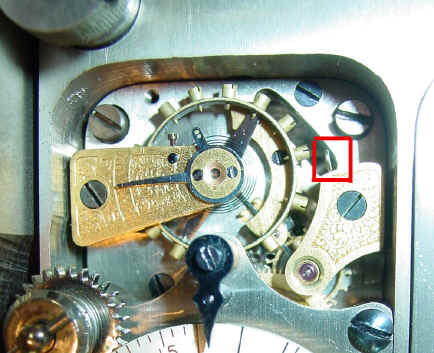 E
E