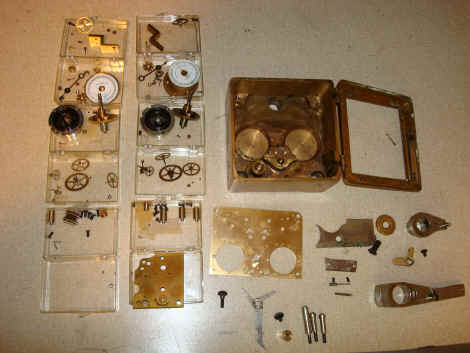
   Sargent & Greenleaf, model #4 version 2. c. 1884, restoration page 2. Below and next page are depicted several steps necessary in the restoration of a time lock. The first is complete disassembly and cataloging of parts. Separate containers are used for grouping parts in a logical sequence. Digital photography makes documentation easy and cheap. Parts are cleaned in various sized ultrasonic machines according to part size. Total parts count 184.
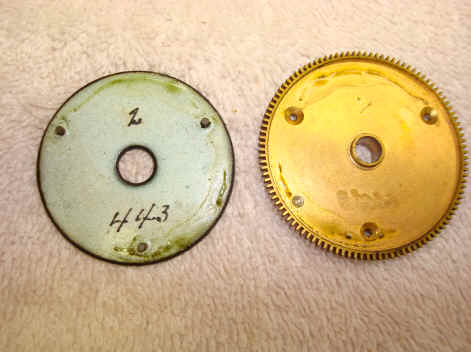
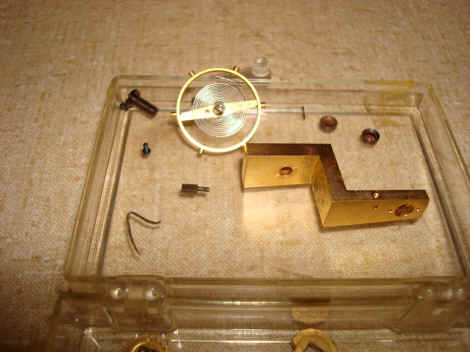
One must be careful to know when a part may not be put into a cleaning solution. Below is a rear shot of one of the porcelain dials denoted in original wax marking. Proper preservation requires this to not be lost as would be the case if the part were put into an ultrasonic cleaning procedure. Notice how badly gunked the parts were, even the delicate balance springs.
As with nearly all parts on early time locks none are interchangeable. One must be certain that pivot jewels are logged in their proper locations; upper lower plate as well as each wheel. On this lock each jewel pivot has a small punch mark to locate the rotational position of each in it's respective hole. Later locks dispensed with this as manufacturing techniques became more precise. A computer at the bench helps in documentation of parts and reassembly.
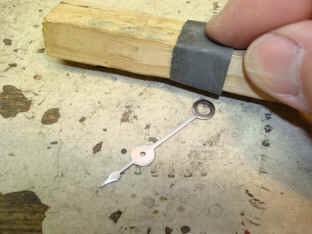
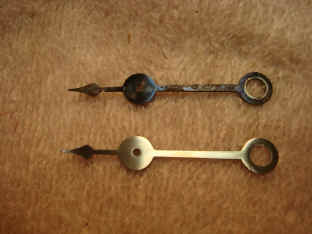
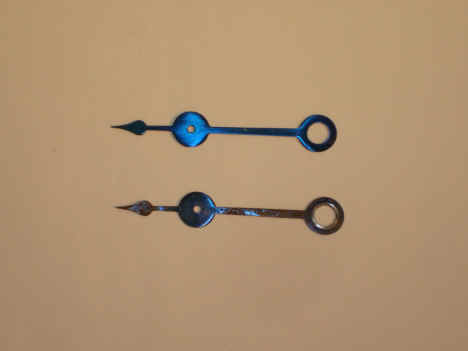
Heat bluing of parts is a particularly enjoyable part of the process for me. It is partly an art to be able to get just the right color as the metal turns from straw to purple to electric blue, and then a dull pale blue in matter of seconds. Surface preparation is crucial, a fine finish as well as no contamination (oil or dirt) is essential for a beautiful even color. Larger parts like the dial hands require an additional skill at making sure the entire part is heated to the proper temperature at the same time to get a uniform color throughout the part. When desired color is achieved the part must be immediately quenched to stop the color change. I use water, others use oil. However, oil tends to darken the color so one must compensate for this when heating. If the part is over-heated and the wrong color is present, the entire refinishing process must be done again. Below are shots of the dial hands. These were given a fine grain as was originally rather than the standard polish given all of the screws.
|