|
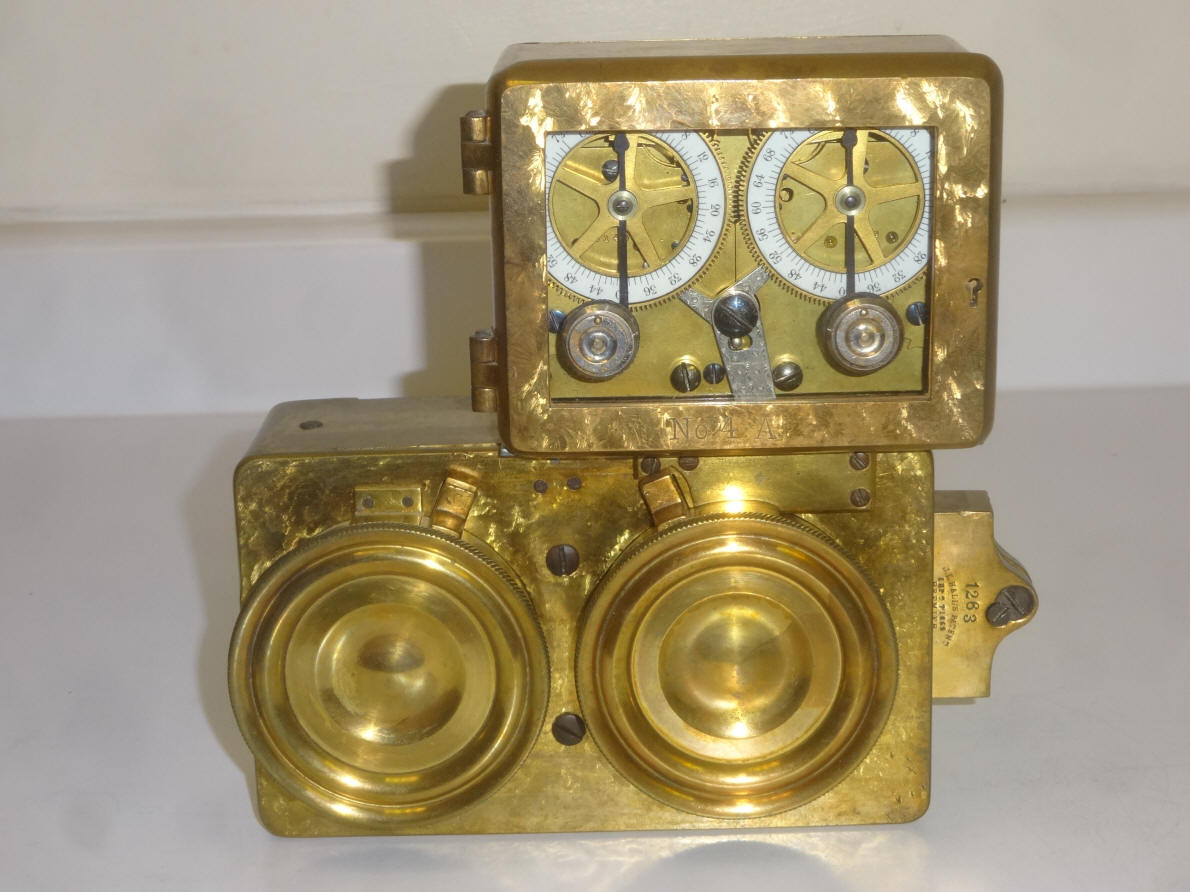
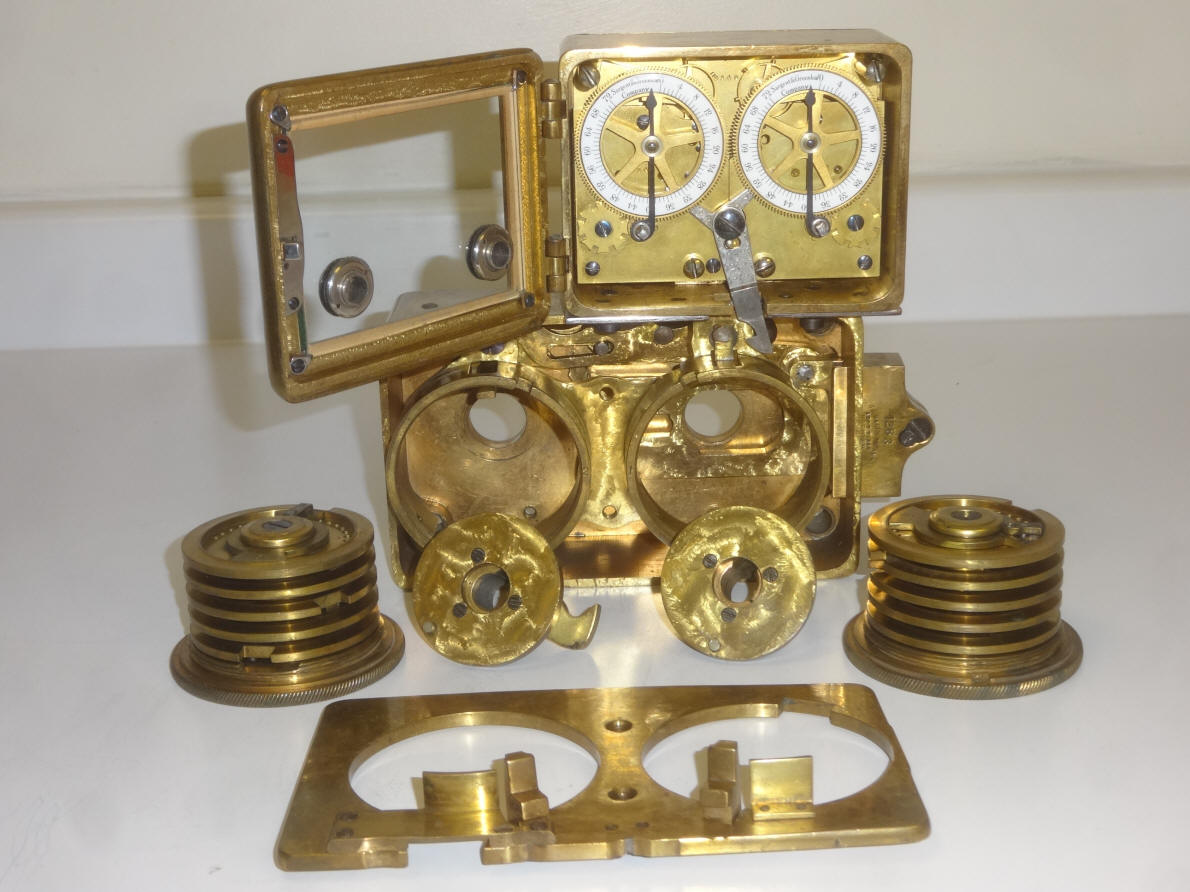
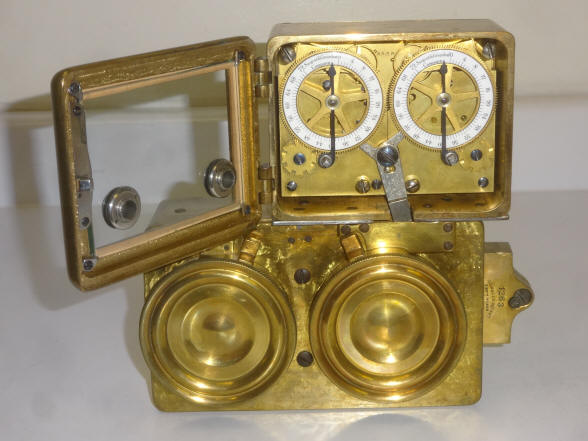
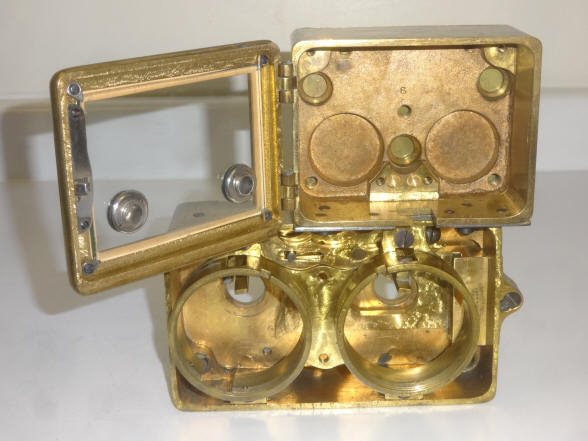
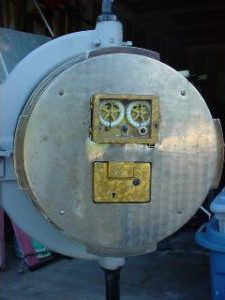
Sargent & Greenleaf, Rochester, New York - 2 movements, Model 4A mounted to Hall Premier double, dial five tumbler combination lock by Hall Safe & Lock Co., size #3.
The Hall Premier dual dial combination lock when first introduced in 1869 and cost $500 depending upon available options. The Premier series of combination locks was were some of the finest safe locks ever made and remained in production for over thirty years. Earlier locks had the Joseph Hall medallions on the wheel pack covers. In May 1892 the Hall Safe & Lock Company was sold and became a part of the Herring-Hall-Marvin Company of new Jersey and at this point the medallions disappeared.
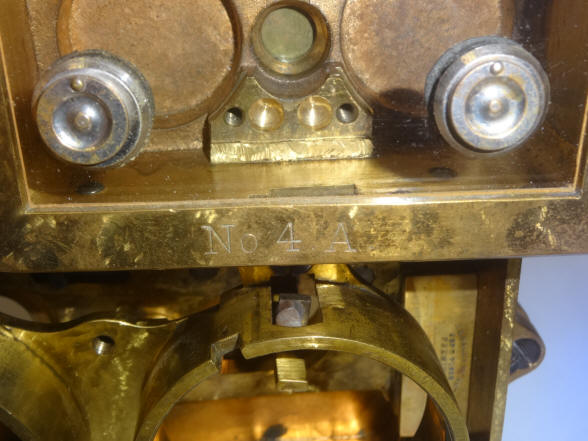
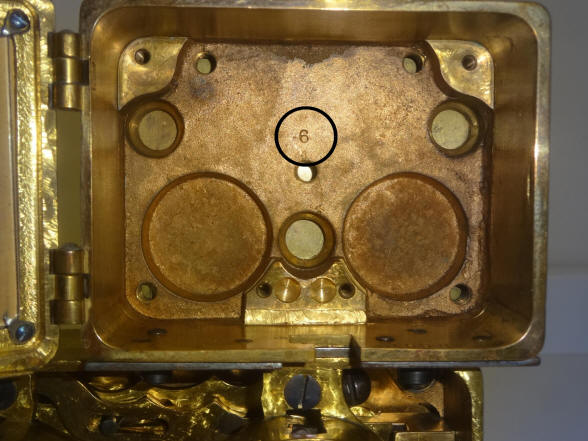 This example operates on the combination lock and has a cut down case because it does not have the drop bolt at the bottom to operate on a manual safe bolt design. S&G did a similar nomenclature with their model #2 and #3 time locks. Both of the Model #2A and Model #3A had a cut-down case with the same movement as the standard Model #2, and Model #3 but were designed to operate with a bolt motor and so had a bottom release. The last pre WWI time lock model S&G introduced was in 1910 designated as Model #4B and was known as the "Cleoh", with a bottom lever that like this example was designed to operate directly on the combination lock. The only other S&G time locks to my knowledge that operated on the combination lock was a modified Triple H which S&G designated as a Triple G. There was also a limited production of a Model #2 (which was used in their Model #1), Model #2A and Model #3 that operated directly on the combination lock's fence. Apparently when they switched from number designations for their models to letter in 1889 they dropped using the number suffix for functional alterations. An examination of the Hall Premier combination lock, c. 1870 reveals that it was not originally designed for for use with a Hall/Consolidated time lock and probably was not originally equipped with any time lock. If it were there would have been witness marks for where the linkages were originally mounted as well as holes for the time lock attachment. It also lacked other options such as the ability to switch between the two combination locks or use both to be able to open the lock, this is known as shifting 'custody'. Also an anti-tampering device to lock the custody control buttons and the wheel packs. An example of this same model of lock with those options as well as a Consolidated single movement time lock can be seen here. In May of 1892 the old Hall Safe & Lock Company had been incorporated into the Herring-Hall-Marvin Company and by 1902 the original three Hall brothers had left the company over disputes over their employment contracts. The Consolidated Time lock Company was a separate entity and was never part of the original sale to the Herring-Hall-Marvin entity. Until their employment dispute with Herring-Hall-Marvin the Consolidated Company supplied time locks when needed in conjunction with the Hall Premier line of combination locks. But since the two companies’ owners were now at odds there would be no time locks being supplied by Consolidated for Premier combination locks. The Model #4A case could accommodate the Model #4 movement without, of course the drop bolt mechanism. So S&G simply took a Model #4 movement and placed it into a recast modified Model #4 case, where the section at the bottom for the drop bolt lever was eliminated making the case from 4 1/2" to 3 3/8" high. The release lever now used to operate on the fence of the Hall Premier lock, hence the designation of Model #4A The end user also got the advantage of two movement redundancy. The internal components used in the Hall Infallible Lockout Protection System ™ needed with a single time lock movement were made unnecessary with the two movement redundancy and there are no witness marks within the movement to indicate that these Hall components were ever installed. (1)The model #4A was probably made about 1900. So the time frame between the closing of the Consolidated firm in 1906 and 1929 fits. Furthermore there was no other time lock during this time that was small enough to fit within the parameters needed. Other very small time locks offered by Yale like the T261 were not an option as Yale rarely engaged in limited custom work. S&G in particular did engage in custom installations. S&G was in a better position than most since they made their time locks in their entirety. The #2A was a custom and possibly one-off design. This author has seen only two #3A's and this #4A example. So the question becomes how many of these custom installations did S&G engage in? It appears that the #2A and #3A were designed to operate a bolt motor and this #4A could have also with a bit differently designed release lever do the same. It would seem that in the example here, the #4A would be used to replace unavailable or defunct Consolidated locks. The bolt motor designs may have been needed where space configurations were at a premium and S&G's model Triple A was too large. So while these would have seen limited demand, there surely were dozens if not many more made.
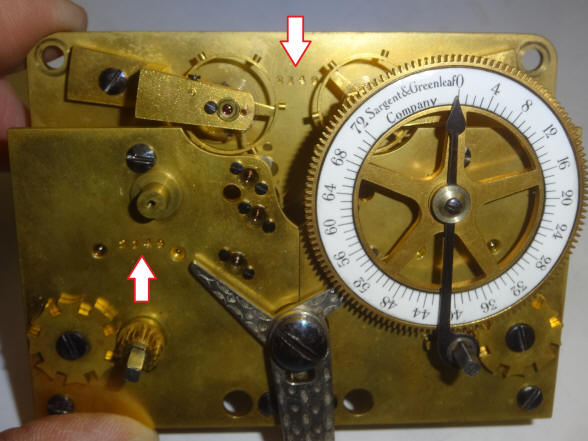
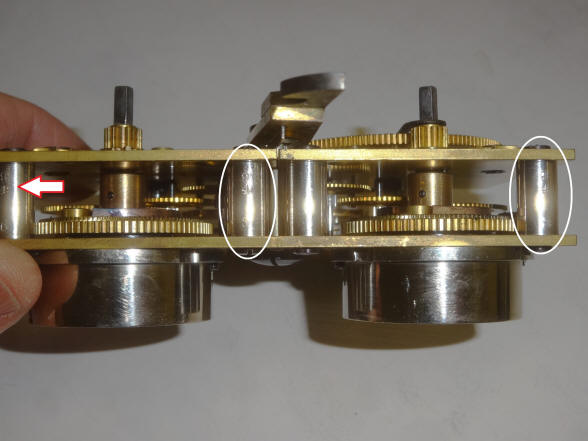
Most time locks had a serial numbering system throughout the movement. In this example the number is 2149 and this number appears on all three movement plates, the rear common plate and the split pair of front plates. The numbering carries through to the plate pillars which are all numbered 49 at the top and then sequentially numbered 1 through 6 at the lower end for each pillar beginning with the number one for the top pillar on the left hand movement and counting clockwise pillar by pillar.
The first video shows a description of a short-cut method to bring a sluggish time lock movement back to life. This method is only recommended for examples that will serve within a display collection and will see little actual use. The second video shows a demo of how the time lock interacts with the Hall Premier combination lock. In that video I neglected to use the proper term for the wheel pack's tumbler indentations. Those are called 'gates' while I correctly reference the part that drops into these indentations when they are all correctly aligned, a 'fence'. When one thinks about the time that these terms were first used it was the middle of the 1800's. What would someone need to protect his property but a good, sturdy fence! And how does one get into that property but by being invited through the gate! So when the tumbler's gates are all lined up the fence can be lowered and the user is invited into the property within the safe. I also called the combination lock a Hall Crescent, when it was a Hall Premier double dial size number 2. Model 4A, c. 1910, on Hall Premier double dial lock c. 1870. Time lock is a customized #4A which S&G created to replace a single movement Consolidated lock originally mounted to the Hall premier combination lock. The 4A case and movement from model #6 stock. Time lock case 4 3/8"w x 3 3/8"h x 2 3/8"d, case #1632, movement #2149, Hall Premier double dial #1263 size #3, about ten of these are known. The earlier Premier locks had plan-faced tumbler wheel packs like this example. Later the Joseph Hall medallions were added until the acquisition by Herring-Hall-Marvin when they were discontinued. file 189 The last two photos are of a Sargent #4A or 4B Cleoh lock. It is hard to distinguish between the two from these small photos. The first is installed in a National Safe Co. cannonball safe. The second is from an unknown safe, but probably also a Cannonball. This one is mounted much closer to the combination lock as it has a different style of connection, but both operated in the same manner.
|

(1) John Erroll, email February 6, 2017