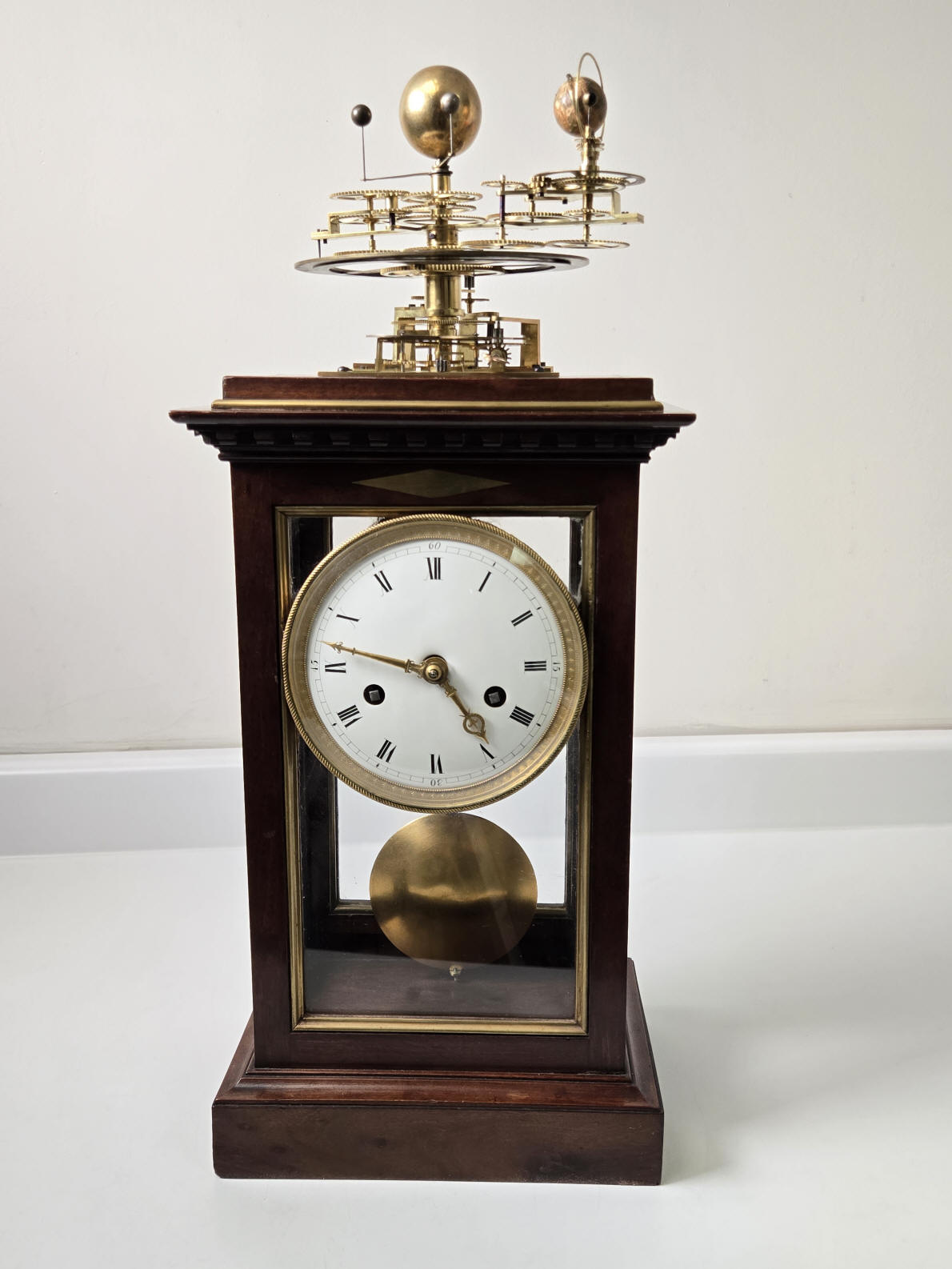
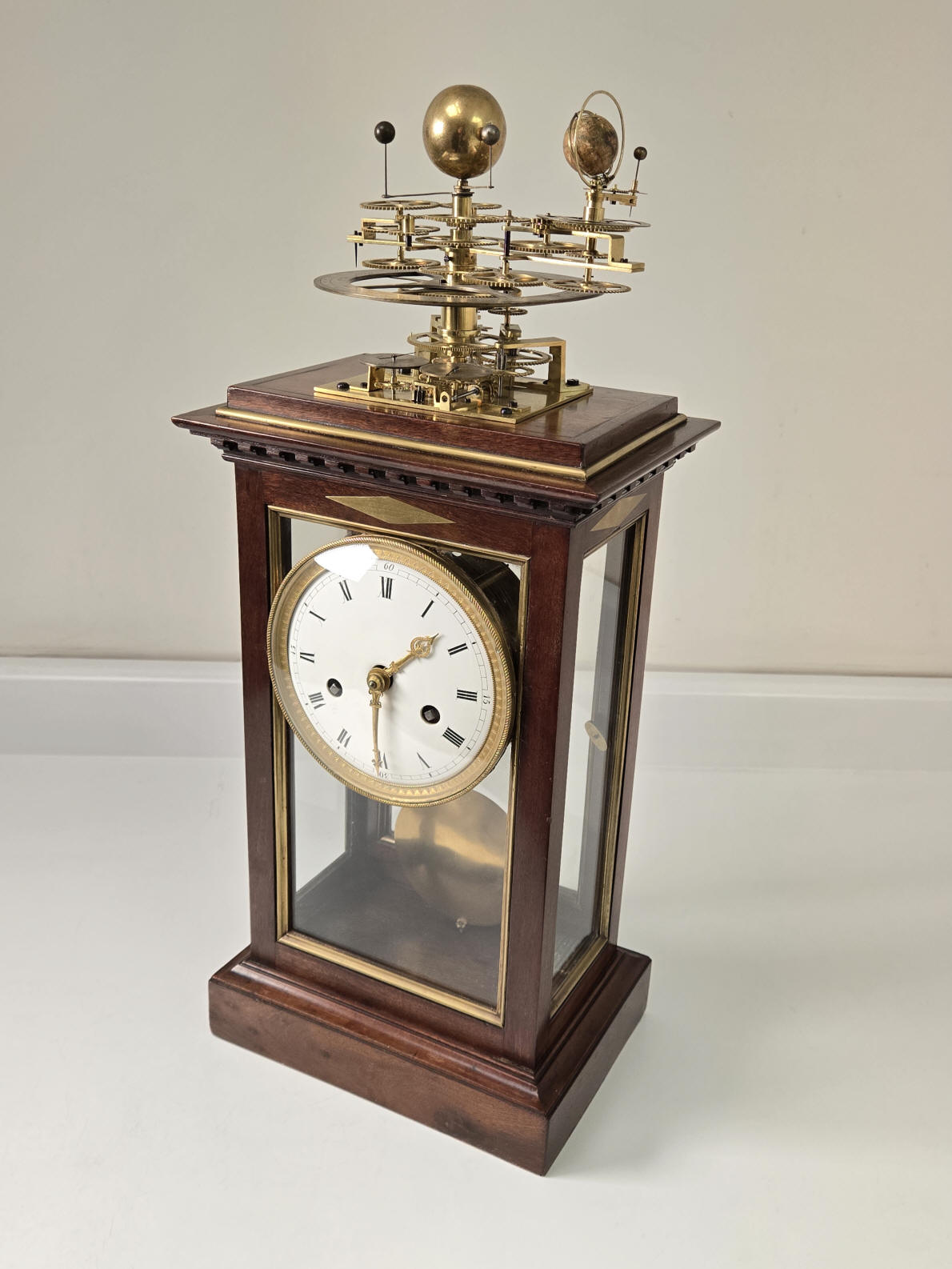
French mantle clock with tellurian, c. 1810, attributed
to Henri Lepaute, see below. Two train, Tic-Tac escapement, half second pendulum, hour and half
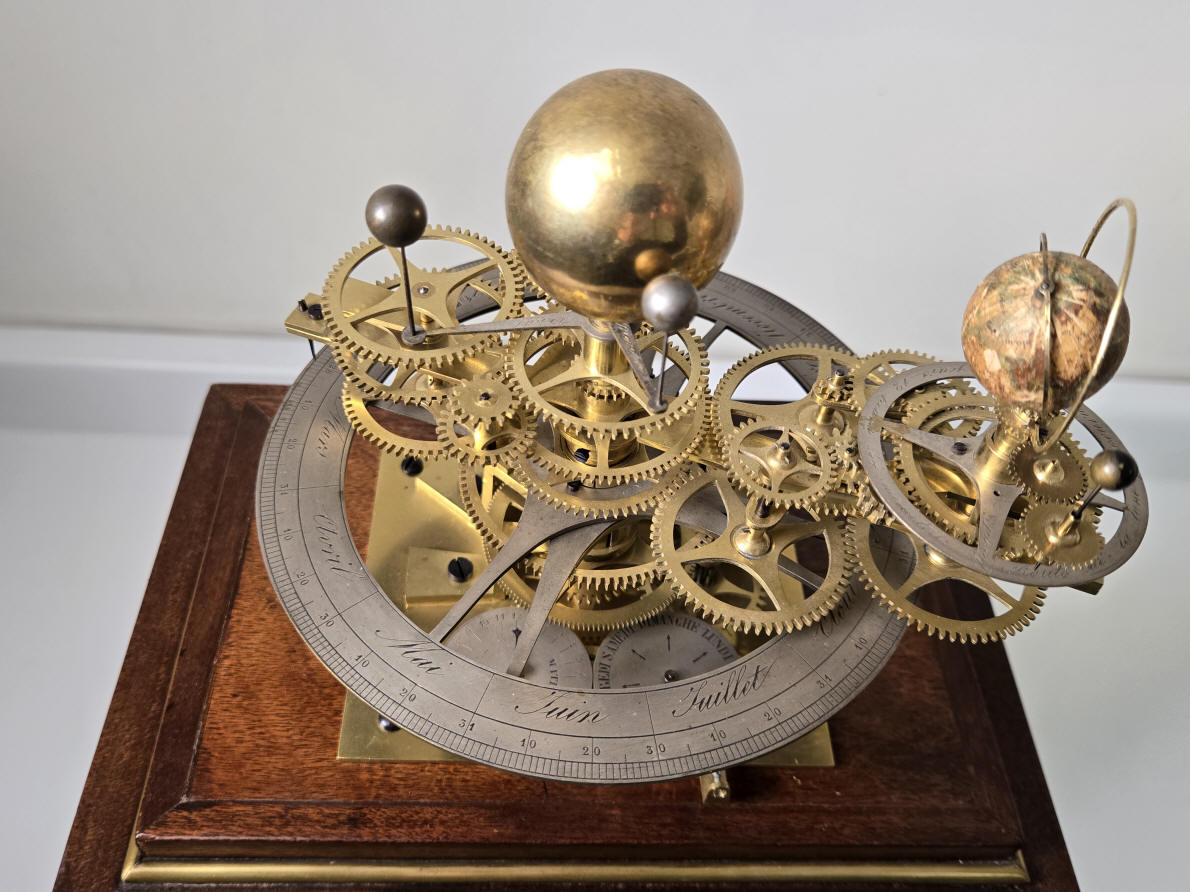
hour strike on count wheel. An orrery is mounted to the top of the clock
case and is driven by the clock in real time as well as by a demonstration
key. 21"h x 9"w x 6.5"d.
Click on pictures for more details
Video demonstration of a French mantle clock, c. 1810 with orrery
mounted to the top. The orrery is driven by the clockwork and can also be
demonstrated by a crank. The clock is unsigned and the orrery was probably
supplied by a third party as many makers including, Janvier, Baltazar,
Guiteau, Berthoud and others have clocks signed by them with this same
mechanism. The basic construction is common throughout, only details such as
engraved vs. enamel dialing or different dial bezels were supplied as
upgrades.
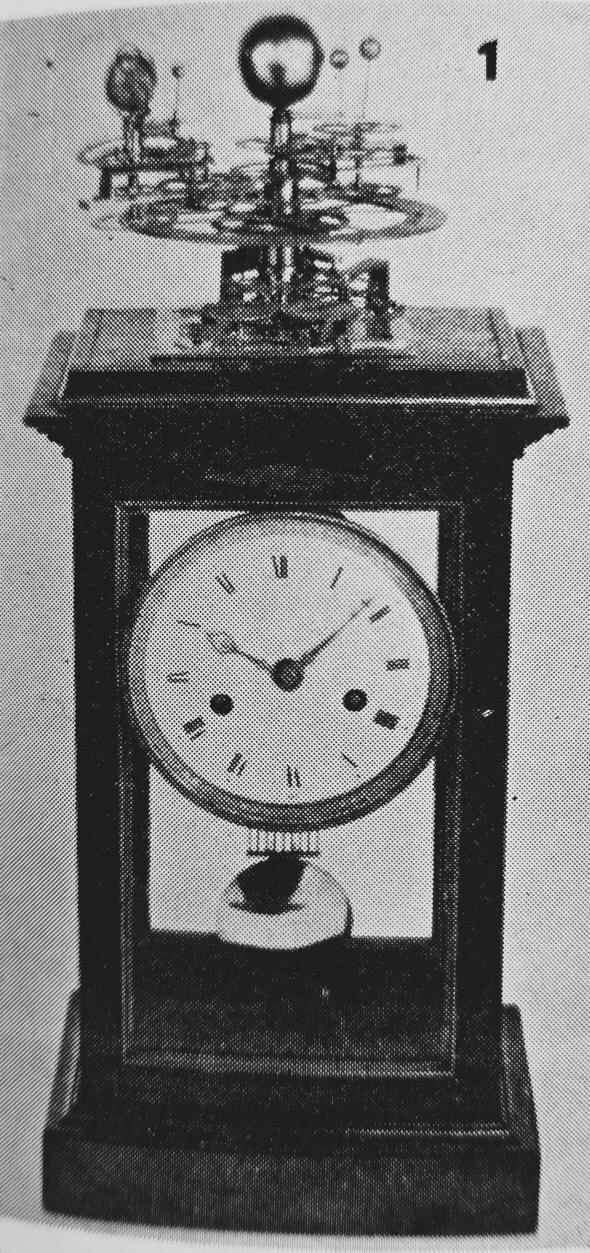
The photo to the left is taken from the
Antiquarian Horology magazine, March 1976,
page 689. It was from a section illustrating
clocks that were recently stolen, in the
United Kingdom.
The description reads: "French planetarium
clock, approx. 24: high, signed Lapaute
de Belle Fontaine, Elementa Suis Proprus
Armis Victa. Sun depicted by brass
sphere; Mercury, Venus, Earth, Moon, Mars,
Jupiter and Saturn by ivory balls, 19th
century.
The description cannot be seen in this fuzzy
photo taken from the printed medium, it may
have been on the dial, but given the length
of the dialog was probably engraved on the
rear movement plate.
The phrase is a mixture of French and Latin
making a literal translation difficult. The
most probable is: Lapaute of Belle Fontaine
— the elements overcome by their own forces.
For an orrery clock, the idea is especially
apt: the “elements” (celestial bodies,
natural forces, time itself) are being
governed and demonstrated through mechanical
ingenuity. The phrase subtly celebrates the
Enlightenment-era notion that nature can be
understood—and even mastered—through its own
laws.
The clock case, brass diamond inlay and
striping, as well as the dial, hands and
bezel are identical to the clock shown in
the author's collection. The two differences
are the pendulum and the additional three
outer planets of the solar system. This
clock has both the inner and outer planets.
In the clock described on this website only
the inner planets are despicted.
However the mechanical design and orrery
dial are identical and are certainly made by
the same hand. What sets this clock apart is
the additional outer planets of Mars,
Jupiter and Saturn. There are many different
makers who used the tellurian design of the
clock that had only the inner planets on
this website and a discussion of this can be
found here.
So the question is whether this clock was
made by Lepaute. Given the extensive
engraving and identical features of the
majority of elements of the clock, it seems
to be, and so my attribution to Lapaute.