|
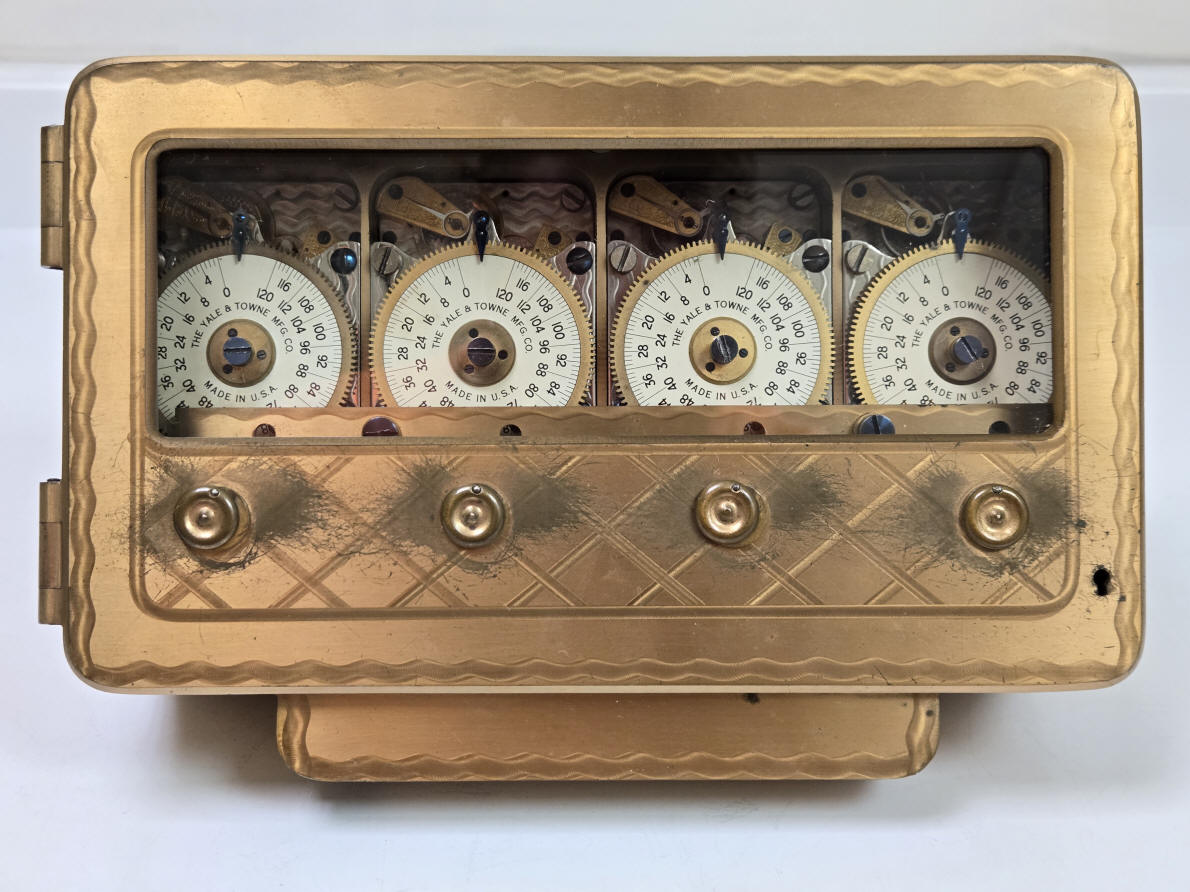
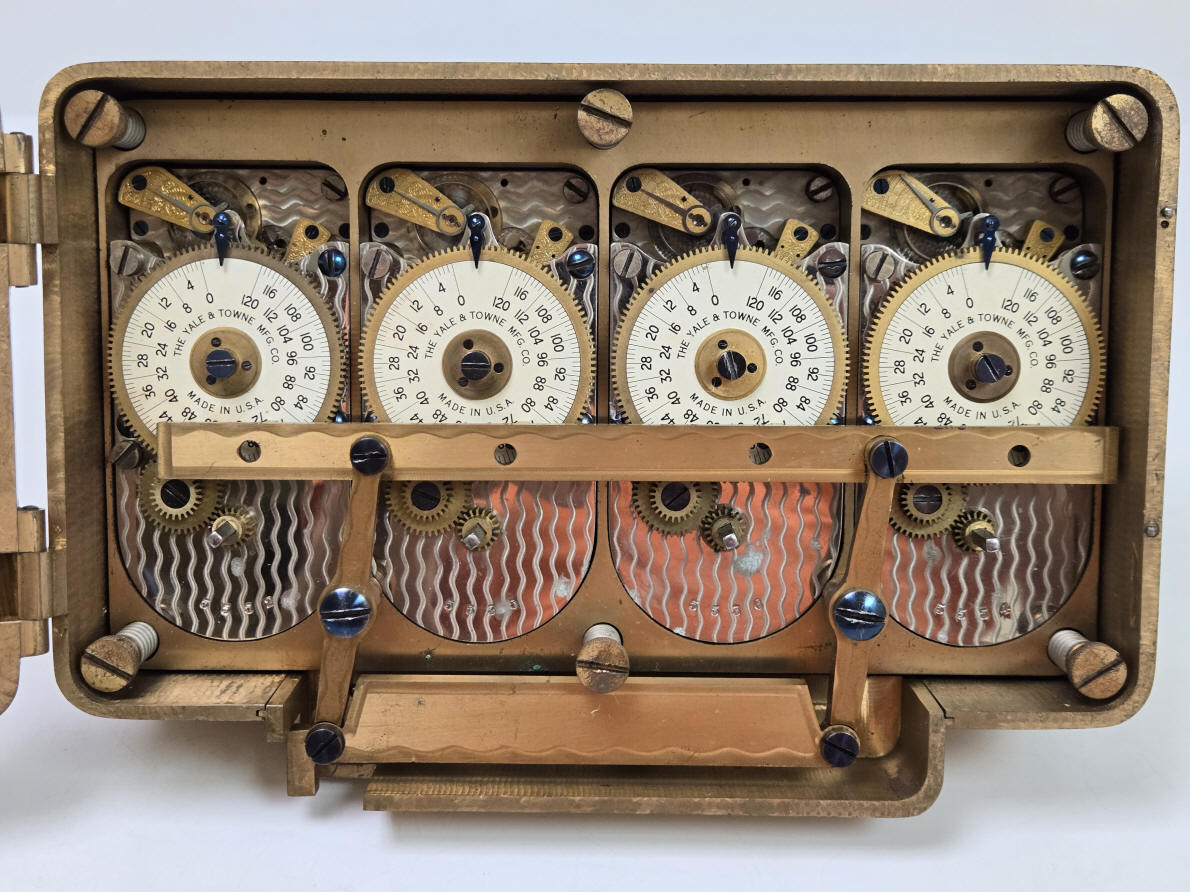
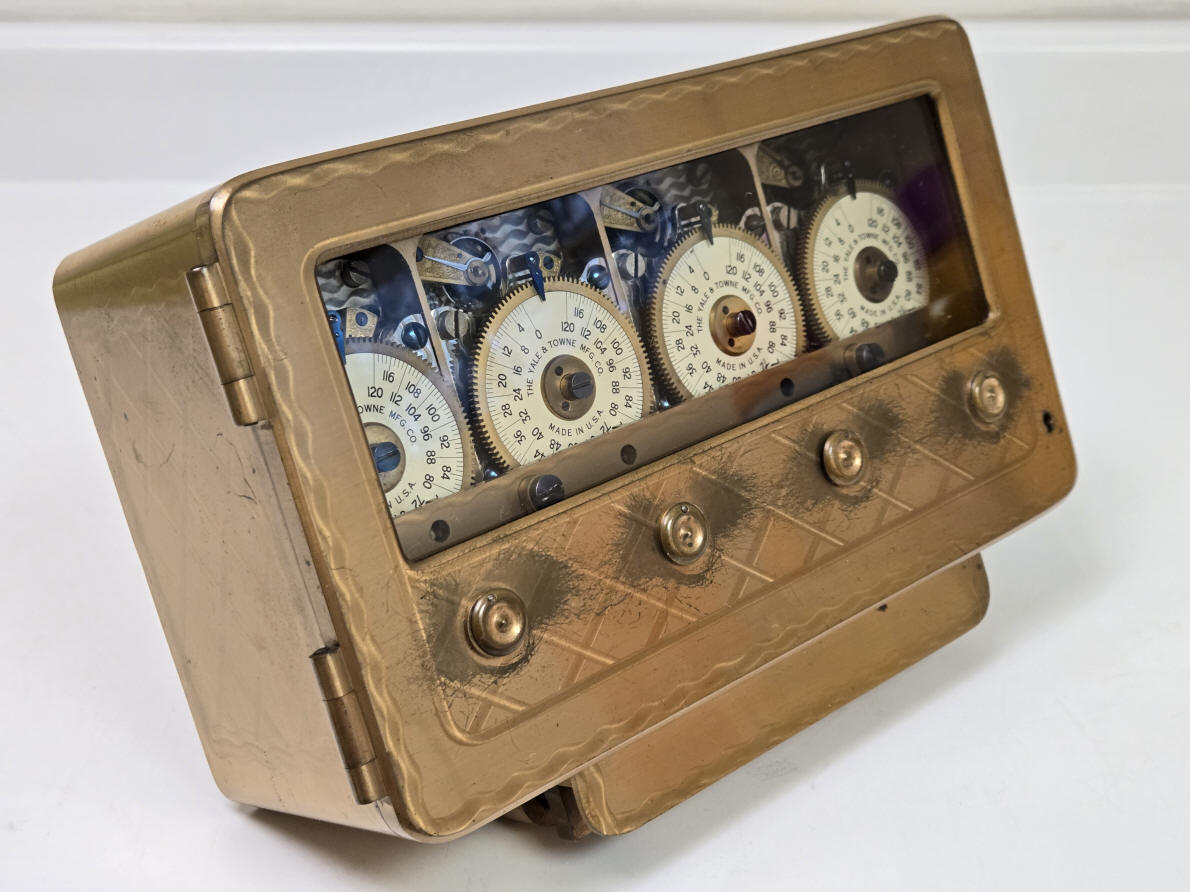
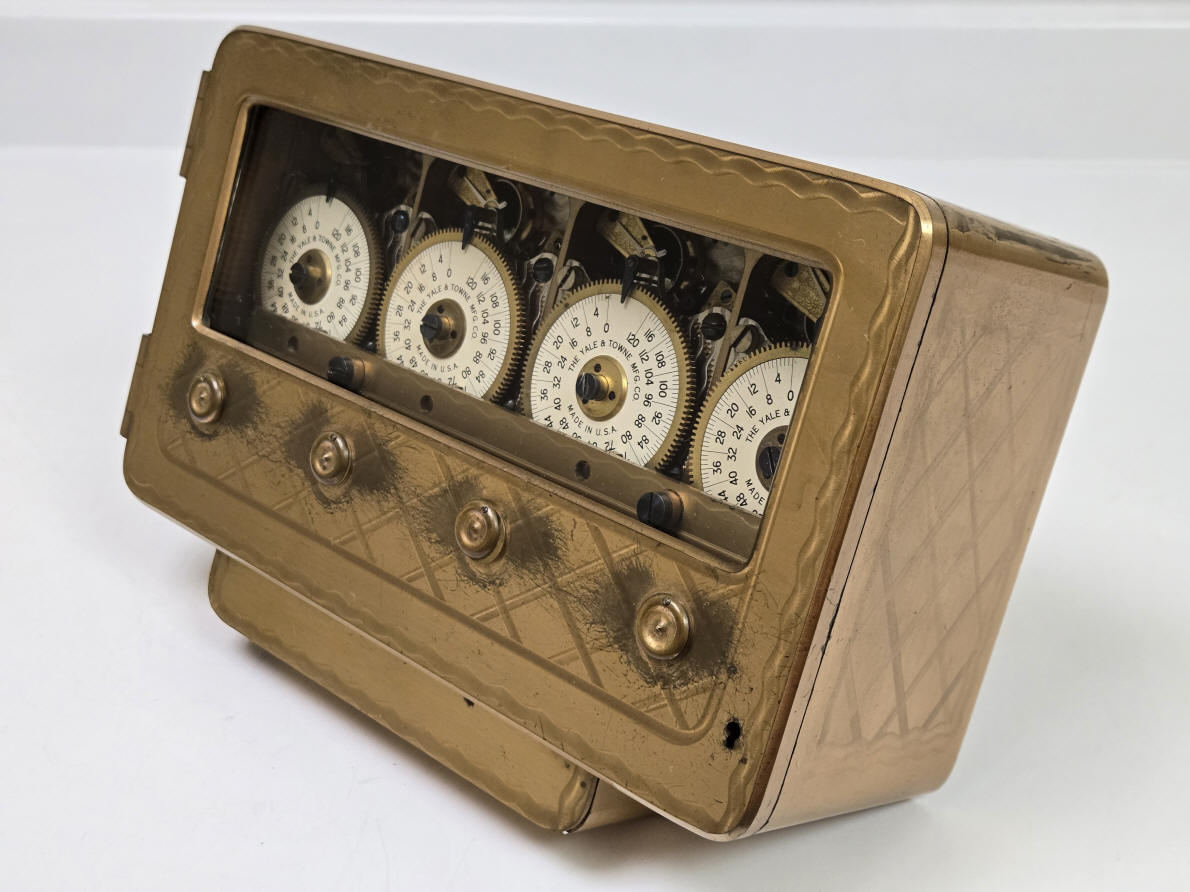
Hollar Lock Inspection and Guarantee Company, Philadelphia, PA, Model Quad N All of the time lock movements supplied to Hollar were made in cooperation and by the Yale & Towne Manufacturing Co,. Stamford, Connecticut. This example is housed in Hollar's unique gold-tone case, but shares nearly all other aspects with Yale's Quad N model which was supplied in their polished nickel case and shares Yale's machined diamond pattern and dimensions. Hollar's vault door designs were often in this gold-toned motif, but some were in a nickel color and Yale would then supply the lock in their standard case color. Hollar was the only customer that were supplied the gold-toned cases. This author is unaware of any other model other than the Quad N and it's variants for the special Hollar Model 1, Model 2 (this one in standard nickel case color) and Model 3. All of these cases are modified in some ways to accommodate Hollar's design. The Hollar Model 3 is a completely unique design.
There were two differences between Hollar's and Yale's Quad N time lock design. The case lock was moved from the center of the front door right hand window door frame to the lower right hand corner. The Snubber bar is modified to have its automatic bolt motor connection moved from the center of the lower actuator lever to the left. It appears that Yale made a different bolt motor for the Hollar company that needed this design change from Yale's standard Model #1 motor, see photo at the bottom of this page. Both appear to be designed for the largest vault doors. Some Hollar units could also work with Yale's standard Model #1 Double Reserve Bolt Operating Device™, a dual bolt motor, their largest, most powerful, featuring a secondary reserve spring in case the primary spring should fail and so had the same snubber bar release lever and kept Yale's same position for the door lock. The Quad N designation was Yale's designation for their largest four movement time locks designed to operate their largest, most powerful bolt motors. In the 1890's, with the advent of enormous main vault doors to project the prestige and security of banks, the vaults equipped with automatic bolt motors to actuate the bolt works and release mechanisms became proportionally larger, heavier, and more difficult to actuate. The Yale & Towne Mfg. Co. had for some years relied on its Triple K and L models, but in 1893 the firm introduced a more elegant solution the Yale Quad N time lock. The quad N was a four-movement design for automatics, but unlike Sargent & Greenleaf's Model K (the other four movement for automatics at the time) the Quad N used an entirely new movement format, the M-sized modular movement. Originally made for Yale by E. Howard, the seventy-two hour M-movement was a large-format design, with a broad face and wider, taller plates that allowed for a longer, more powerful throw-the combined pull of four M-movements exceeded 70 pounds. Significantly over engineered with regard to its need for reliability, the M-movement was intended to be an impressive part of an impressive vault door. Due to the thin market for four-movement time locks in general, E. Howard had made only two hundred of the M-movements before its exit from the time lock movement business in 1902. After this, all Yale movements including the M were supplied by Seth Thomas, with M-movement serial numbers beginning at 500. Seth Thomas continued making the M-movement until about 1916 with the very last of these having a different dial design, including the Yale name in a circle at the top center. Almost all were seventy-two hour movements, but a handful of the last M-movements could run for ninety-six hours. The only known set of ninety-six hour movements in a time lock is in a Hollar Model 3. When the industry standard advanced to 120-hour movements after World War I, Yale offered to retro-fit seventy-two hour M-movements, a procedure that was still being done as late as 1970. Consequently, the 120 hour M-movements can be found with any serial number and commonly display a ring of wear around the winding arbor gear were the older, larger seventy-two hour arbor gear was replaced with the smaller 120-hour gear. The total production of Quad N time locks by Yale did not exceed four hundred.¹ Those supplied to Hollar, particularly in a the gold-toned color were much smaller. This is the only example excepting the one seen still mounted to a vault door built by the Carnegie Steel Co. and L.H. Miller Safe and Iron Works. Hollar, unlike other time lock makers was only involved in safe and vault design but did not actually fabricate them. Hall, Diebold and Mosler are other examples of time lock makers who were also not only designers but also builders of safe and vaults. see below. Model Quad N. c. 1896. Case #281, movements #5335, #5336, 5352, #5354. 9.5"w x 6.25"h x 4"d. file 372
This photo is another Hollar vault design built by L.H. Miller Safe and Iron Works. It has a Hollar Quad N style time lock that has been retrofitted with four much later Swiss movements and using the smaller size 'L' in place of the original, larger 'M' size movements. The automatic bolt motor has a beautiful bevel glass insert in place of the solid name plate. This is the only example this author has seen of this style, but an illustration of this type appears in a 1908 catalog. This particular bolt motor model required the release at the end of the snubber bar bottom lever just as illustrated in this example. It is interesting that the owners were confident that the weaker, smaller movements have sufficient power to trip the bolt motor. The entire rationale for the Quad N was its having the larger, stronger M-movements to ensure the motor's release. At least this was the marketing rational from Yale. In reality it took a very small amount of force to trip even their largest bolt motor and the larger scale time lock and movements were presented to match that of the door. If one looks closely into the vault, it is no longer in use as many of the safe deposit boxes have been opened and removed. (1) American Genius, John & David Erroll, pp. 276-279.
|