|
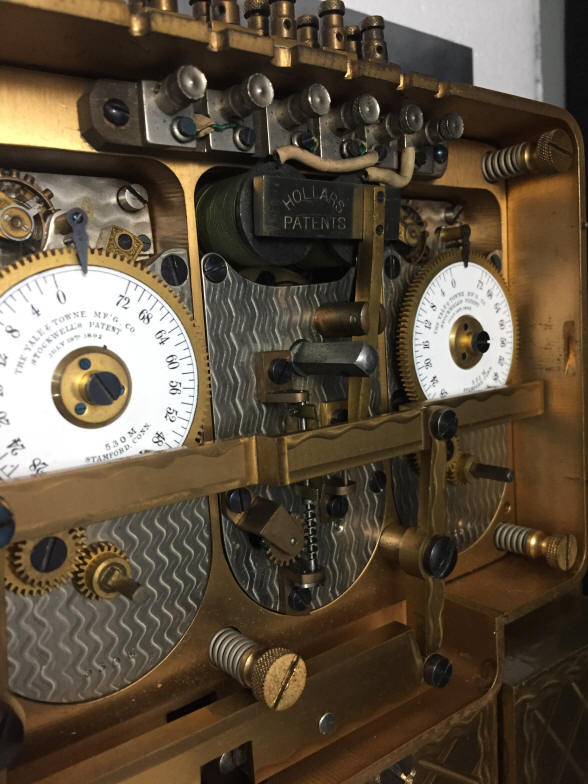
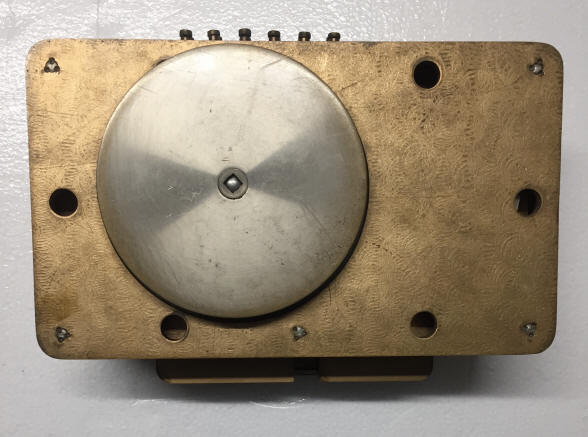
Hollar Lock Inspection and Guarantee Company, Philadelphia, PA, Model 1 The earliest Seth Thomas made M-movements were used in a time lock made by a company owned by Hollar, beginning in 1896, shown here. Based on the Yale Quad N design, the Hollar time lock included a patented device that could be electrically triggered to rewind the time lock without opening the door. This modification involved cutting a round hole in the case back for Hollar's large ( over 4 1/2 inches in diameter) power spring in a case and the replacement of the third movement with the electric switch that would be connected to the outside of the vault door through the connections on the case top. other specially made parts on the Hollar time lock included thee third though-glass eyelet for the oversized winding arbor, the angled snubber bar that could move clear of the electric winding motor, and the case itself, which was made by Yale and supplied only to Hollar with this polished bronze finish and machined scalloping.
The third movement space is reserved for the rewinding mechanism. A very large spring is located behind the movement. Located at the top, and under the Hollars Patents plate is a solenoid that when energized pulls that plate toward the solenoids behind it, that plate is connected to a pivoted lever which engages a fly fan (hidden behind the snubber bar, see patent drawings below) which is connected to the worm screw. When the solenoid is energized, the fly is released and the spring rewinds the time lock to the right, not all of the time locks. To prevent the other two time locks from continuing to run down, thus putting the lock off guard prematurely, there is also a locking mechanism to freeze those movements. One can immediately see several problems that may arise with this system. First, the reserve power to rewind the time lock movement, and thus extend the period that the lock is on guard is limited to the duration of the spring. Hollar tried to ameliorate this issue by supplying a huge spring, with an ability to rewind the the time lock several times. Next if there is a malfunction with the movement to the right of the rewind spring, and the other two are frozen you have a lockout. Of course this rewind option would only be used in the case of an emergency so one can see the acceptable risk. Third if the mechanism fails to lock out the two other time lock movements to the left, the delay function is defeated. Their Model 2 eliminated these issues by substituting the manually wound spring with a solenoid that wound all of the movements simultaneously, eliminating the need to lockout any of the movements or having any large spring limiting the duration of the emergency time extension. This time lock is devilishly complicated, refer to the patent drawings below, a bad thing for a time lock that should be designed to operate as simply and flawlessly as possible, but great for a collector!
The control mechanism for the activation of the emergency rewind mechanism. See patent drawings below for clarification.
The very large emergency rewind spring barrel is shown here at 4" in diameter. Next the electrical connections to release the rewind spring for one movement and stop mechanisms for the other two.
These photos show Yale's No. 1 Double Reserve Bolt Operating Device, dual bolt motor, their largest, most powerful, featuring a secondary reserve spring in case the primary spring should fail. In the 1890's, with the advent of enormous main vault doors to project the prestige and security of banks, the vaults equipped with automatic bolt motors to actuate the bolt works and release mechanisms became proportionally larger, heavier, and more difficult to actuate. The Yale & Towne Mfg. Co. had for some years relied on its Triple K and L models, but in 1893 the firm introduced a more elegant solution the Yale Quad N time lock. The quad N was a four-movement design for automatics, but unlike Sargent & Greenleaf's Model K (the other four movement for automatics at the time) the Quad N used an entirely new movement format, the M-sized modular movement. Originally made for Yale by E. Howard, the seventy-two hour M-movement was a large-format design, with a broad face and wider, taller plates that allowed for a longer, more powerful throw-the combined pull of four M-movements exceeded 70 pounds. Significantly over engineered with regard to its need for reliability, the M-movement was intended to be an impressive part of an impressive vault door. Due to the thin market for four-movement time locks in general, E. Howard had made only two hundred of the M-movements before its exit from the time lock movement business in 1902. After this, all Yale movements including the M were supplied by Seth Thomas, with M-movement serial numbers beginning at 500. Seth Thomas continued making the M-movement until about 1916 with the very last of these having a different dial design, including the Yale name in a circle at the top center. Almost all were seventy-two hour movements, but a handful of the last M-movements could run for ninety-six hours. The only known set of ninety-six hour movements in a time lock is in a Hollar Model 3. When the industry standard advanced to 120-hour movements after World War I, Yale offered to retro-fit seventy-two hour M-movements, a procedure that was still being done as late as 1970. Consequently, the 120 hour M-movements can be found with any serial number and commonly display a ring of wear around the winding arbor gear were the older, larger seventy-two hour arbor gear was replaced with the smaller 120-hour gear. The Model 1, however, could only rewind the time lock once through the use of a very large spring which had to be manually rewound and can only be accessed after the vault door is opened. The Model 2 solved this problem by substituting an electric motor for the spring, thus allowing an unlimited number of times the the lock movements could be rewound. The Model 3, moved the rewinding switch gear and motor to an area above the movements behind a plate, allowing the fourth movement to be reintroduced. This version was described in a Scientific American article, April 21, 1906, which explained the value of Hollar's device: "Should conditions arise, however, which would, in the opinions of the proper custodians of the vault, justify them in keeping the vault locked for any additional number of hours, beyond the time for which it was originally set, this can be accomplished without opening the vault doors, and without anyone having to access the locks. The value of this feature may be illustrated when the contingency of fire or or riot is considered, for in either case it would be undesirable to permit the action of the time lock mechanism to make possible the unlocking of the vault. Under these conditions, all that would be necessary would be to simply close a switch, when the time lock movements would be electrically rewound, thereby preventing the opening of the doors until the expiration of the added number of hours." Altogether fewer than one hundred Hollar rewindable time locks are thought to have been made, and two of each type are known to survive today. This example was was recovered following the demolition of an abandoned bank building in Indiana in 2002. The total production of Quad N time locks by Yale did not exceed four hundred, with five examples of the Quad N remaining today.¹
A demonstration of the Yale model Quad N time lock mounted to a Yale No. 1 automatic bolt motor. Both the Quad N and No. 1 bolt motor were Yale's largest and meant for the largest vault doors. The Quad N operated in an identical manner as the Holler as far as the operation of the bolt motor was concerned.
Here one can see the rewind mechanism complete with the fly mounted to the worm gear. This is acts as a governor to the large, powerful spring to which it is attached allowing the time lock movement to the right to be rewound in a controlled manner.
This drawing shows the stop bar that engages the two remaining time lock movements that are not rewound, preventing them from prematurely putting the lock off guard in case of an emergency requiring a rewind of the one movement to the left, as seen from the rear.
This drawing shows the solenoid release for the fly fan controlling the large spring for the rewinding of one of the time lock movements. Model 1. 1896. This small company used the earliest 'M' sized movements supplied by Seth Thomas about the time E. Howard exited the time lock business in 1902. Those movements serial numbers began at 500. This company's unique design incorporated an electrical device (the switch gear located where the third movement would have been placed as well as electrical contacts on the top of the case) that could, in case of an emergency, allow the time locks to be rewound without having to open the vault door. This could be useful in the case of a civil catastrophe such as riot or fire, an occurrence that Bankers of the 1890's would have been aware of, having seen recent unrest from such issues as race and labor organization as well as earlier concerns such as the Civil War draft. However, unlike the Model 2 this model did not contain a motor which could rewind the time lock movements over and over. The Model 1 uses a large spring which is actuated electrically but could only rewind the time lock once. It then had to be rewound from the front of the lock by hand. Various electrical sensors would relay information about the state of winding, when it is started and finished. Apparently this was not a feature that the market felt justified the extra cost. Less than 100 Hollar locks were made in three design formats of which only two of each format are known to survive. Given the many similarities in the case design and the fact that Hollar's movements were interchangeable with Yale's, and indeed the Model 1 was equipped with Yale insignia movements, and used Yale's Model Quad N case design, the locks were certainly supplied by Yale. There is an example of a M-movement made for Hollar that has a Hollar designation on the dial. Just as Hollar designed, but did not fabricate safes and vaults, it appears that this too was the case with its time lock. Later Yale would help out another new entrant into the time lock market, Mosler Safe Co. in 1916. The bolt motor was Yale's Model 1, their largest and most powerful. This time lock is the same example as illustrated in American Genius. Case #36, movements #504M, #530M and #532M. Time lock only, 9.5"w x 6.25"h x 4"d. Bolt motor #141 file 282 Most complex or otherwise esoteric time locks like the Hollar, Holms and Hall/Consolidated have either been modified or replaced as time went on and their reliability or serviceability became problematic. In the case of Hollar it was especially easy to convert the lock to a Yale Quad N by replacing the third winding mechanism with a regular third movement and the Hollar snubber bar with the Yale counterpart, so few unaltered examples of the Hollar survive.
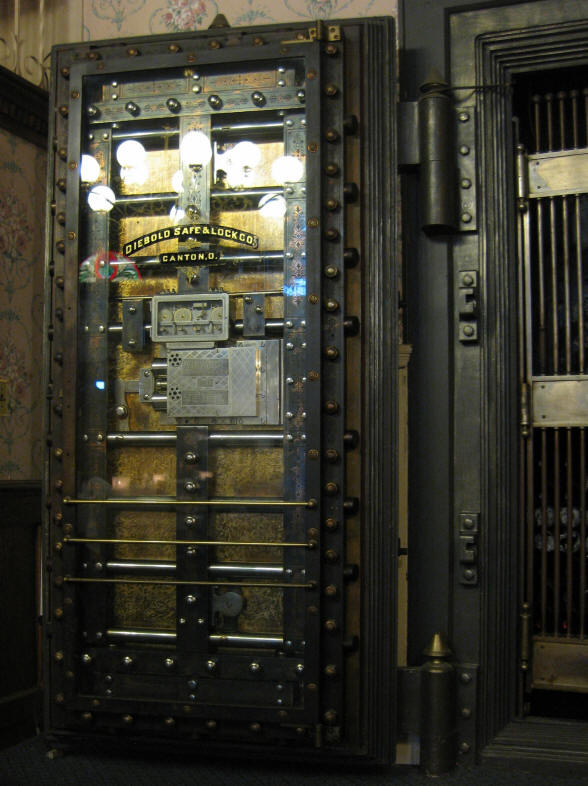
These photos show an installation in a Diebold Safe & Lock Co door with later updated time locks to 120 hours. The door is currently located in a restaurant.
This photo shows the Hollar model 1 in what appears to be a Yale case, note the four winding eyelets, the third one is located where a winding arbor should be if the movement were like the other three and the larger winding arbor currently located on the third movement lacks the larger eyelet as illustrated on the example illustrated at the top of this page. This lock now operates like a Yale Quad N but less one movement. Note the six electrical contacts are split into a pair of three to accommodate the safe door bolt work. Here too, the rewinding feature of the lock has been disabled as the wiring that connects the electrical contacts within the lock is missing from connecting to the wiring posts above the lock case. That wiring is run from the now empty post holes in the front through a set of holes drilled in the lock's door jam which can just be barely seen in the foreground of each post. The wiring leading from the lock to the exterior electrical source and controller is still connected to the rear of each post through the conduit running parallel to the top of the case. It would be interesting to know if that controller still exists. This change may have taken place when the original 72 hour movements were replaced with longer duration 120 hour movements. A Hollar movement mounting plate would be interchangeable with a Yale Quad N case. In most instances the case color was the same chrome plate as provided by Yale. The gold-tone case and bolt motor was a rare option. In most other installations, like this one within a Diebold door, Yale provided their standard case, silver finish and bolt motor. Photos: Ryan Krakowsky.
These photos show a Hollar Model 1 installed in a Detroit Safe Co. door. Note the possibly unique leopard spotting and the beautiful high-relief engraving of the door components similar to that used to decorate firearms. This is the only example this author has seen of the spotting design. What's interesting about all of these examples is the fact that Hollar makes sure by prominent signage that they are the designers of each of these vaults. Hollar, unlike other time lock makers was only involved in safe and vault design but did not actually fabricate them. Hall, Diebold and Mosler are other examples of time lock makers who were also not only designers but also builders of safe and vaults.
This photo is another Hollar design built by L.H. Miller Safe and Iron Works. It has a Hollar Quad N style time lock that has been retrofitted with four much later Swiss movements used by Yale and using the smaller size 'L' in place of the original, larger 'M' size movements. The automatic bolt motor has a beautiful bevel glass insert in place of the solid name plate. This is the only example this author has ever seen of this style, but an illustration of this type appears in a 1908 catalog. It is interesting that the owners were confident that the weaker, smaller movements have sufficient power to trip the bolt motor. The entire rationale for the Quad N was its having the larger, stronger M-movements to ensure the motor's release. At least this was the marketing rational from Yale. In reality it took a very small amount of force to trip even their largest bolt motor and the larger scale time lock and movements were presented to match that of the door. If one looks closely into the vault, it is no longer in use as many of the safe deposit boxes have been opened and removed. (1) American Genius, John & David Erroll, pp. 276-279.
|