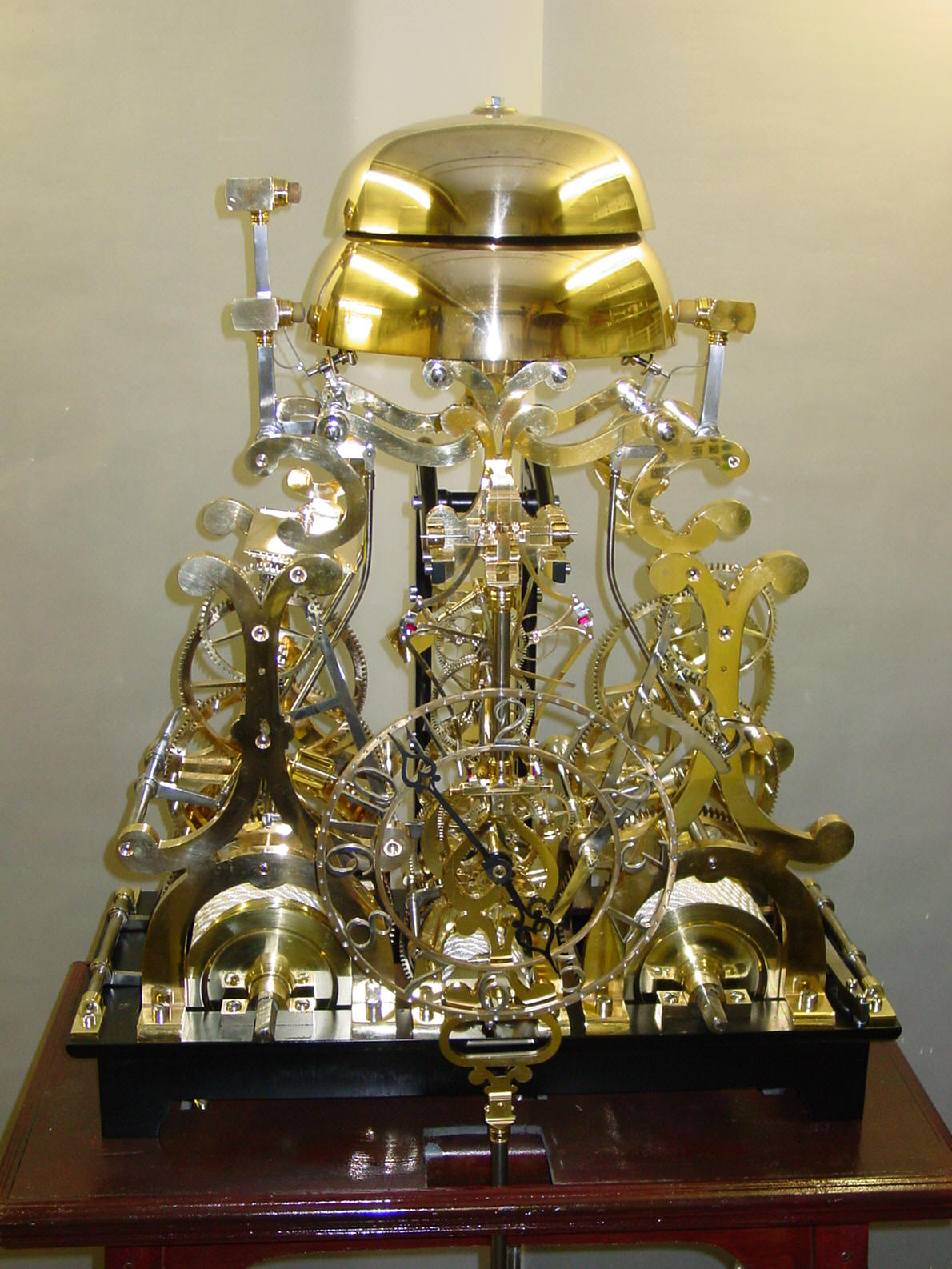
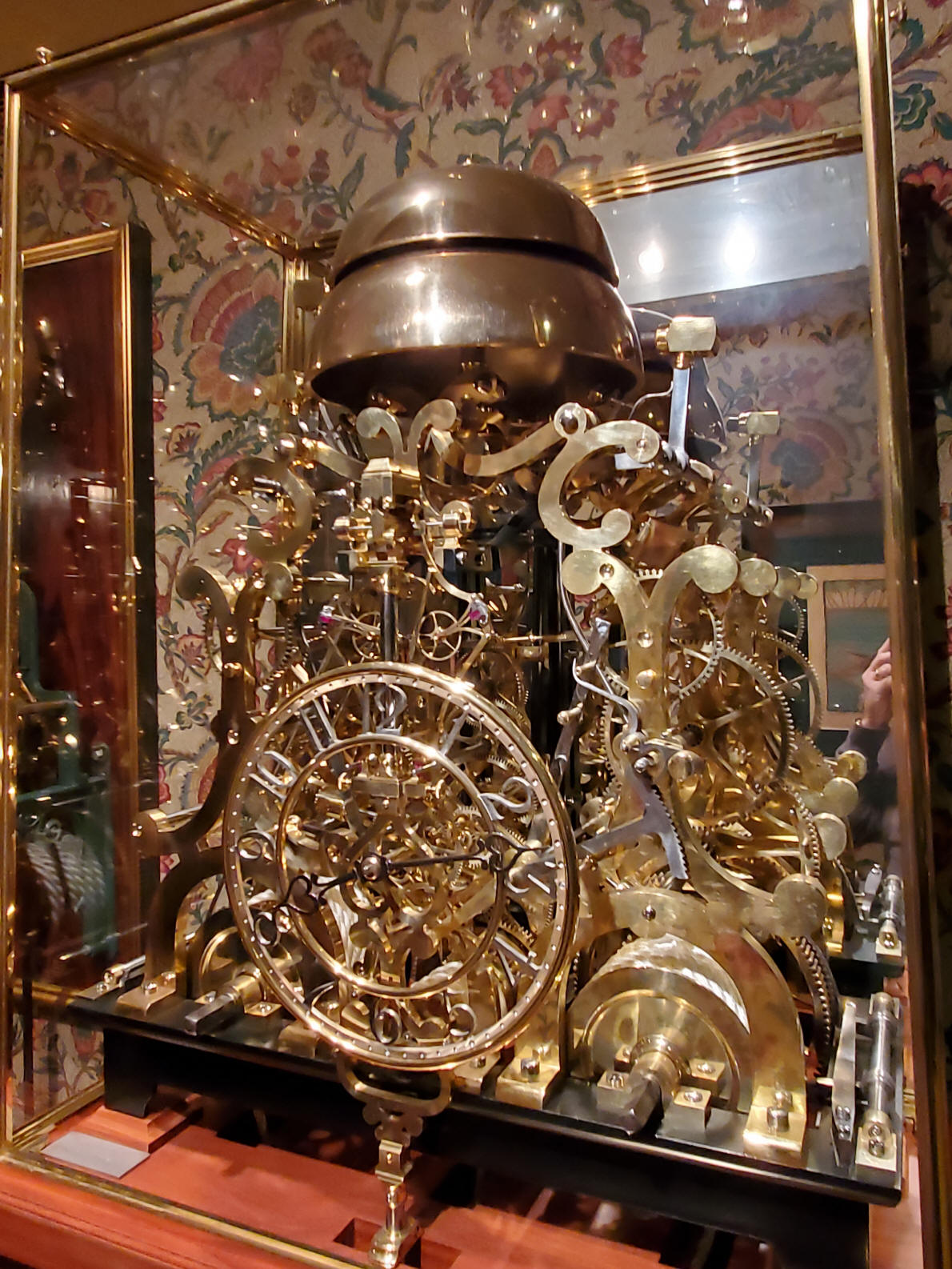
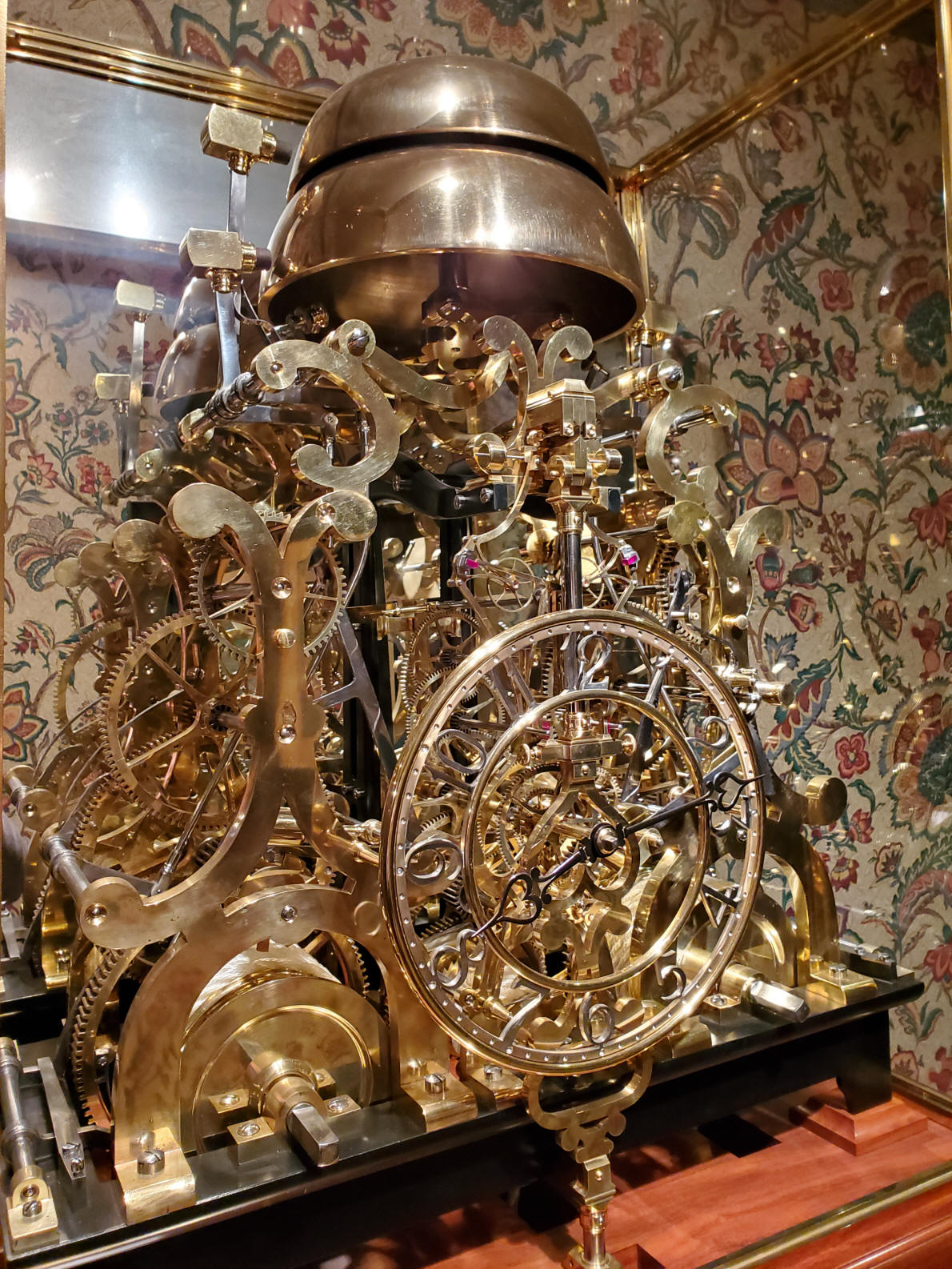
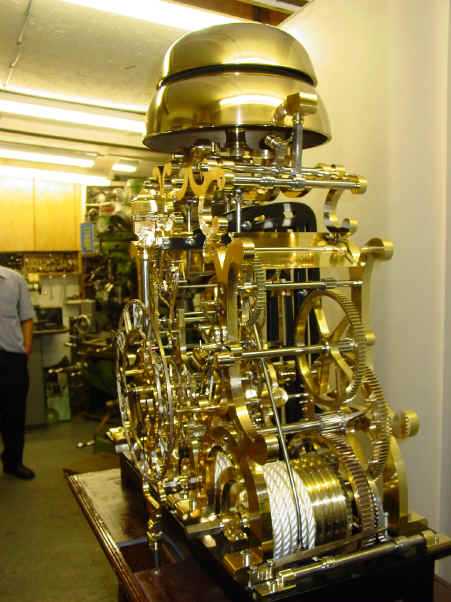
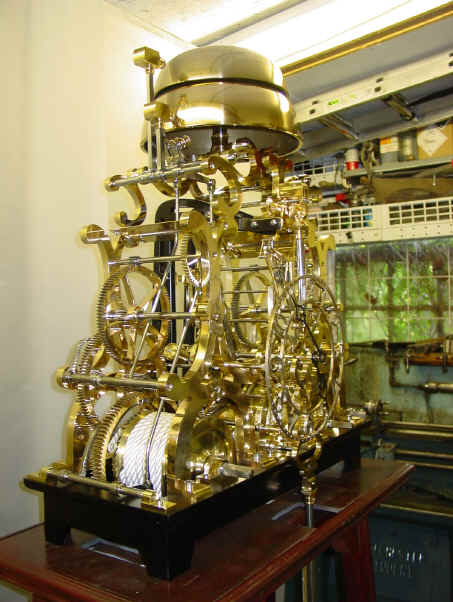
   Maker, Unknown, most likely American. c. second half 1800's. Brass and bronze hybrid flat bed frame design. Strike train frames one-half inch thick, going train three-eights inch thick. Hour strike using rack and snail system with quarter strike using a count wheel. Jeweled four legged gravity escapement using jeweled anti-friction wheel impulse rollers. Mercury compensated pendulum. Eight day duration (three day in current configuration). On custom Amboyna wood stand 27"w x 22"h x 11.25"d. Originally it was thought that this may have been a tower clock which had European origins, but a few years after this movement was found, an entire and complete example but with a Graham style deadbeat escapement which was undoubtedly built by the same maker was found complete with its original and very large wood tall case. This movement underwent extensive renovation as well as recreation of many missing and damaged subsystems by the firm of Buchanan of Chelmsford. See last photo below for a shot of the movement as originally found. Click here for a presentation on the entire restoration, more photos and videos.
A photo of the completed movement at the restorer's facility before delivery.
The restored clock delivered, in custom case, right three quarter view. Note the pendulum safety catcher incase of a suspension spring break. This is critical as the pendulum bob is composed of twin glass jars each holding 10 lbs. of mercury. This avoids a major environmental disaster in my home!
Left three quarter view, within custom case.
Views of the clock at the restoration facility.
Demonstration video.
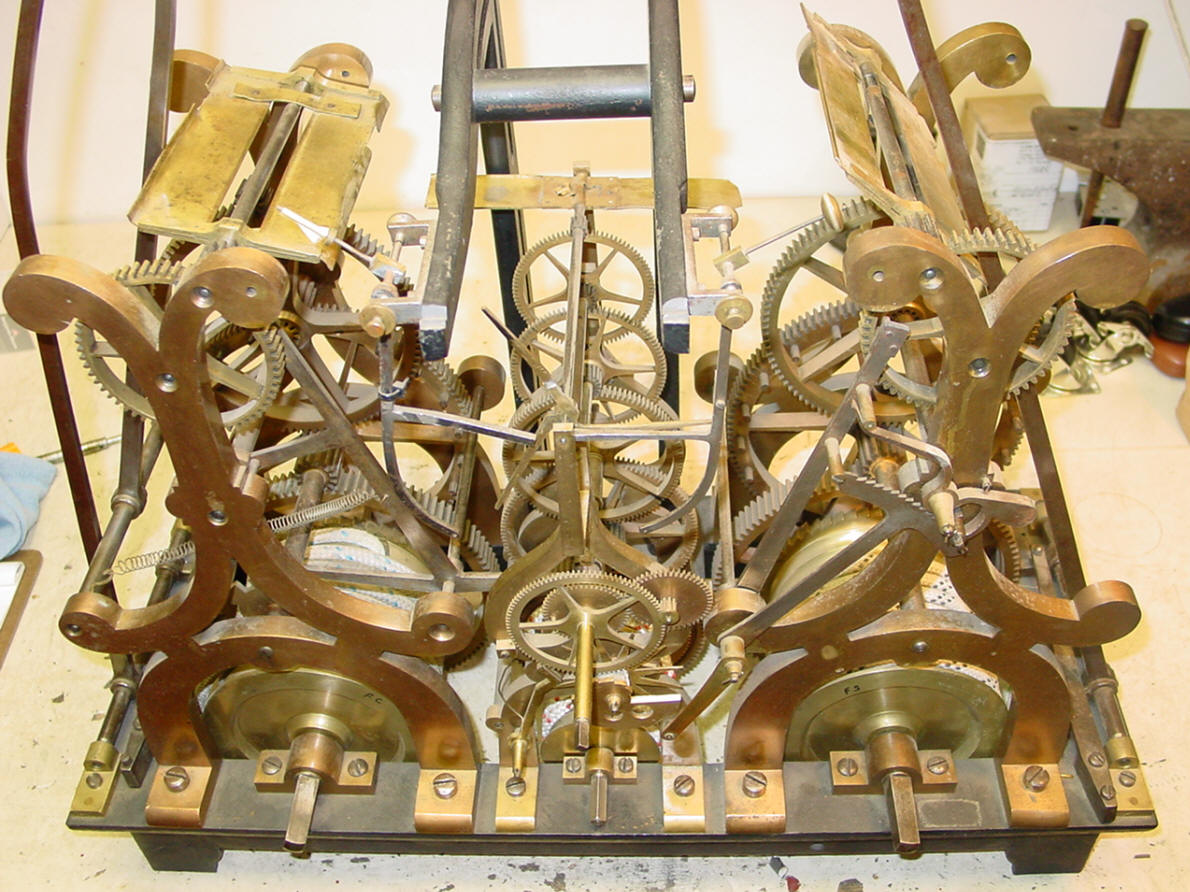
The movement as found. This most unusual movement was originally thought to be a small exhibition tower clock as was another example in the skeleton clock section (see Dent exhibition clock) or a very large domestic skeleton clock. Because of this ambiguity I have included this in both the skeleton and tower clock sections. But as noted above it was actually a movement mounted within a very large wood tall case. The hour and quarter strike frames are made of bronze and extraordinarily thick at 1/2" (12.5mm). Wheel work displays classical English design in that the hoops and spoke profiles are relatively thin compared to their width. The other outstanding feature is the very high tooth and pinion counts found throughout. The central going (time) train has six wheels with the following counts: Great wheel 96 teeth, Second wheel 120 teeth and 24 pinion leaves , Third wheel (center)112 teeth and 20 pinion leaves, Forth wheel 96 teeth and 16 pinion leaves, Fifth wheel 90 teeth and 16 pinion leaves, Escape wheel 3 teeth and 9 pinion leaves The strike trains each have five wheels (including fly). Close examination shows that this movement has either run for a very brief period, or more likely, never run at all. There are also ample signs of attempts at getting this movement to run by later 'repairers' - actually butchers. One half of the gravity escapement impulse system is missing and replaced with an amateur attempt at repair. One the three legs of the escapement has been broken and replaced with a crudely soft soldered piece. The pendulum is missing. Ad-hoc springs were used to make the rack system, which originally required none, to operate. Other tell tale signs of empty holes and repositioned components (very likely the strike flies) shows that this was a probably a unique design. If not for the beautiful frame design, and exquisite wheel/pinion work this movement might have been destined for the scrap heap. Instead I have commissioned a master clockmaker, Buchanan of Chelmsford, to make the necessary repairs, recreate the pendulum, weights and any other components necessary and do a general renovation to the entire movement. Since this clock has been subject to many changes over the years, and had no history of or provenance before the discovery of a second, but somewhat different movement I felt free to make more extensive repairs and changes than would otherwise be made. Even if I had known of the other example, this one was missing the entire case and recreation of that case would have made the presentation of this beautiful movement obscured as can be seen in the other example. Click here for a presentation on the entire restoration, more photos and videos.
|