


Maker, E.J Dent, London, England. Model - Special exhibition/presentation piece, c. 1850's. Six - legged gravity escapement variant based on Dr. James Clark's design; with 15 second Bernard-Henri Wagner train remontoire. One second compensated pendulum. Harrison style maintaining power. Solid cast brass plate -and -spacer type frame, 22'H x 17"w x 12"d. Thickness of main plates 7/16". Overall height 6' 6". Click here for a video and audio of this type of remontoire.
Click on the individual pictures to see an enhanced image as well as others.


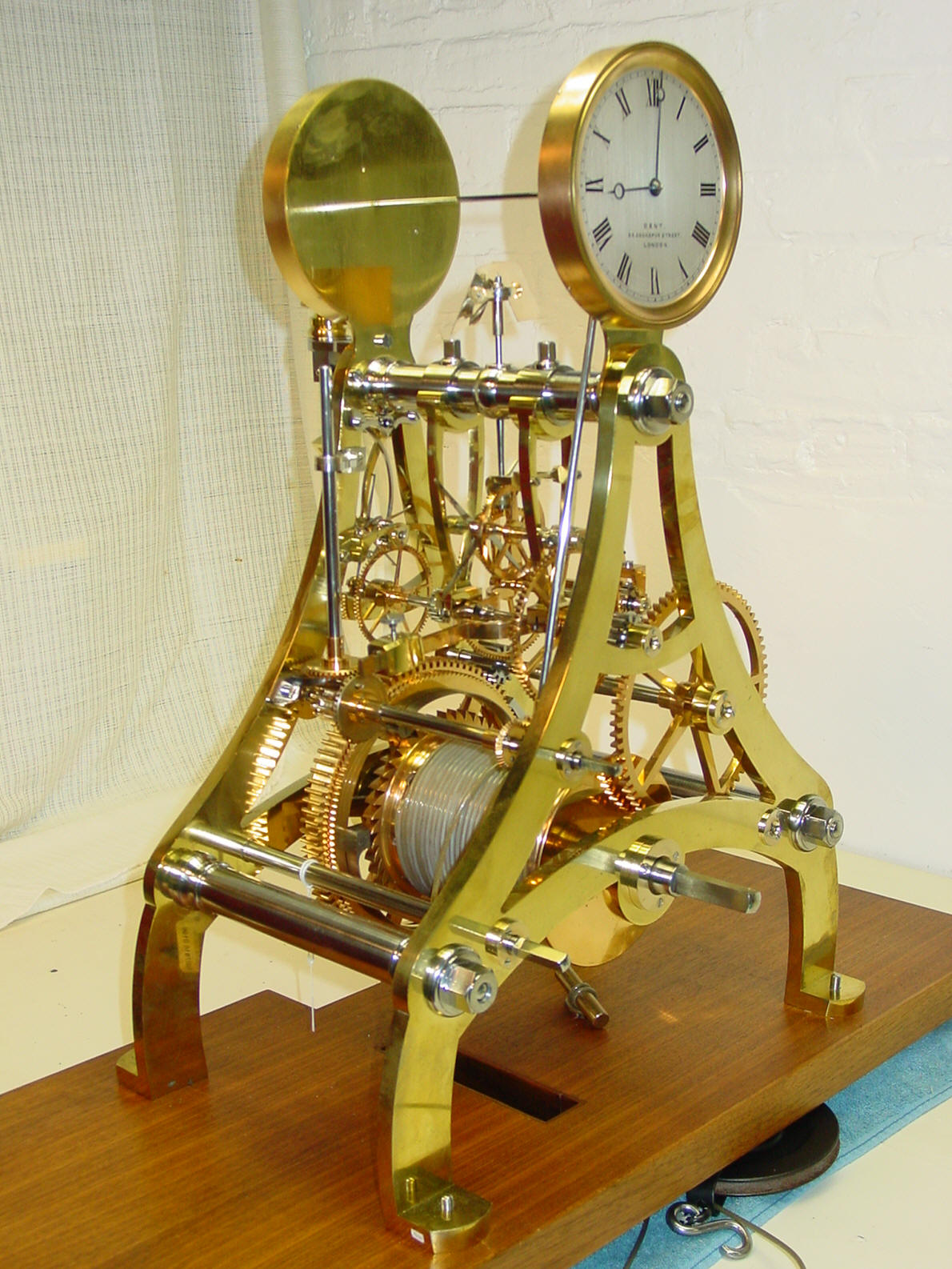

This Dent exhibition clock was made about 1867. It may have been made for the Paris exhibition of 1867, as there is a description in the catalog that may refer to this. Other references say it was a prototype made around 1852 by the Dent firm in cooperation with Edmund Dennison (later Lord Grimthorp), as a model for the escapement for the clock in Westminster Palace commonly known as Big Ben. Either way this movement displays the best example of Bernard-Henri Wagner's, c. 1850, gravity-driven remontoire that this author has ever seem. The Wagner remontoire is the most visually attractive amongst all the remontoire used in horology.
A film taken from 1959 of the Dent workshop featuring this clock at their Waterloo, Southwark facility. In the film a model of a tower clock of the mid 19th Century (this clock). Fly wheel and escapement. Workshop at Dents, Mr. Buckney, Mr.Williams walks across workshop. Man working on an automatically rewind tower clock with a double three legged gravity escapement. Mr. Buckney and Mr. Williams (Works Manager) looking at clock. Driving weight. Buckney and assistant - run into escapement. Escapement of a. Westminster quarter chime clock. Various shots of men and mechanism. Old Chelsea Clock made in 1761. Various shots of small domestic clocks, all hand made, men working on clocks. A pendulum of another clock.
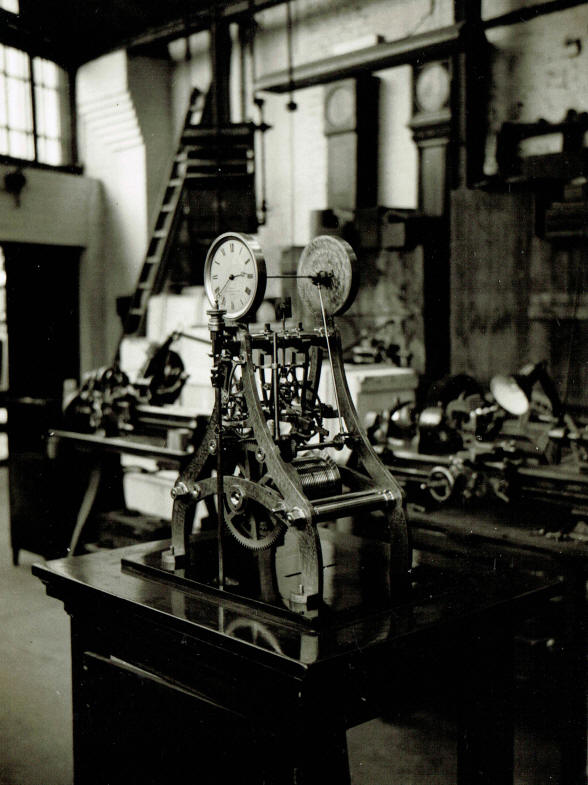
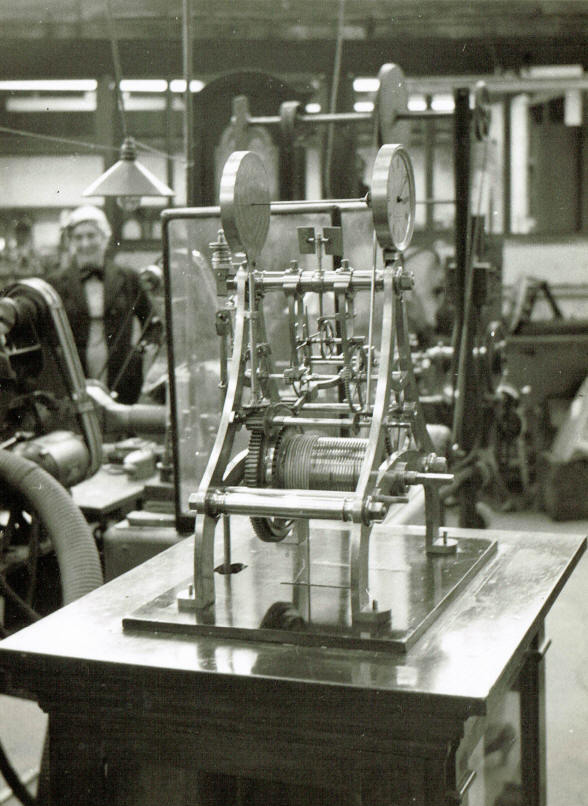
One can see that the clock originally had a damascened finish. I have heard that the first US owner, Mr. R.S. Stevens had this buffed out. On the second photo one can see what is probably the glass case for the top of the stand to contain the clock. If this is so it must have had an enormous amount of weight given the heavy framing and case size.
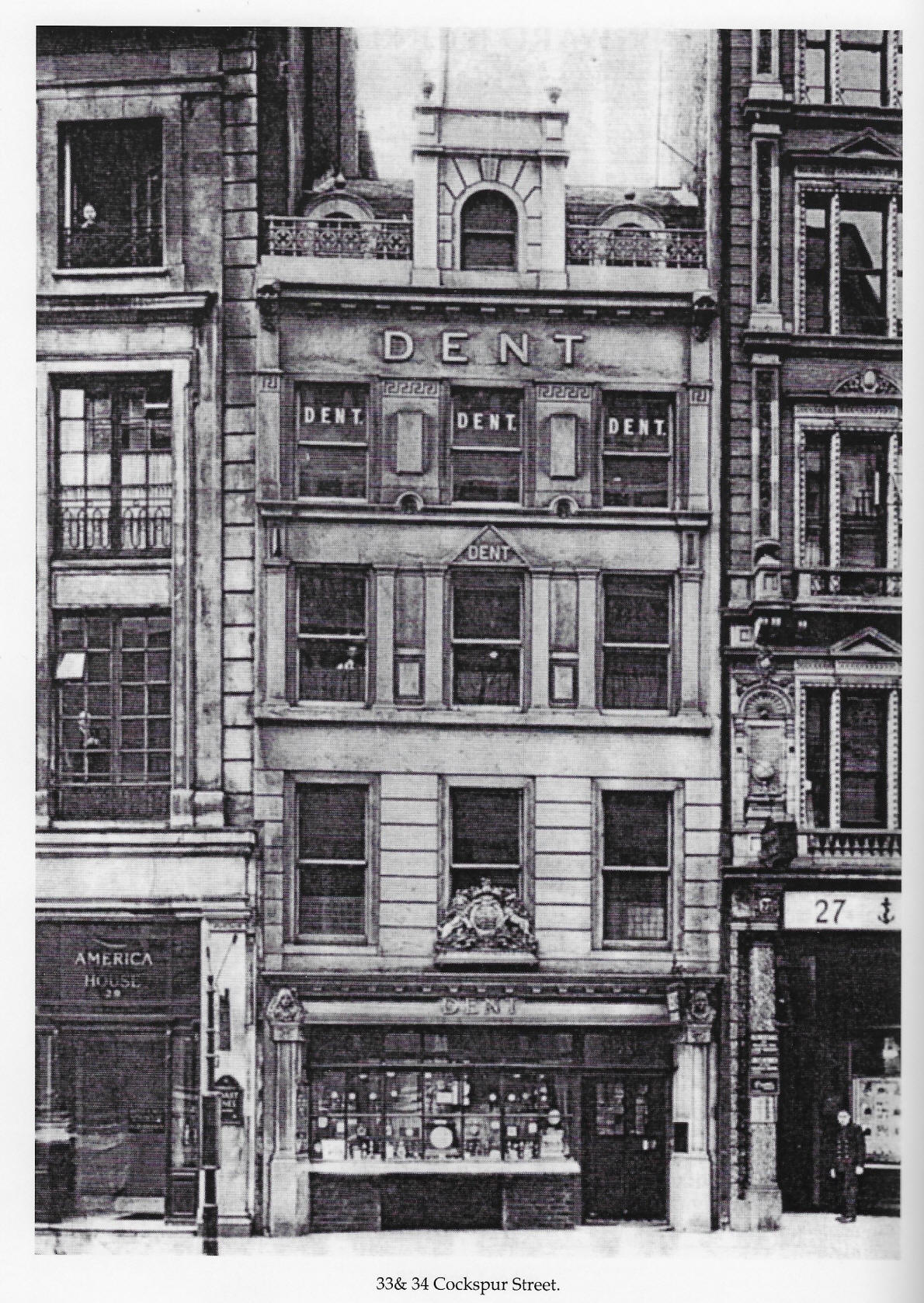
The Dent firm was located at 33 & 34 Cockspur Street, Charing Cross, London between 1862-1904. 33 Cockspur appears on the clock dial, no serial number has been found.
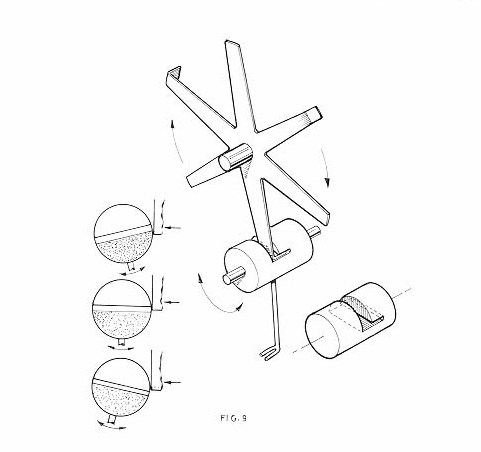
The first illustration shows the slotted cylinder used in the locking of the escapement, and it is controlled by the crutch below attached to the pendulum. In reality, in is hard to see how this gravity escapement variant holds any improvement from the conventional Dennison double three-legged escapement. The crutch which controls the locking cylinder is in constant contact with the pendulum, thus defeating one of the desirable aspects of a gravity escapement which is to reduce as much as possible any interference from the clock movement with the pendulum.
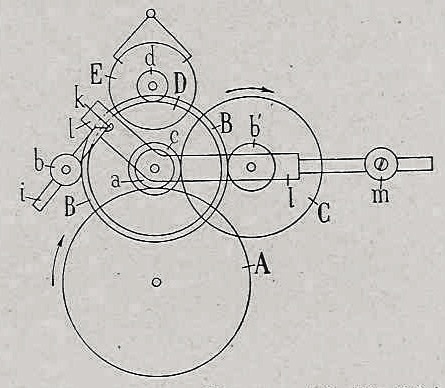
The second illustration is a drawing of the Bernard-Henri rocking frame gravity remontoire developed around 1850.


Click here to view an animation of the Wagner rocking frame remontoire, it requires Adobe Shockwave player. There are three animations, click on "GOING" to see this one. The second picture is of Bernard-Henri Wagner.
|
One line of thought is that this was made by Dent as his submission to the British government for the escapement and remontoire design for the great clock at Westminster; commonly known as Big Ben. According to The Country Life International Dictionary of Clocks, page 252 by Alan Smith this clock was the original model of Lord Grimthorp's gravity escapement made by the hand of Edward Dent for submission to the British government for Big Ben. He goes on to say that this design was the one preferred by Dent for that tower clock. It was certainly made as a special exhibition or presentation piece. Exhibition pieces were made to highlight the creators' horological skills and/or demonstrate a new innovation. This clock fits both criterion and was on display in Dent's main office's area for many years and is probably the only one of it's kind made by the firm. The gravity escapement used in this clock is certainly not the first iteration developed by Grimthorp, but may have been the one settled on before the final iteration of the double three legged type ultimately fitted to Big Ben. Another possibility is this clock was made a few years later, quite likely for the Paris Exhibition of 1867. The only other example I have seen of a clock equipped with this type of gravity escapement is one clock by Dr. James Clark, c. 1869. It is a six legged, single impulse arm style. This escapement also has a slotted cylinder acting as the detent and has only one gravity impulse arm. An example of this escapement is discussed in the Summer 1979 issue of the Antiquarian Horology, pp. 394-400. It is also illustrated on page 546 and discussed on page 536 in Edward John Dent, Vaudry Mercer. The illustration shows two impulse arms vs. the single arm used on this clock, but the remainder of the illustration is a near perfect match, right down to the anti-friction wheels for the crutch pin. The clock discussed in the book, however, is described as an "observatory clock or regulator of unusual design" with a "compensated mercurial pendulum". One could imagine the pendulum bob being switched, but it's hard to imagine this clock being called an observatory clock. It is a tower clock in every respect of it's design, right down to the presence of a lead off arbor to drive external dials. Also the subtle difference between this and the escapement described in Mercers' book along with no mention of the very prominent remontoire, makes me think that this clock is not that described. There are no signs of alteration in the escapement so the entire assembly would have to had been replaced wholesale. It is an open question as to whether this design predates or is after the two impulse arm design but my guess is that it predates. The remontoire is based on the design of the French clock maker Benard-Henri Wagner and has a 15 second period. The original design specifications for Big Ben called for a deadbeat escapement and remontoire. That clock was built and tested in Dent's factory for a number of years since the Westminster tower was not yet completed when the clock was finished. During that time one of Dent's associates, Edward Beckett Dennison (later Lord Grimthorp) developed the double three legged gravity escapement. This was incorporated into Big Ben. The escapement was so successful that the remontoire was judged to be unnecessary and was removed. (For an example of this escapement see William Potts, in the tower clock section). For more information on the purpose and function of remontoire see Wagner, Paris, in the tower clock section. A very similar 30 second design is used in the tower clock made by Wagner, Paris in the tower clock section. Few clocks were made with both a gravity escapement and remontoire combined as they were thought to be redundant. This is technically a tower clock by design, but may reasonably be interpreted as a large skeleton clock. Thus it is also included in this site under the skeleton clock section. All parts of this movement are highly finished and have been made to the best horological standards available at the time. The design is geared toward a maximum level of visual action through the mechanical movement of the remontoire and gravity escapement. Its large scale wheel train better shows the mechanical interactions that otherwise would be diminished on a smaller scale movement. Watching the mechanism going through its dance is truly a sublime experience. I have never seen a better example in both quality and pure visual 'eye candy' of a clock movement with remontoire. Provenance: Sotheby's, New York, June 19, 2002; Lot #196. Formerly from The Time Museum, Rockford, IL, Inventory No. 3240. Formerly from the collection of R.S Stevens, Lake Forest, IL. Referenced in The Country Life International Dictionary of Clocks, pp. 253. Formerly from the showroom in the main office of Dent.
|