|
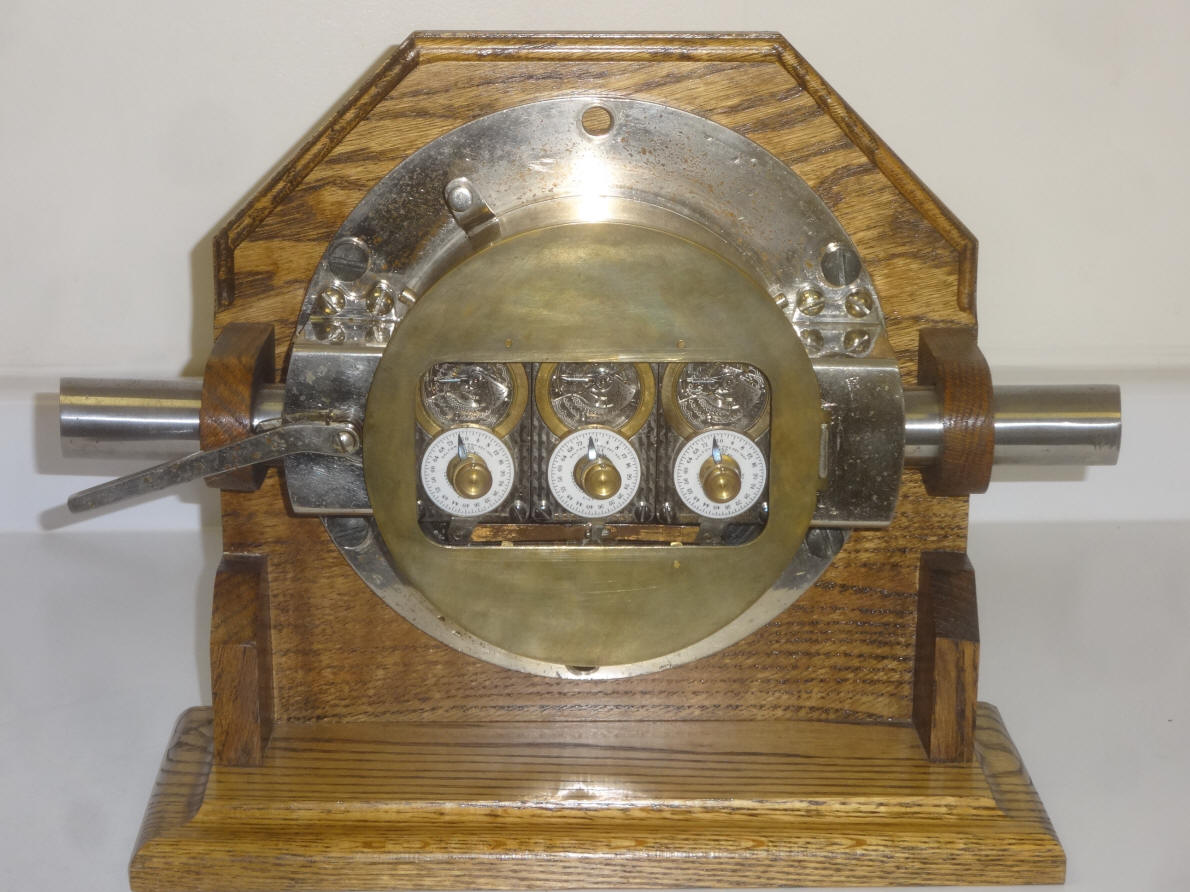
Consolidated Time Lock Co., Cincinnati, Ohio - 3 movements, Harry Dalton Automatic for Ely Norris, v.2
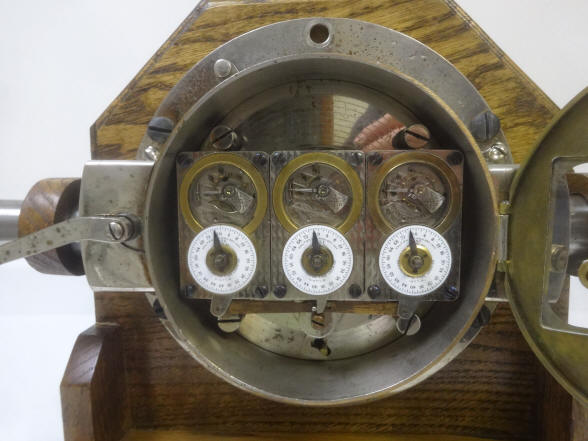
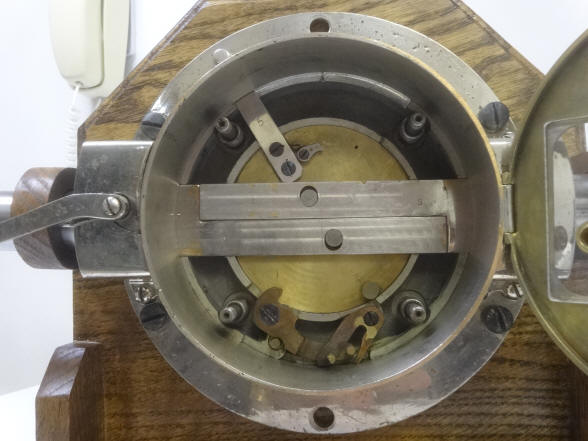
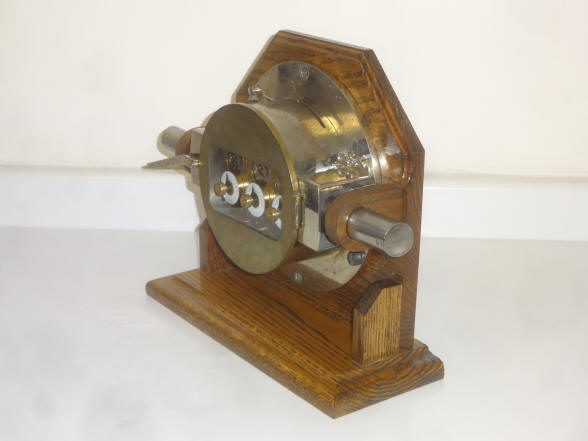
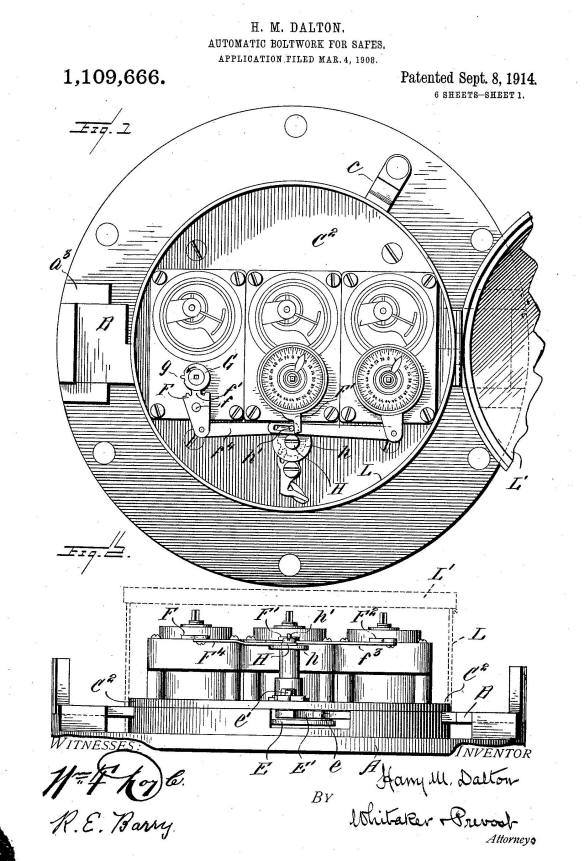
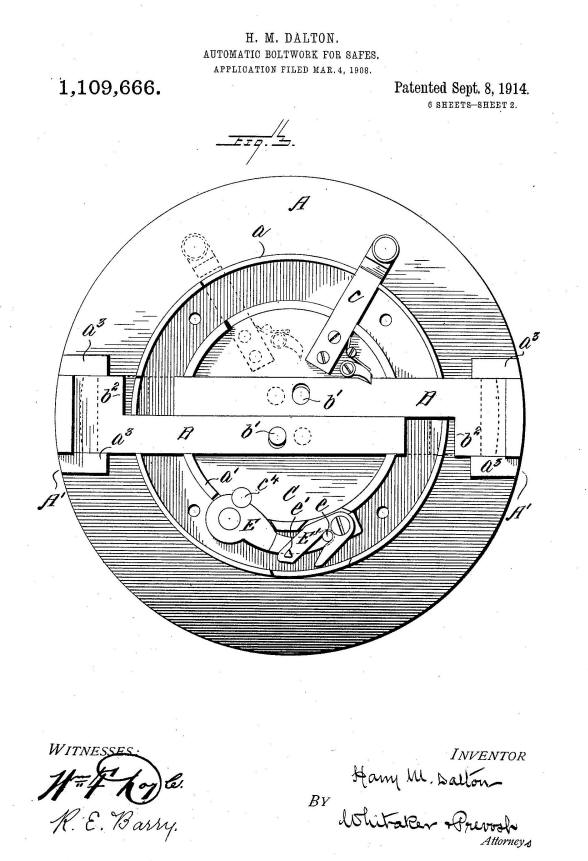
In the early 1900's, the Ely Norris Safe Co., operating in Perth Amboy, New Jersey, introduced a new solid-door model of cannonball safe. The company then looked to the Consolidated Time Lock Co. for a time lock to fit the round safe door. As the Ely Norris design was intended as a commercial money chest, it would be open during all business hours, a common feature of the time. Consolidated produced a time lock design that featured a round case with an internal automatic bolt motor controlled by three movements that were based on a new patent awarded to Harry Dalton, an employee of Consolidated in 1904. These movements had a seventy-eight hour reserve that at first were made by the Elgin Watch Co. with white enamel dials. At some unidentified point, Consolidated's movement construction shifted from Elgin to the South Bend Watch Co., identifiable by the black enamel dials. The movements were wound through eyelets in the glass. This example from 1905 retains the complete working boltwork, including the triggering lever, running along the left door bolt. With the the time locks and automatic bolt motor wound, the safe door would be closed and rotated into place, depressing the the lever and shooting the the bolts outward. ¹At some point during 1906, ² the Consolidated Time Lock Co. stopped production, bringing to a close the last of Joseph Hall's legacy of independent lock production. While historically interesting, this also had commercial consequences. One of these was to force Ely Norris Safe Co. to go elsewhere for time locks for its cannonball-style safe now that Consolidated's Dalton-designed round time lock was no longer available. Ely Norris went to Yale, which began production of its T-Movement automatic time lock in 1907 or 1908.
The first video is a demonstration of the Consolidated time lock under a patent issued to the firm's employee Harry Dalton in 1904, the time lock dates from 1905. Here the automatic bolt motor is actuated. Automatic bolt motors were basically large springs that would move the bolts which secured the door after the safe door was closed and then retract the bolts when the time lock winds down to the pre-arranged opening time. This eliminates the need for an exterior opening through the door for a spindle to actuate the bolts and can also eliminate the need for a combination lock if the owner knows he will always be present when the time locks allow the bolts to retract. The obvious advantage to this is a solid door with no openings for a safe cracker to access. The disadvantage is the additional cost, complexity and possibility of something going wrong with the system. The second video shows the same demonstration with the time locks removed to better show the bolt motor system. Harry Dalton Automatic, v.2, 1905. The first version, c. 1904, substituted a key actuated square arbor to wind the bolt motor for the sliding lever as well as replacing the fixed front bezel with a hinged door in the second version. Today three examples of the Dalton Automatic with the complete internal bolt motor and time lock are known to remain. 6 3/4" dia. x 3 1/4" d., 9 1/4"dia. with mounting flange. Case #5, movement #92, #94, #230. file 185 |





(1) American Genius Nineteenth Century Bank Locks and Time Locks, David Erroll & John Erroll, pg. 304-305
(2) This author has some question as to exactly when the Consolidated Time lock Company went out of business. A case can be made with the Harry Dalton v.2 Automatic for Ely Norris for a later date to at least 1914. That lock is described in a patent #1,109,666 dated September 8, 1914 and is the same lock as illustrated in American Genius Nineteenth Century Bank Locks and Time Locks, David Erroll & John Erroll, pg. 304-305. Furthermore another lock with different style Harry Dalton movements appear in a time lock with a Hall's Safe Co. logo that is illustrated in a patent #1,632,429 dated June 14, 1927.