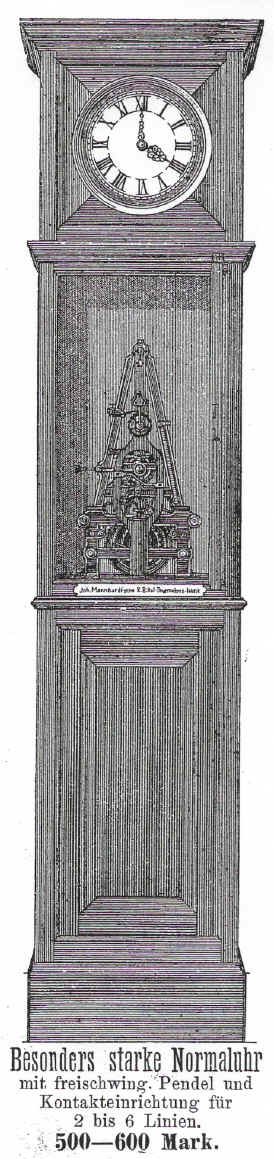
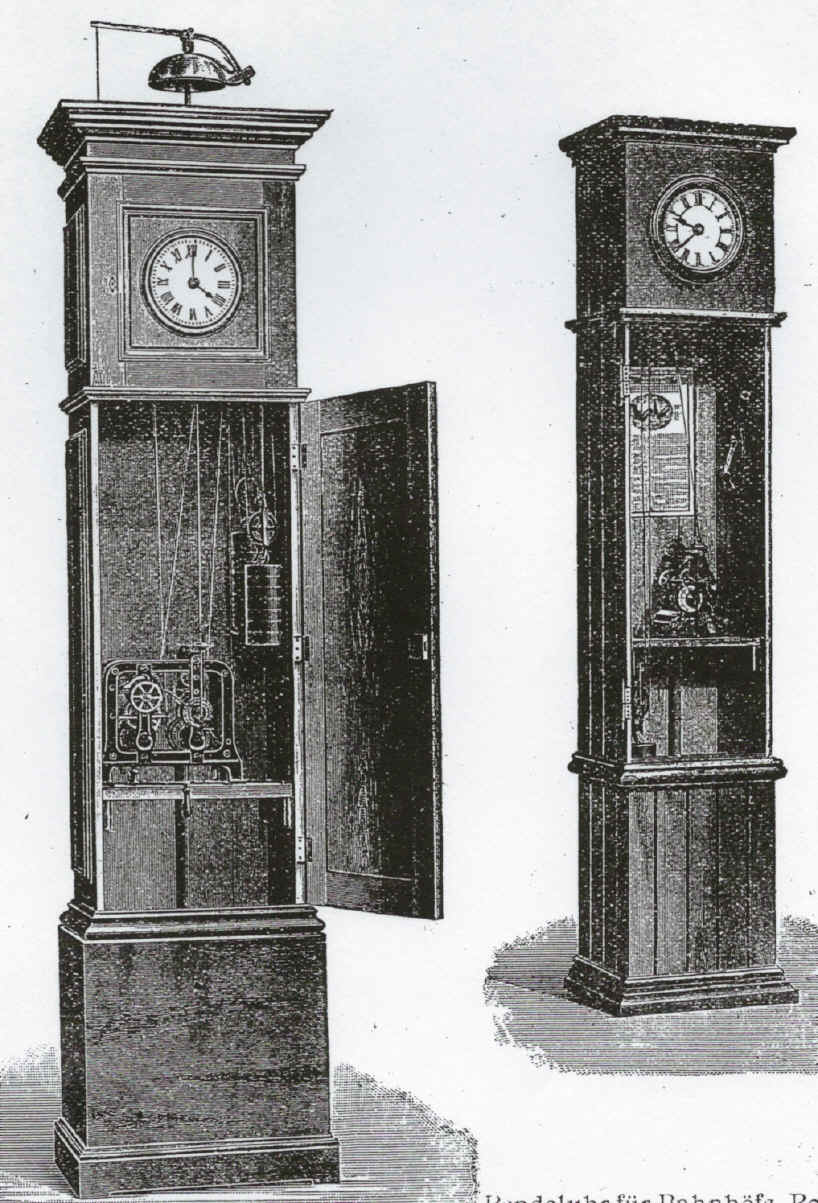
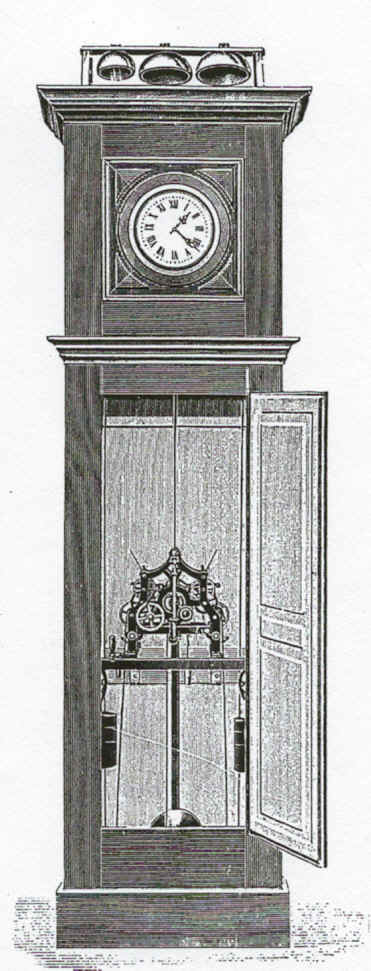
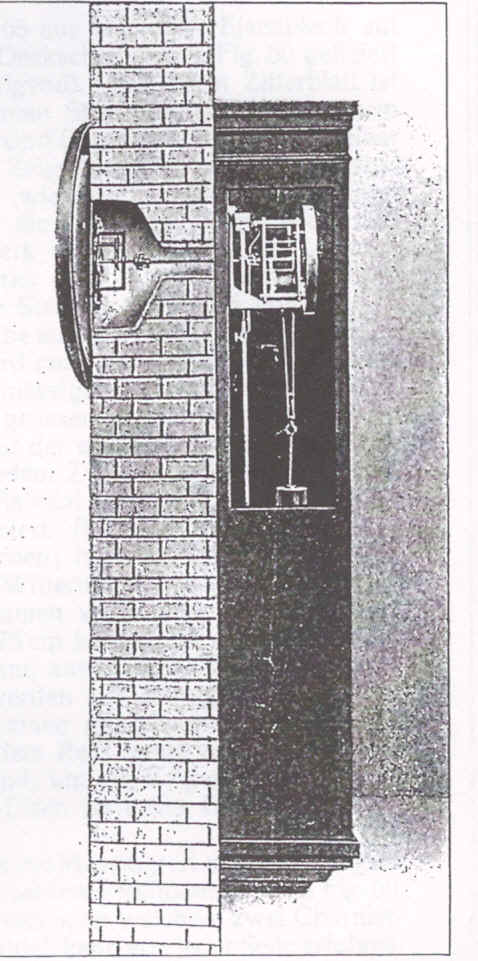
   Maker, Unknown. Case made in Germany, c. 1880. Miniature tower clock probably French, same vintage. Three train, eight day duration in Walnut a burl wood case. Steel strap framed design, Count wheel quarter striking. Graham type dead beat escapement, one second wooden rod pendulum. Case = 91"h x 21"w x 9 1/2"d, movement = 13 1/2"w x 9"h x 5"d. Below are scans from old catalogs of tower clock makers featuring their domestic versions. In many instances these were still meant to drive one external dial either from the rear of the case; through the wall or via a linkage above and then through the wall, see last example. The fairly plain, functional cases, especially those with solid trunk doors, indicate that these examples were probably meant to do this or to serve as master clocks in a commercial environment as in the first example by Mannhardt (see German description). This was a very special movement as it employed a 'free swinger' pendulum system. The fact that these were depicted in a particular catalog, does not mean that the model was in regular production or even ever actually sold. They must have been rarely ordered as I have seen only only one of these type; from Ungerer and Beyer. The example on my website as well as the Wagner from France has a much more refined case that was clearly meant for a retail, domestic environment and has no provision to drive an external dial. Notice the next two pictures carefully. The middle clock is from a Mannhardt catalog while the next one is from J. Neher & Sohne. Other than minor differences in the case style, the two movements within are the same. This copying of each other's movement designs was rampant amongst the tower clock makers of France and to a lesser extent Germany and England. The movements of the tower makers Odobey, Probst Freres and Cretin, all from the Jura region of France are pretty much indistinguishable. In all examples, the movements shown were all miniature versions of those used in full-sized tower clock installations.
These examples are from the firm of J.F. Weuele, Bockenem, Germany. The first illustration shows a clock case that is 91 cm w x 47cm d x 275cm h or 36"w x 18"d x 108"h. Given these proportions it would seem that the tower clock in this case is not a miniature at all, but a regular two train version. Even the weights are the disk-stack used in a normal tower clock setting.
The photos below are from the firm of Ungerer, Strassburg, Germany. The second photo shows an installation where what looks like a conventional wall clock is used to drive an external dial.
|