Sargent & Greenleaf, Rochester, New York - 4 movements, Model M and special order Model M, aka Model R
S&G introduced the Model M in 1901 as a counterpoint to Yale's Quad M; both models using the same letter designation was probably not accidental since the automatic bolt release model for S&G was the Model N and Yale's was the Quad N. S&G followed on a few years later with what was to be their largest and most expensive time lock the Model M, Special which, when equipped with the larger 96 hour duration size 'R' movements, retailed in 1929 for $533.34, the equivalent of $7,684.00 today! The M-movement was larger than its L-sized predecessor, with a small indicator arrow at the upper left, a full front plate extending to the case top, and a small skeletonization behind the dial to monitor the balance wheel. More substantive differences between the l and M-movements are less obvious, with the M-movement's construction more robust throughout, using heavier-duty escapements, stronger pivots, and an overall construction clearly proportional to its tougher intended use. Overall, the Model M was only three quarters of an inch larger in height and width than the Model O, but this modest increase in size allowed for simpler, hence smaller, boltwork on the door. (1)
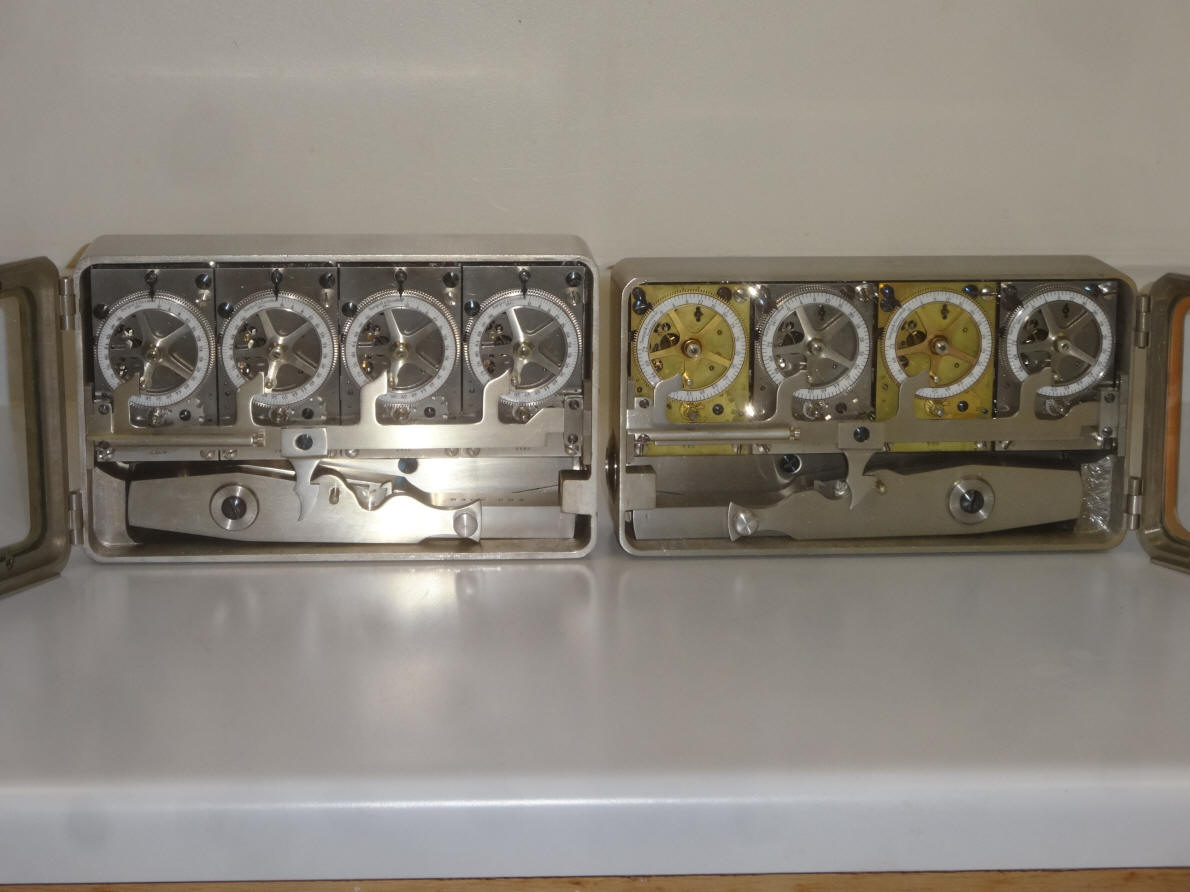
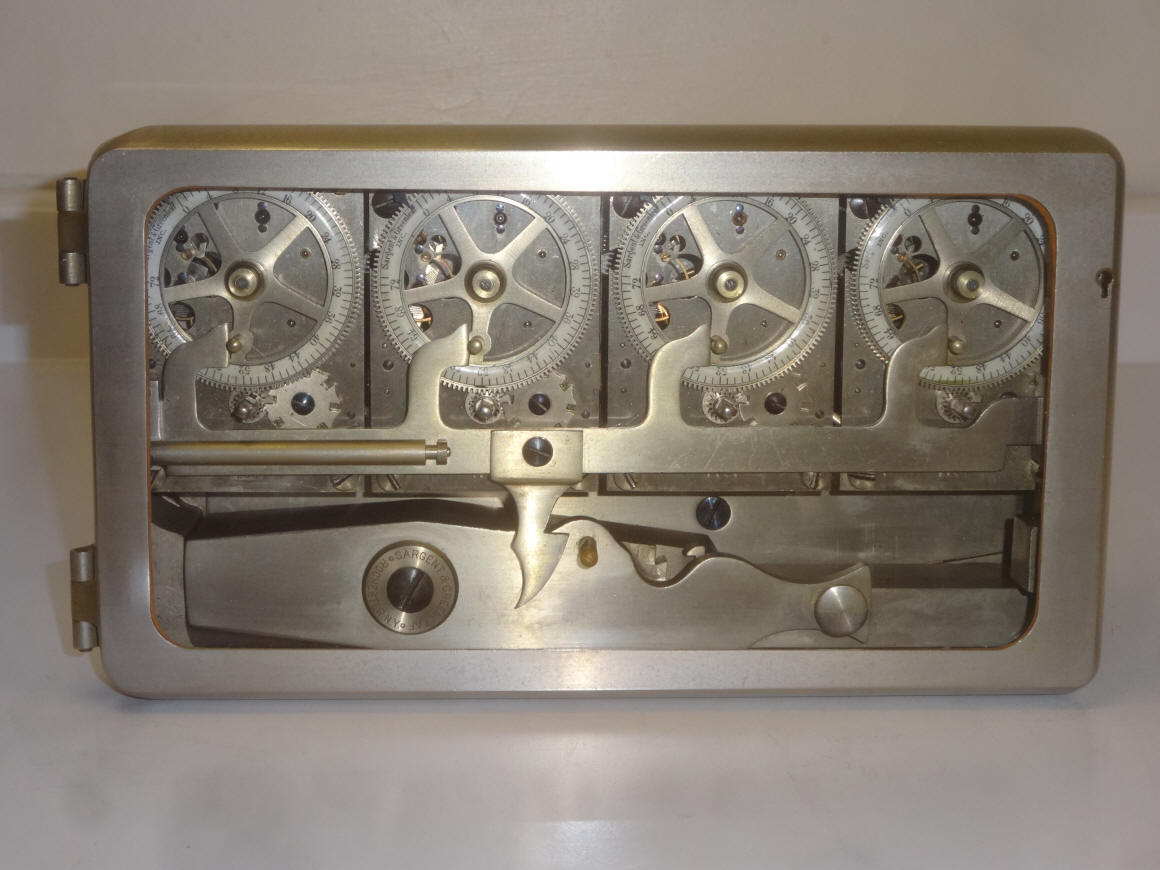
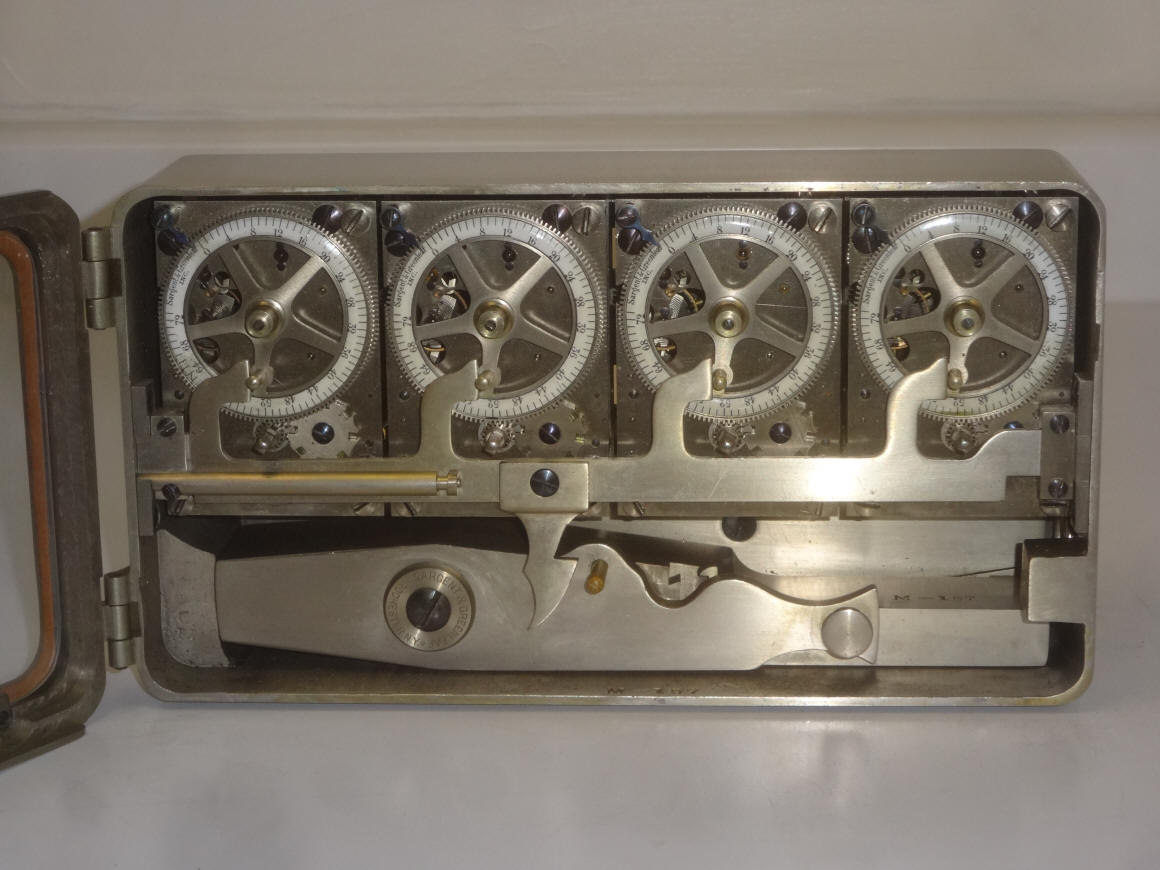
A. Model M, (later model #6406). c. 1902. This lock is equipped with the standard drop bolt dog located beneath the movements to operate directly on the vault door's bolt work and is equipped with S&G's largest standard 'M' sized movements. This is a very large time lock and was S&G's largest using their standard 72 hour duration movements. 5 1/2"h x 9 7/8"w x 3 1/8"d. Case #M-157, movements #2041, #2045, #2046, #2047. file 245
Comparison between the standard S&G Model M with 72 hour movements and the special order model M with 96 hour movements. Both cases were the same length, so the drop bolt and snubber bars were identical.
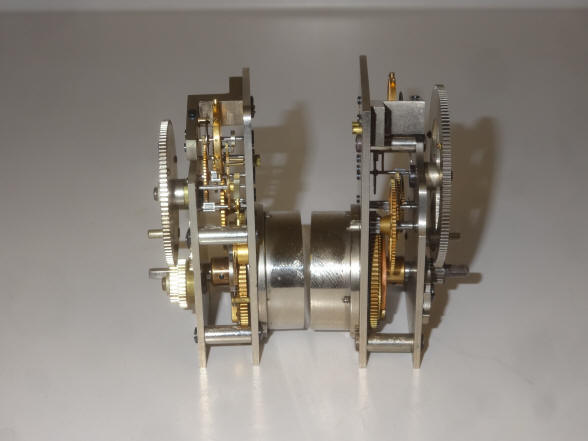
The M-sized movement, left compared with the R-movement, right.
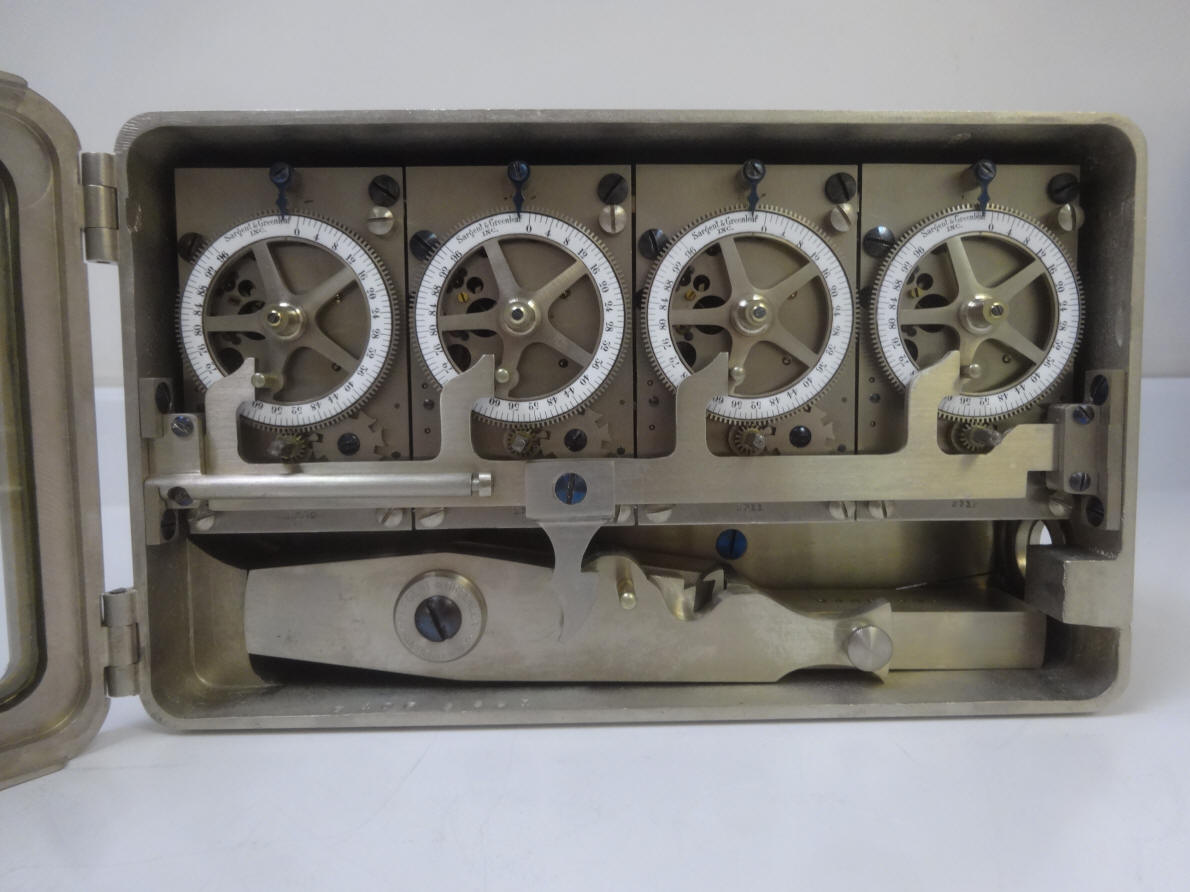
The components of both the 72, (left) and 96 hour, (right) movements are identical. I have examined all of the individual wheels as well as the spring barrel diameters and they are all the same. The planting of the wheel works in the 96 hour movement are spread out a bit more in the vertical direction to take advantage of the taller movement plate. The spring barrel sizes are identical. The video clip shows a demonstration of the S&G time lock. The drop bolt mechanism was the heart of S&G's design. This was first introduced in 1874 as a round roller bolt, later changed to the 'cello bolt' so called because of its resemblance to the musical instrument and finally the drop bolt as exemplified in this video. However all of these designs worked upon the same simple principal of the drop bolt being released under the influence of gravity. While the first design, the roller bolt was set in a different way, all of these designs worked upon the same simple principal of the bolt being released through the force of gravity. The bolt would be manually set by the operator and would be disengaged through gravity. Many other designs, including the other largest time lock maker, Yale, used springs or the force generated by the time lock movements themselves to move the mechanism that served to block the vault door bolt work. While remote, the possibility of jamming could defeat the time lock. The engineering behind S&G's design was elegant - simple, robust and fool-proof. Qualities that were essential in a bank vault time lock where failure would result in the catastrophic expense of forcing open the door. This example was the largest time lock produced by S&G featuring their long duration timers of 96 hours verses their standard 72 hour models. This time lock would have been installed on the very largest of bank vaults, doors weighing in at 20 to 30 tons or more. The 6406 was S&G's most expensive lock with the standard 72 hour model in 1929 priced at $433.34 and the 96 hour model at $533.34, the equivalent of $7,684.00 today! B. Model M, special order, c. 1909. Lock is equipped with longer duration 96 hour movements. This was the largest time lock made by S&G and had the largest movements, the size 'R'. The time lock case itself has the same width and depth as the Model M with standard 72 hour duration movements, but like the time lock movements, the height of the case is slightly higher. The higher profile of the size 'R' movement plate allowed S&G to move the dial pointer from where it was tucked away on the left hand corner to the center front above the dial. In this author's opinion the difference in the time lock movements size as well as the time lock itself was purely a marketing exercise. The components of both the 72 an 96 hour movements are identical. I have examined all of the individual wheels as well as the spring barrel diameters and they are all the same. The planting of the wheel works in the 96 hour movement are spread out a bit more in the vertical direction to take advantage of the taller movement plate. I have not been able to measure the length and power characteristics of the springs in both types of movements, but I would suspect that here is where there are any differences. It is likely that the 'R' movement has a longer and stronger spring contained within the same sized spring barrel as the 'M' time lock movement. The 'R' sized movements came in both the standard 72 hour and 96 hour durations, and perhaps 120 hour durations, although this author has not seen an example of the latter. S&G added longer duration locks extending from their standard 72 to 96 and then 120 hours on their smaller movements the 'L' and 'H' series, but this did not involve any changes to the size of the time lock movement. I have not seen this 120 hour duration on any of their other larger movements: 'M' or 'R'. 6"h x 9 7/8"w x 3 1/8"d. Case #6406 - 391, movements consecutively numbered, #2209, #2210, #2211, #2212. file 214
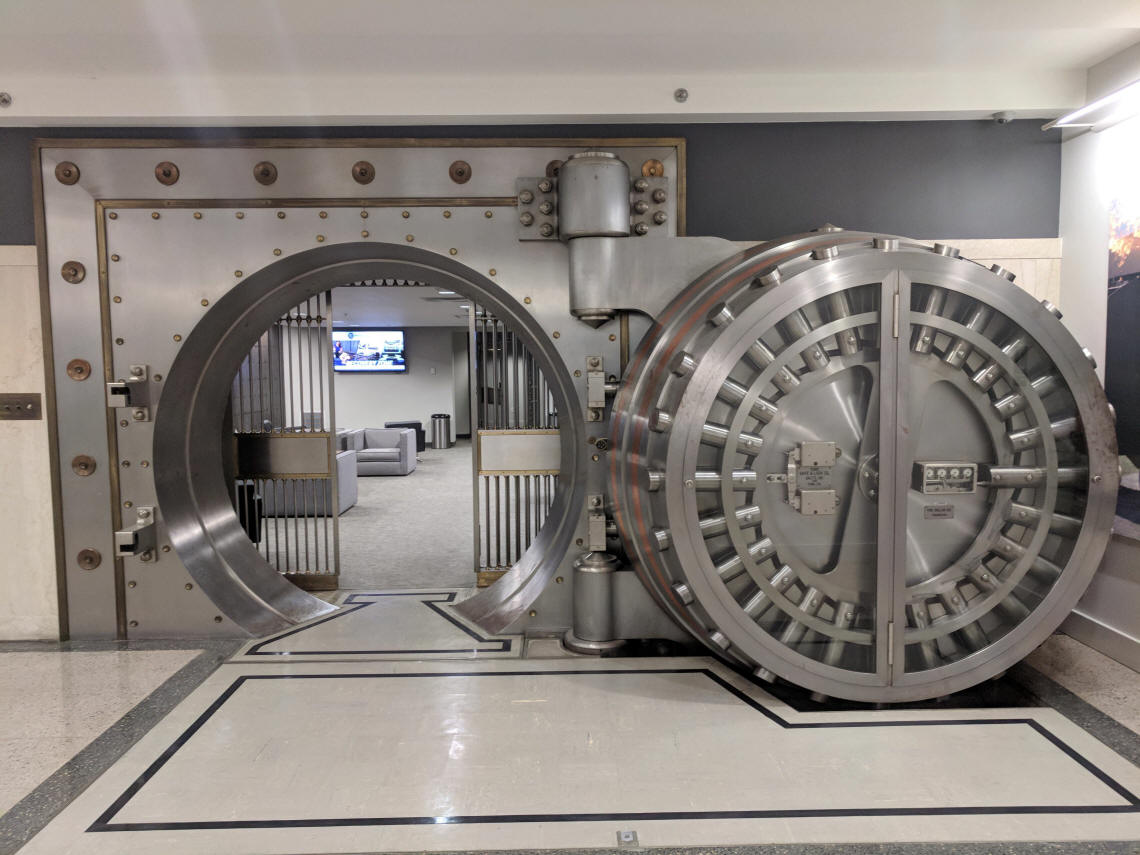
Under Armor Gym in Baltimore is in an old bank building. They kept the vault door and turned the area into a lounge. Model M time lock with later replacement time lock movements, probably post 1950 Yale.
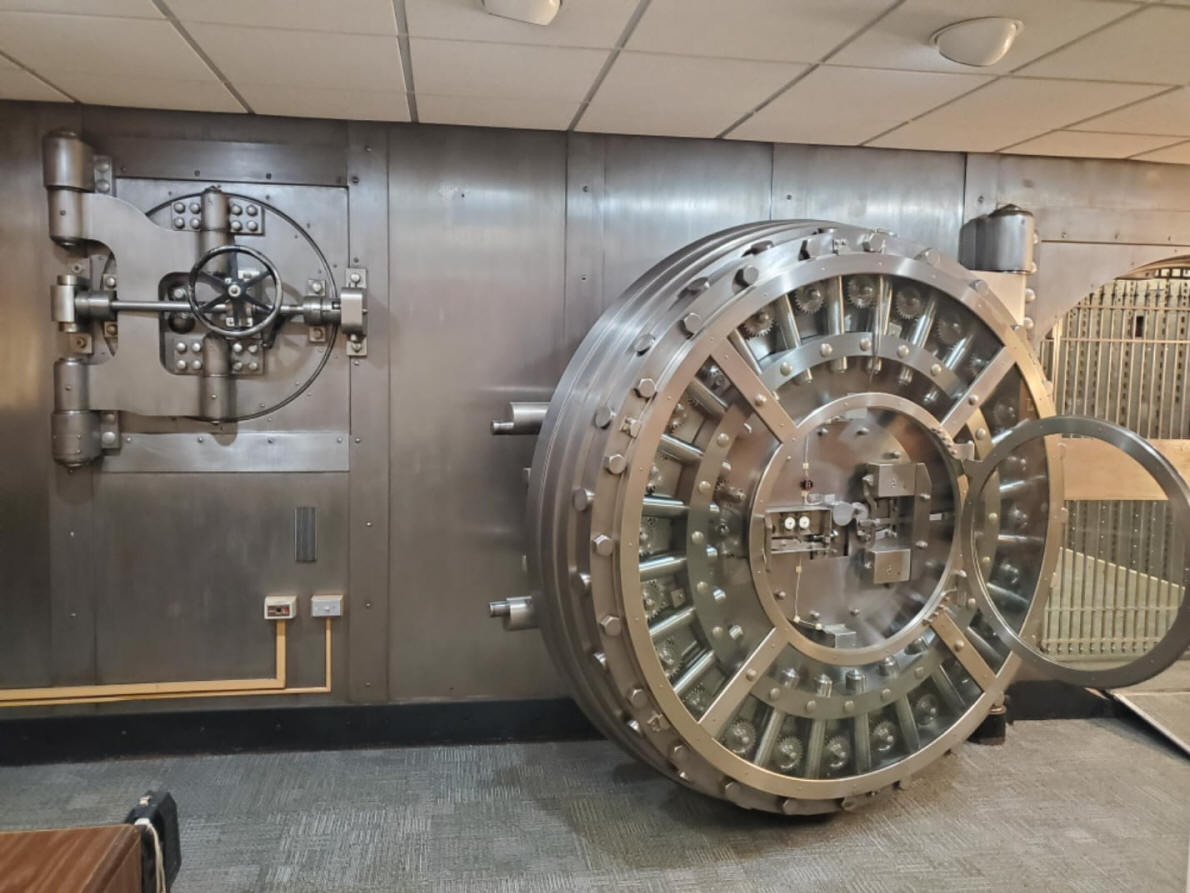
This photo is an example of how older time locks have become too difficult for modern banks to properly maintain. This large vault door was originally installed with a S&G Special Order M. This lock had a special, larger movement known as the 'R' size and was from the beginning a limited production model and quickly became obsolete. Over the years it became difficult to service and maintain. One can see that the time lock was retrofitted to accept what looks to be smaller, post 1950 Yale 'L' model movements made in Switzerland. This is a substantial vault where a secondary door is provided in case the main door fails to open for whatever reason. It is understandable that the bank had chosen to retrofit the the original movements with a brand that was still available, but it has also taken the financial shortcut of only fitting two where four where originally designed to be. One can make two statements here. The first is that the bank is reckless to do this by cutting the redundancy from four to two movements. The other argument is that time lock and vault makers simply used additional movements to "look appropriate" to the ever larger, massive vault doors that were being introduced at the time and that the additional redundancy from two to four movements was more of a marketing scheme to to make the vaults look more secure to both the buyer and the public than to actually increase safety, not to mention the additional profit to be made from a larger time lock. The odds of two time locks which were properly maintained failing together during any period available on the dial are very remote, additional timers were probably not necessary. My guess is that this vault was not on the main floor where customers could view the door, perhaps it was in the basement guarding the safe deposit box area. Otherwise, the cost of two additional movements would have been spent to keep up appearances.
(1) American Genius Nineteenth Century Bank Locks and Time Locks, David Erroll & John Erroll, pp. 274-275 |



 A
A
 B
B