Mosler Safe Company, Hamilton, Ohio - 3 movements, Type 1
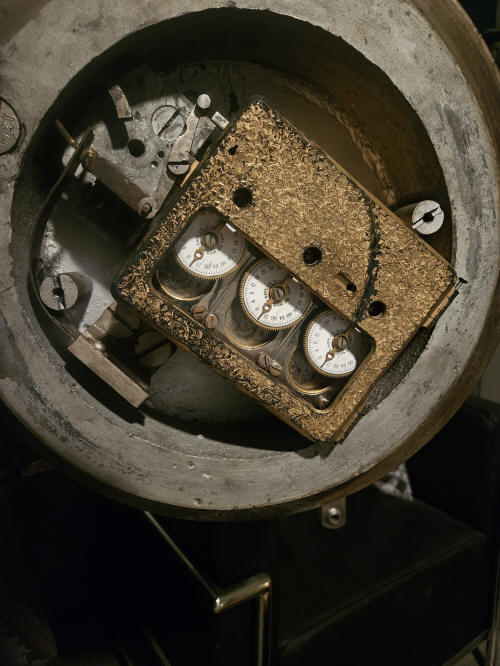
A. Type 1, 1916. This is an early example from the Mosler Safe Company. It should is not to be confused with Mosler Safe and Lock Co. which was a different company but still connected with the Mosler family and produced two models in 1887 after their purchase of the patent rights from Beard & Brother that same year. Mosler Safe Company's first offering was a four movement model that featured this same gold-plated door with a crackle jewelling finish and this is the distinguishing characteristic for a Type 1. The three movement was introduced around the same time. This feature was used only for one year and by 1917 was replaced with a less expensive smooth bronze finish similar to that of the three movement in example C. Unlike the earlier incarnation of this company, the Mosler Safe Company used production pocket watch movements bought from other watch suppliers. This author knows of three movement suppliers that were used throughout the life of the company until it was sold by the founding family in 1967 to American Standard Companies. The first type used was an 18 size Model #4 movement supplied by the Illinois Watch Co., Springfield, Illinois and is illustrated above. Waltham Watch Company, Waltham, Massachusetts using their size 16 movement was substituted in 1933 after the Hamilton watch Company took over Illinois Watch Co. Sometime in the 1950's Mosler turned to the Recta brand of watch movement made by Muller and Vaucher, Switzerland and continued with this until production ceased in 1967. Around this time Mosler as well as most US time lock makers had turned to Swiss imports. No production records exist for this model of Mosler time lock, but it is thought that about a hundred were made. The case numbering appears to have been initiated at #4000. It is unknown how many, examples survive, see photo below for a second example in situ of Cannonball Safe. 5 7/8"w x5"h x 2 7/8"d. Case#4080. file 147
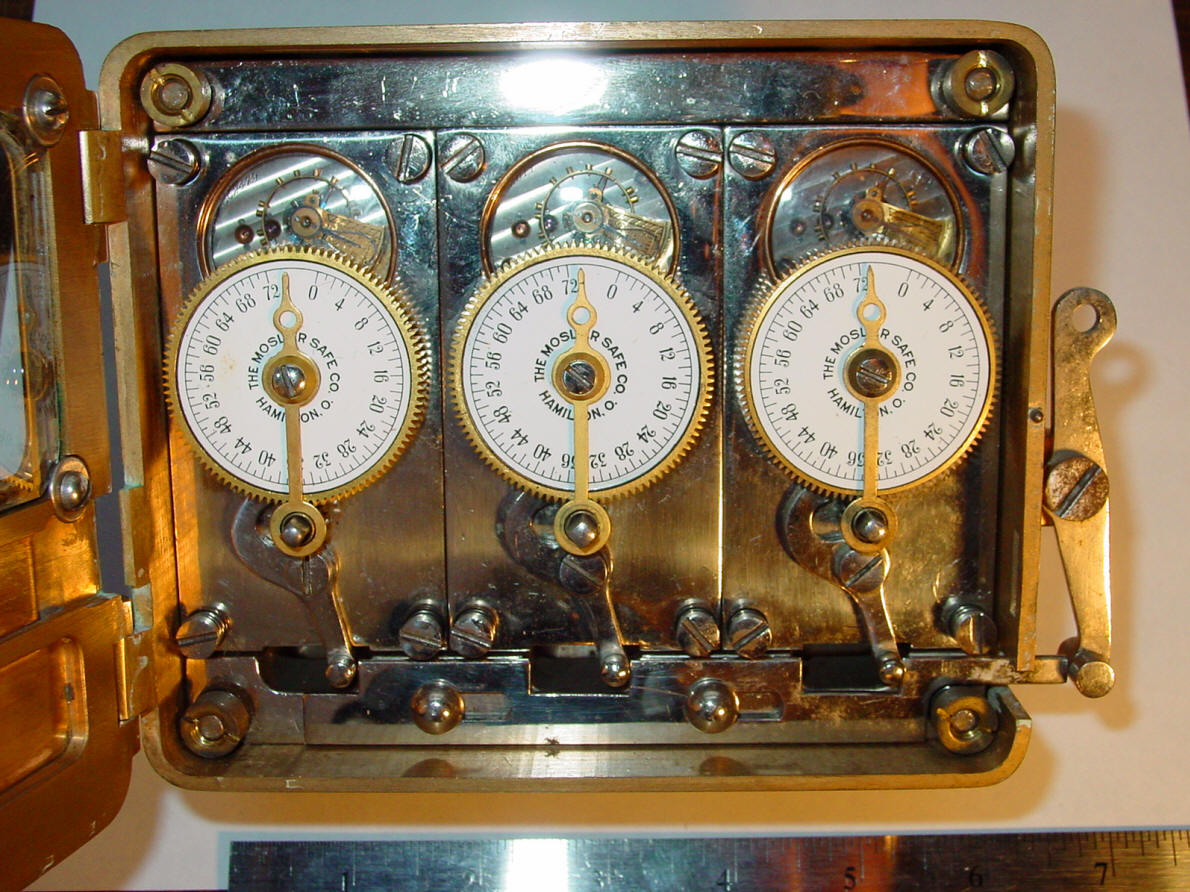
B. c. 1918. Around 1902 with the sale of E. Howard & Co. to the Keystone Watch Case Company, E. Howard exited the time lock business. Therefore, the time lock companies that used E. Howard shifted to Seth Thomas movements. Mosler, however, did not begin manufacture until 1915 and chose 18-size Model #4 pocket watch movements supplied by the Illinois Watch Company. The movements had a separate crystal covering the watch movements much like on a conventional pocket watch providing exceptional protection from contamination compared to other time lock movements. Bankers Dustproof Time Lock Co. was another company that used movements supplied by Illinois Watch Company. This was probably not coincidental since Banker's disappeared as a brand in 1915 and Mosler Safe Co. appeared in 1916 based on designs very similar to that of Bankers. After 1932 Mosler switched to American Waltham Co. 16-size pocket watch movements. Mosler Safe Co. was the result of a series of consolidations of earlier companies including Mosler Safe and Lock Co., Mosler Bahmann and Bankers Dustproof Time Lock Co. That company emerged in 1917. In addition to the protection given the watch movements by a glass crystal fitted over them, the movements can be wound without having to open the door by sliding the lever to open the winding holes. These features result in Mosler movements being some of the best in surviving condition . This lock as well as the example above dogged the bolt work via a lever attached to a right hand lever located on the outside of the case to the right. In the first year of production the case had the crackle finish door with satin bronze sides. By 1917 the door was changed to the same satin bronze finish as the sides, but this design was short-lived and only lasted a few months making this a fairly rare example. That year Mosler replaced the satin bronze with a satin nickel finish which remained until the change to the plastic front cases beginning in the 1950's. 5 7/8"w x5"h x 2 7/8"d. Case #6427. file 115
C. c. 1930's. By this time the style in the time lock industry began to favor the art deco sleek satin silver designs that survived past WWII. And so Mosler only had their crackle finish door and bronze satin case design for about a year or two before moving to this case color. This example is equipped with a longer duration 120 hour movement set. 5 7/8"w x5"h x 2 7/8"d. Case #9926. file 298
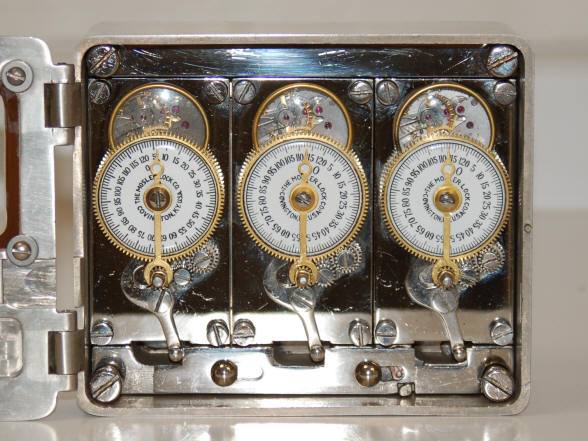
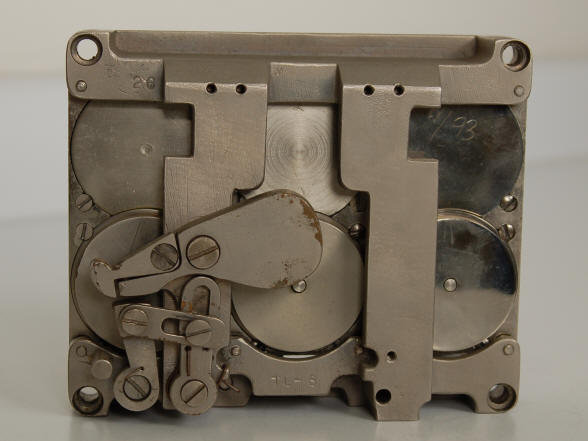
Illustrated above is one of the patents stamped into the door of all Mosler time locks. The second picture shows Mosler's sophisticated dual spring suspension system. Most other makers, if they used a spring system used this for the movement plate only and the time locks were firmly secured to that plate. Mosler used a second spring set to fasten their movements to the spring-suspended movement plate. The decorative bolt escutcheon located on the right side of the case in the first illustration was never incorporated in their production models; only a round hole in the case.
The first photo shows a fairly complex bolt dogging lever system compared to most other makes. The next photo shows the dual spring suspension system as illustrated in the second patent drawing above.
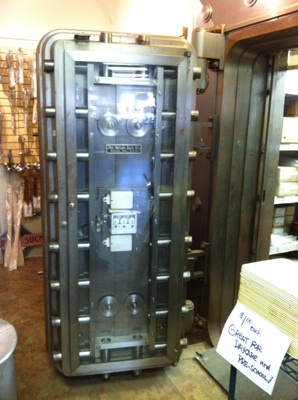
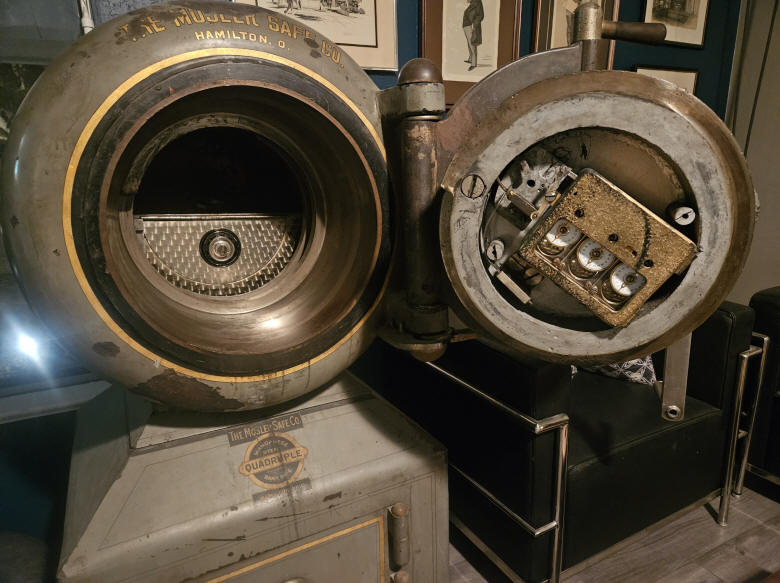
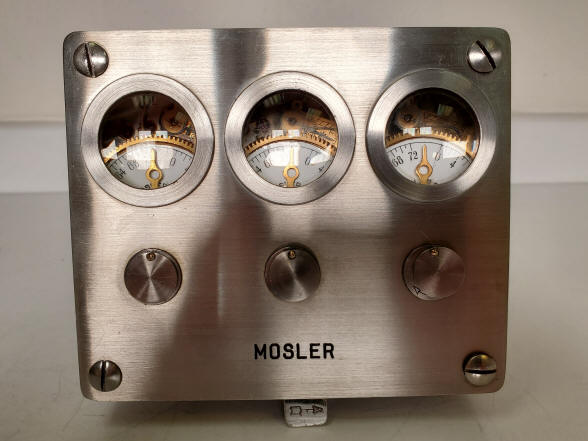
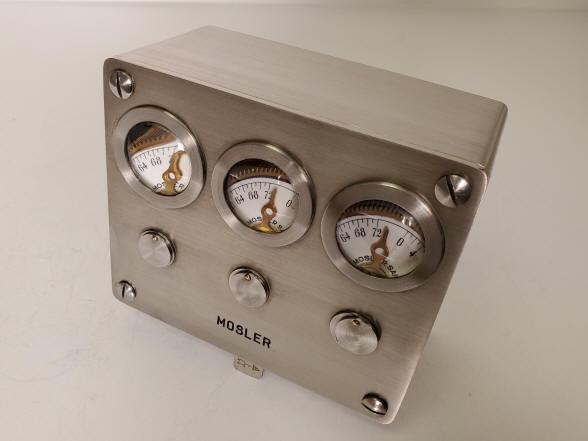
D. c. 1960's. This time lock case style was meant to convey a sense of impregnability similar to Yale's model M33. 6"w x 5"h x 3"d. Case #15045. file 312 Below are two Mosler vaults with a Mosler triple movement time lock similar to example 'C'. However this model dogged the bolt work in the more conventional fashion by blocking the release bolt directly through a hole in the side of the lock. The three movement size was appropriate on the first square door, but one might expect that a large round vault door as depicted below would have had a four movement lock. Although the need for one was superfluous. The probability of a three movement lock failing was as vanishingly small as a four, and there was no greater need for the pulling power of an extra movement to release the bolt work. However, a four movement lock would have 'looked right' to provide the appropriate drama suited to the door and would have been the correct size. This was pure aesthetics and marketing as historically was much of the time lock as well as the safe and vault business, as well as the architectural design of bank buildings - all to convey solid, safe and dependable imagery. Now look at the third photo at the bottom,. This is the same type of lock as on the huge round vault door, but is located in a very small Cannonball type safe, probably no more than two thousand pounds (look at the hand next to the lock on the right) compared to the ten ton door.
In this photo one can see that there was something that was rubbing up against the door of the time lock and rubbed a deep groove into the surface after repeated opening and closing of the door. The door turns to open and close rather than in the conventional way of a rectangular door. Perhaps the combination knob seen in the first photo. It does appear that the Mosler is quite large for the door upon which it is mounted. I have never seen this Model of Mosler mounted into a screw-door Cannonball safe.
|





 A
A
 B
B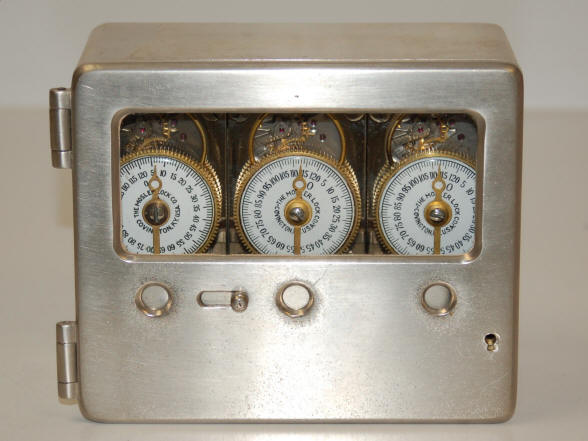
 C
C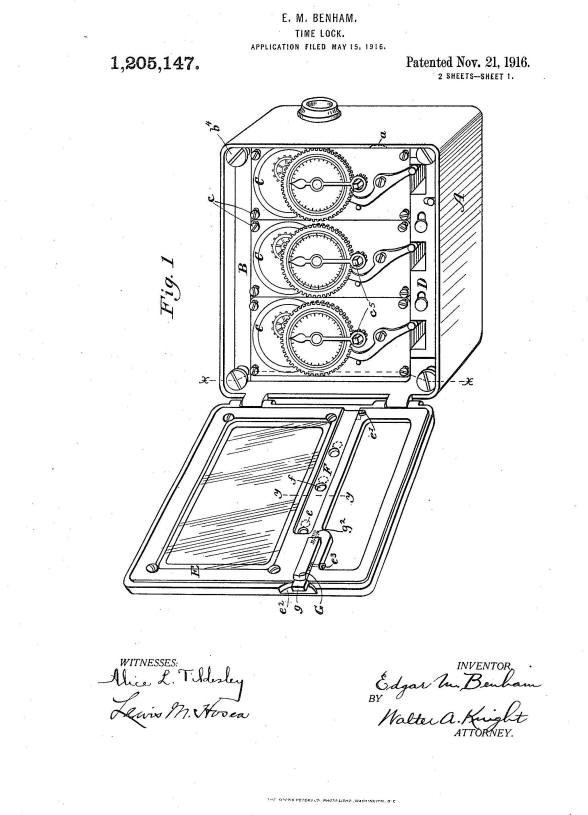


 D
D