|
Hollar Lock Inspection and Guarantee Company, Philadelphia, PA, Model 2
The example is shown in the "as found" condition.
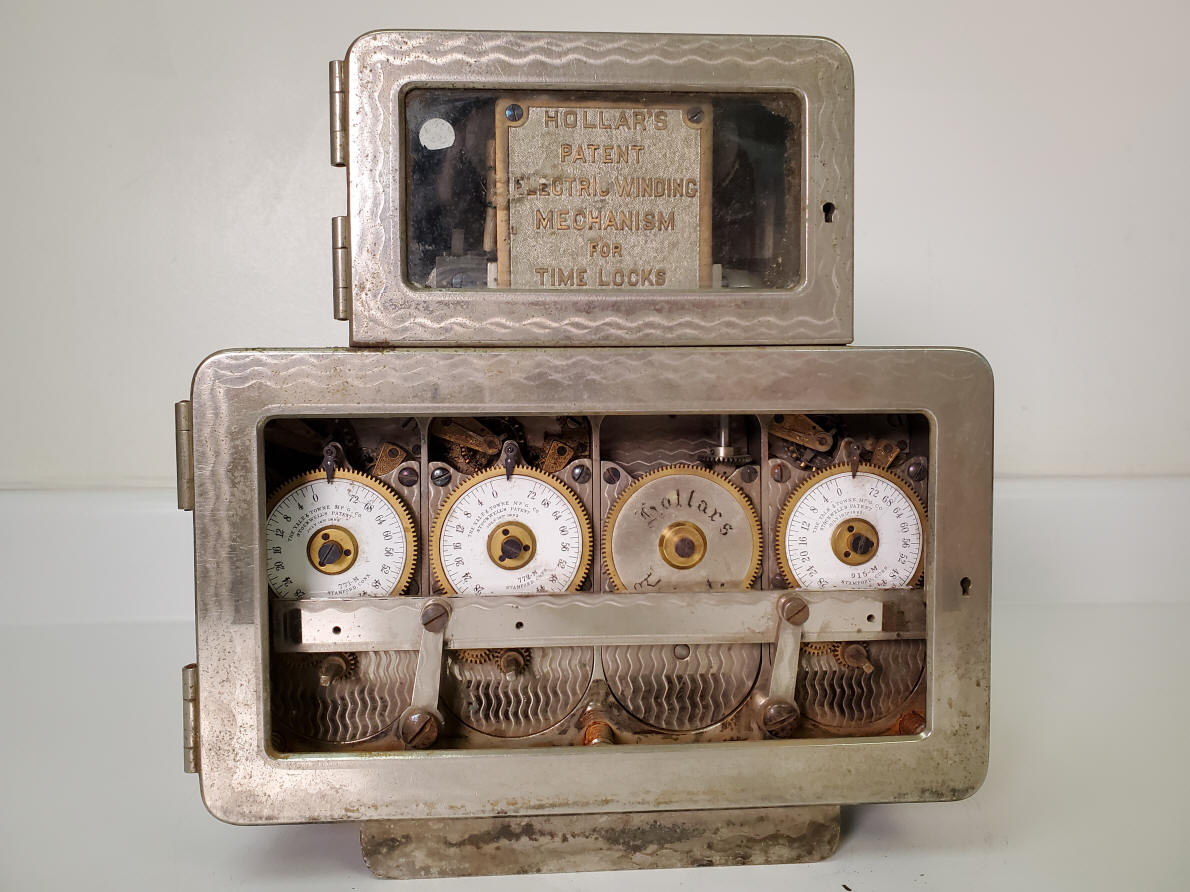
Front elevation.
The three regular Seth Thomas movements are in operable condition, but must be completely restored. Rusted screws will have corrosion removed, polished and blued. A few were not salvageable, those two securing the lower snubber bar as well as those that secured the door skirt seen in the lower left hand corner. The upper case contains the rewinding mechanism, it has a motor that connects via a bevel wheel to what looks like the third movement. That movement has no serial number. This is a dummy movement and the bevel is attached to a set of reduction gearing behind the movement front plate that will rewind the movement adjacent to the right. The 'dial' wheel that has the Hollar logo does not turn and is purely decorative.
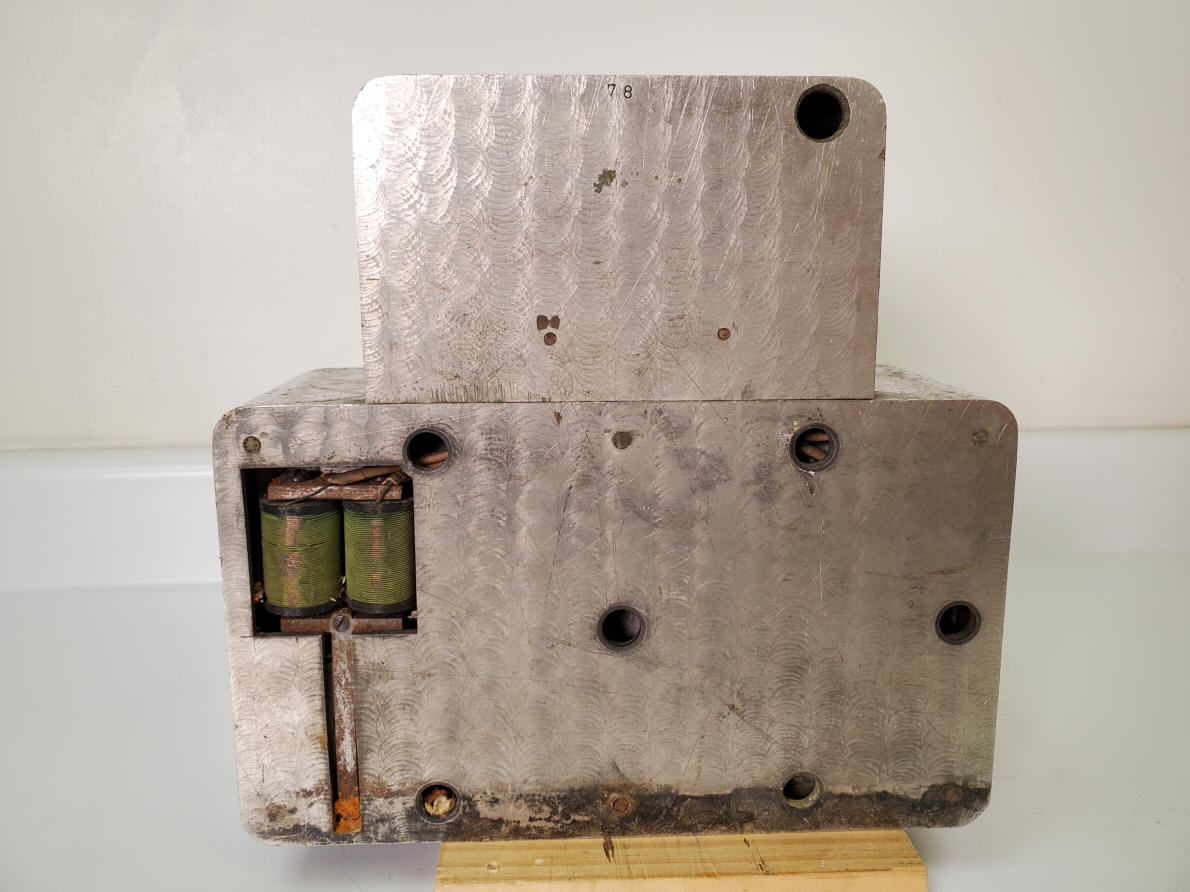
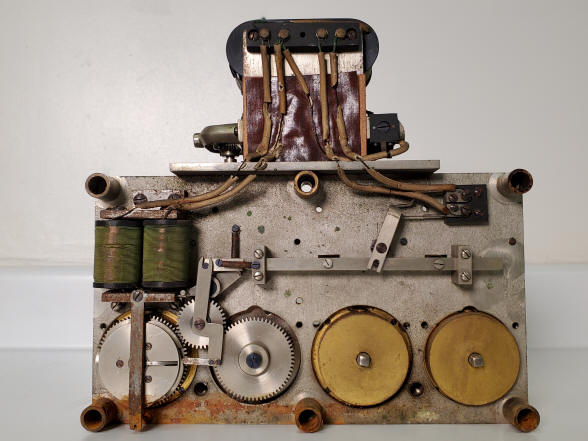
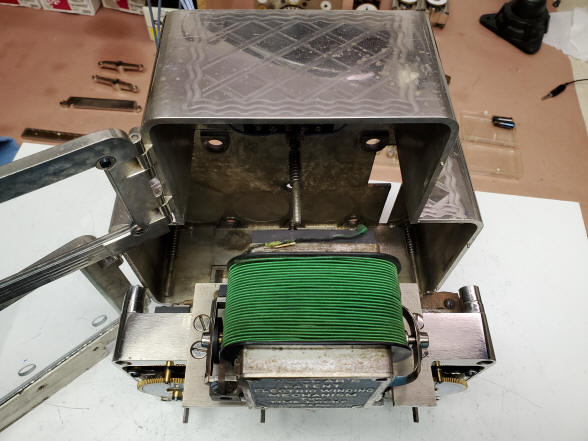
Rear elevation. The coil set is a solenoid that actuates the connection to the motor in the upper case. Notice the wear on the front of the coils. This is because they were never properly recessed into the time lock case and rubbed on the surface of the vault door to which the time lock was mounted. Had these ever been energized they would have immediately caused a short circuit, never allowing the motor to perform its emergency rewinding function. The fact that there are no burn markings indicates that this option was never called upon after the coils began to wear.
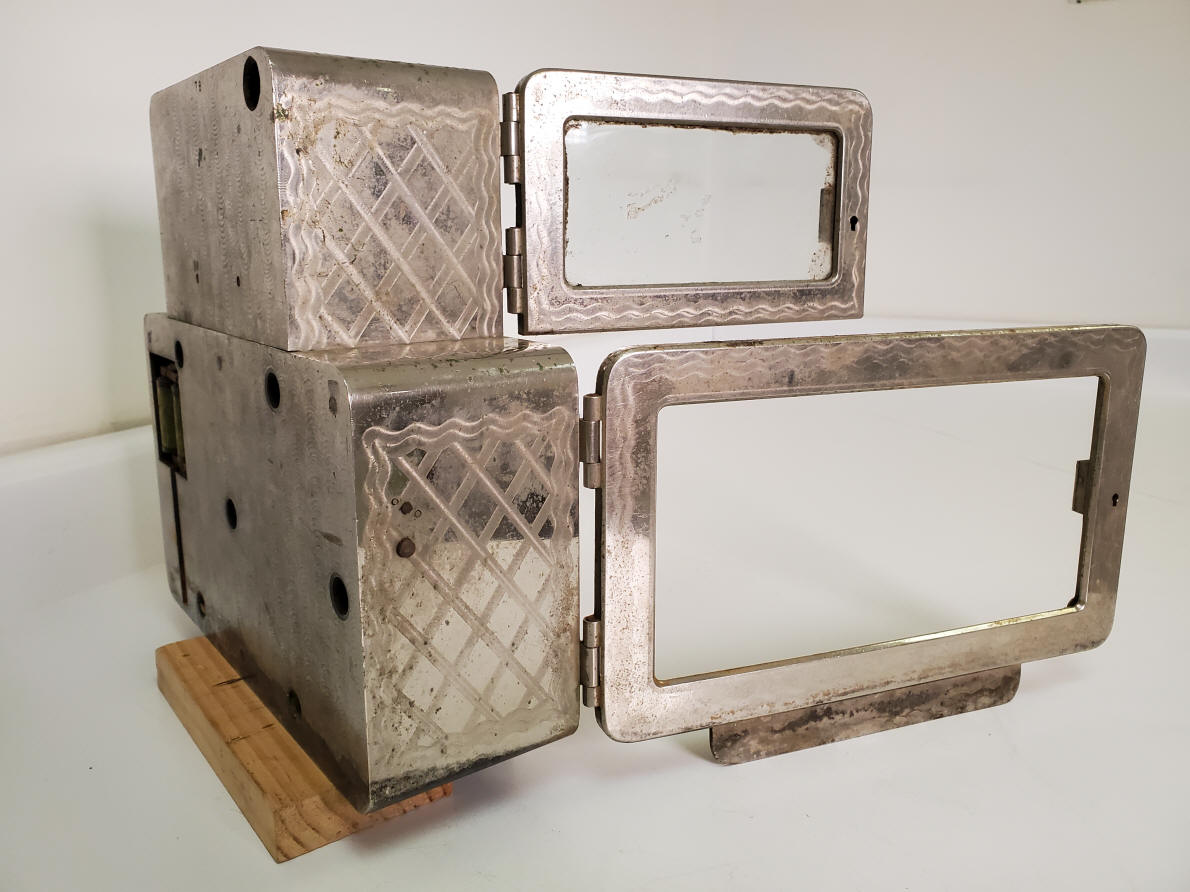
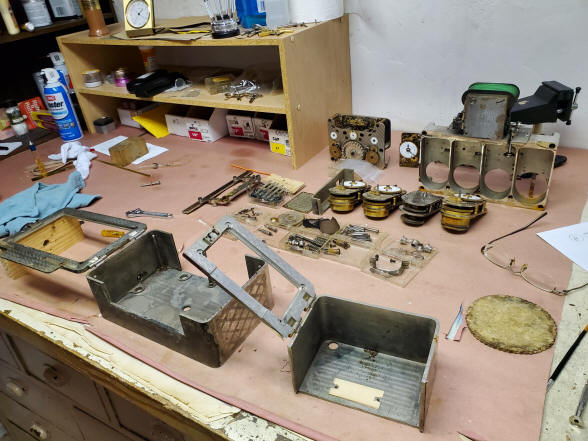
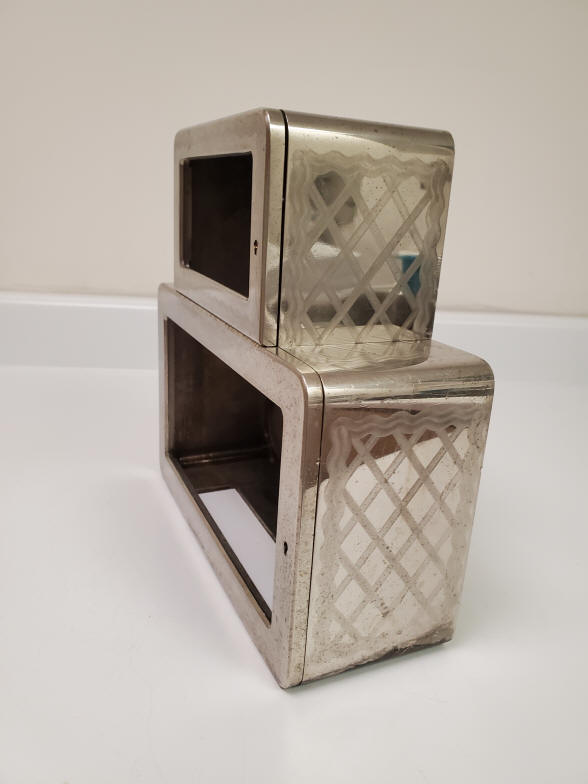
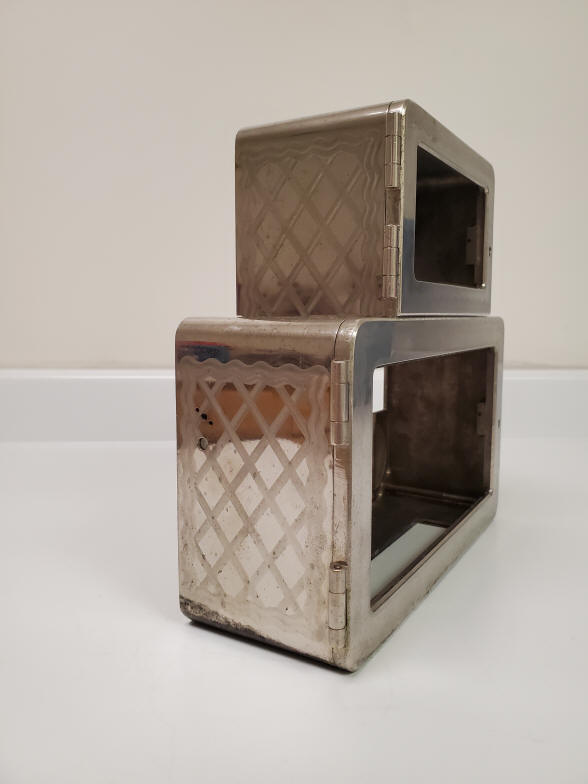
Most of the case eventually cleaned up well except for the one inch that was below water, this can be easily seen on the metal skirt beneath the door and dark areas on the lower base of the case.
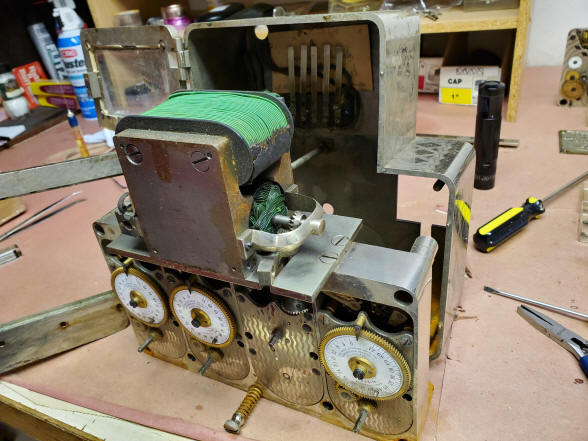
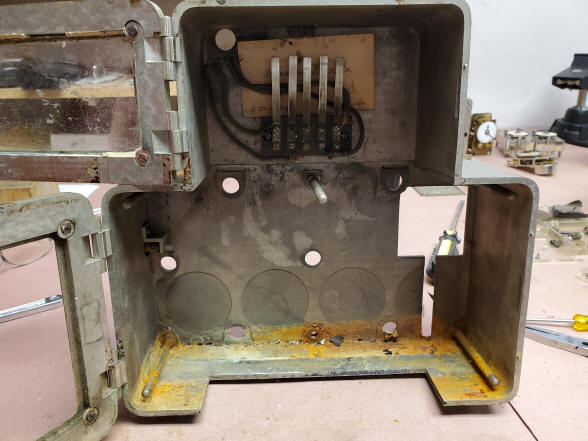
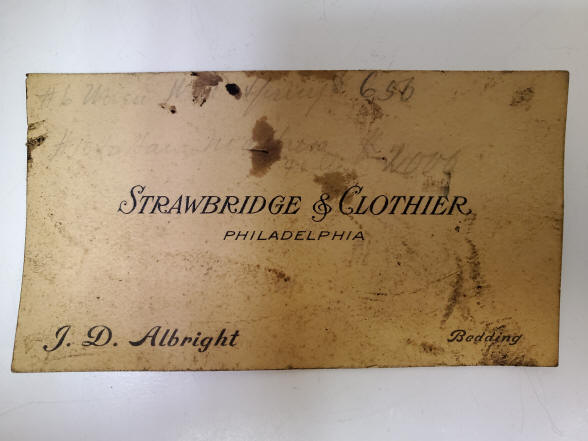
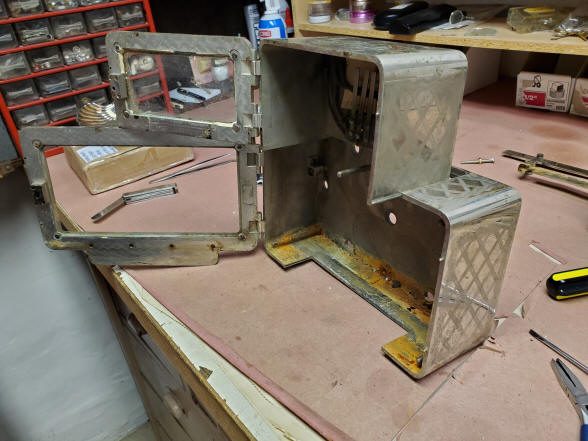
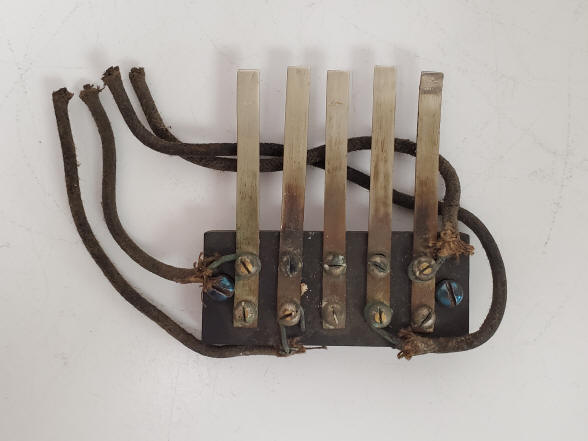
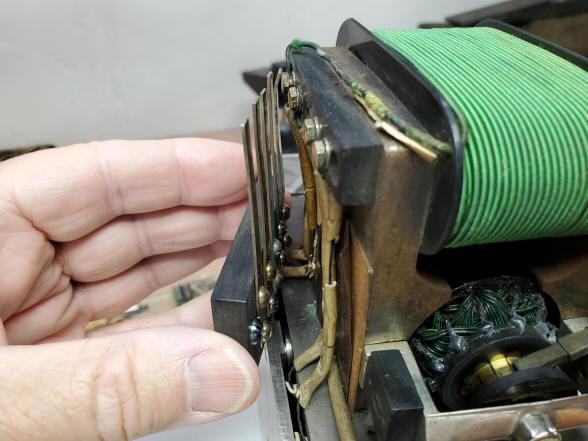
Removal of time lock mechanism from double case. One can see the rust from the steel mounting screws and springs staining what otherwise would be rust-resistant chrome plated bronze case. It's clear from the amount of oxidation that the lock stood in about an inch of water for some time. Fortunately it was from the bottom and was just below the timer movements, sparing the most vulnerable parts. Most screws were restorable except for the two on the lower snubber bar as well as a few others. The second photo shows the contact set that connects the electrical components of the lock to the electrical control panel outside the case. Notice the calling card located behind the contacts, presumably to prevent a short between the contacts and the back of the case. A surprising shortcut that one would not expect in such an expensive and critical component. Perhaps a better insulator was originally installed and a later repairer inserted the card.
A close up of the card, the obverse is blank. The writing is largely illegible. On the top line one can read "#6 Woven .... "and what looks like a price of $656. The second line reads "#10 ½ Hawthorn ... and again a price that looks like $2000, both prices are an incredible amount of money at time. Next the upper case is being removed from the lower. It slides in a groove forward.
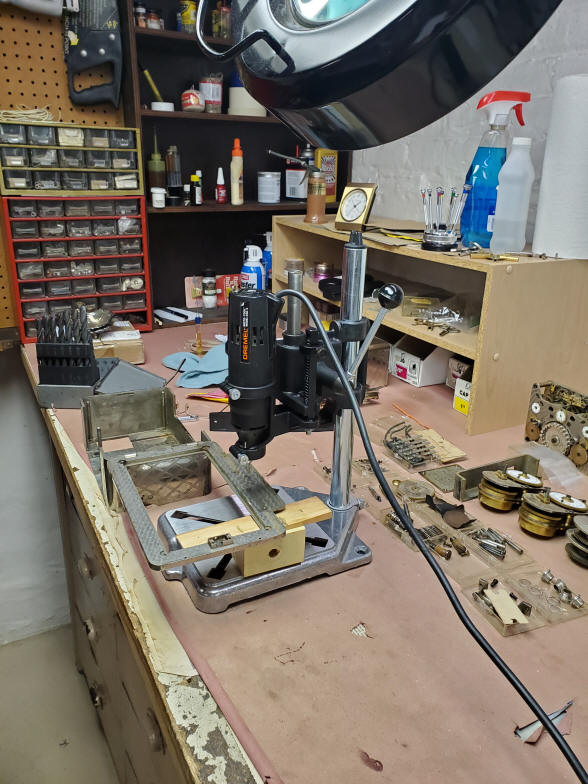
The first photo shows a setup used to drill out a screw. This requires skill and patience to correctly direct the drill bit down the center of the screw head. A micro punch applied in the right spot will assist in this.
A rear view of the time lock, one can see the rust line. The electrical wires look to be heavily damaged, but the cracked parts are the brittle outer insulation covering a thin inner cloth-insulated wire, The electrical connections remained in tact and this is a low voltage system running on 4.5 - 4.75 VDC, 1 amp. max. I could have replaced the wiring, but decided to keep it as long as it continues to work to preserve what I consider an important historical part of the lock. The same reasoning is the retention of the calling card on the back of the upper case behind the contacts. The left most movement received just a bit of water damage, fortunately is was superficial. This was fortunate since this is the movement involved in the rewinding and contains additional special components including a clutch and second winding gear.
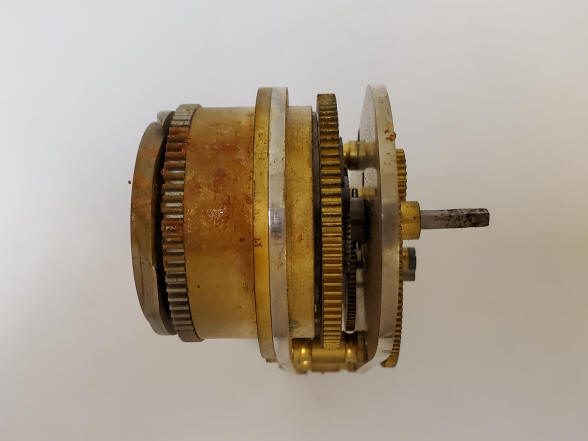
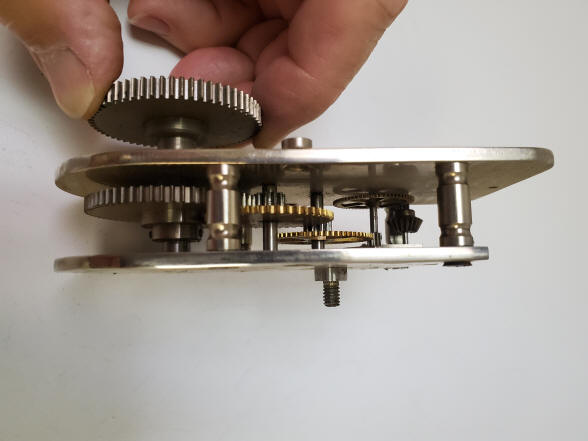
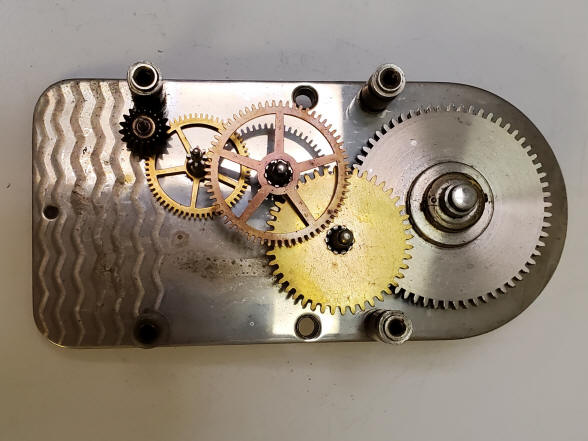
Two views of the third, dummy movement, which contains the reduction gearing from the fast spinning motor down to a slow winding gear, this also enables the motor to easily wind the fairly strong movement spring
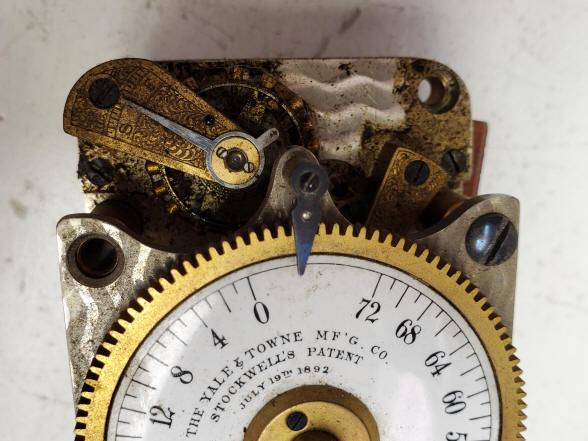
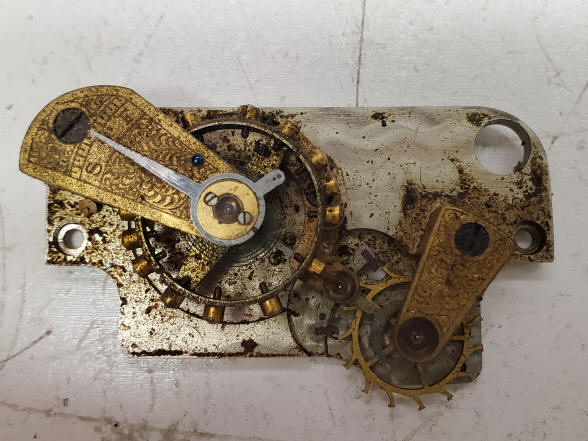
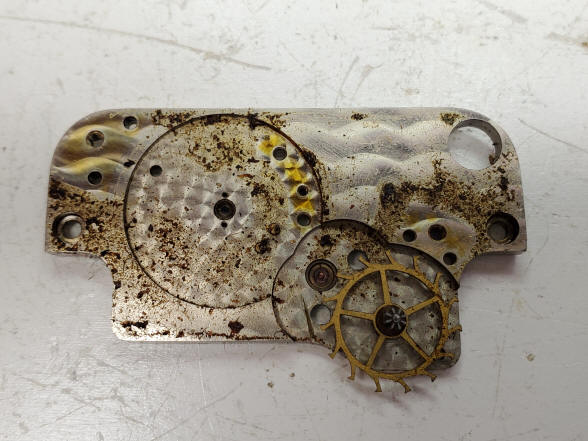
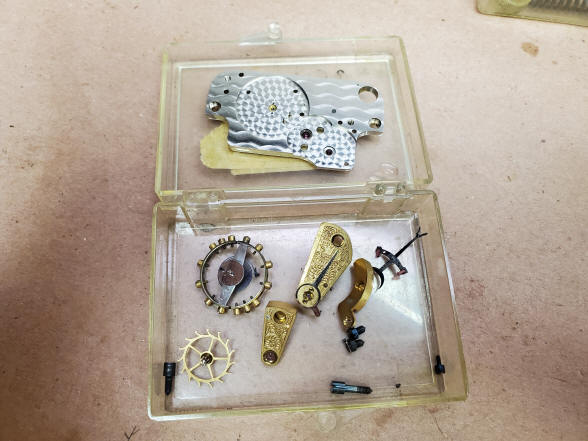
This movement was about as dirty as it gets, but fortunately no corrosion. Any amount of dirt, sludge or oil-turned-to-varnish can be dealt with fairly easily with the right tools, cleaning agents and patience. Corrosion, depending on the amount and where can be remediated but the object will never be the same, the metal surface has been irretrievably damaged. Second photo has the platform escapement removed.
I found a dead bug in the platform escapement assembly, obviously a time lock aficionado.
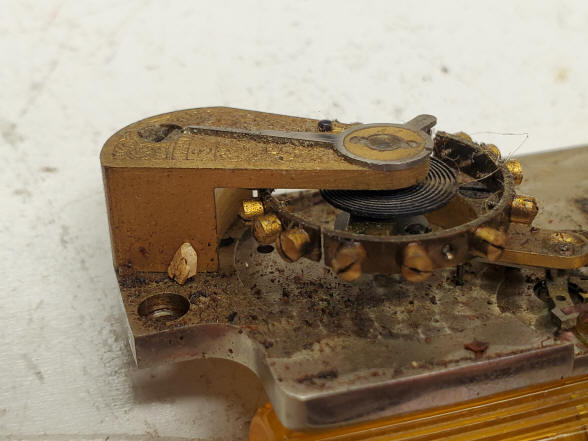
One must be careful with what cleaning solutions are used. An ultrasonic is good for most parts, but care must be not to immerse the balance wheel spring too long as it can alter the mechanics of the spring. Also note that the jeweled parts of the impulse pin and fork pallets are held in with shellac that can be dissolved by some cleaning agents. Also look carefully at every jewel bearing to see if they are a secure press fit. I learned the hard way that in this type of movement the upper jewel pivot for the escapement fork is secured by shellac. After a fevered search I found the jewel, but it was pure luck usually when this happens its gone.
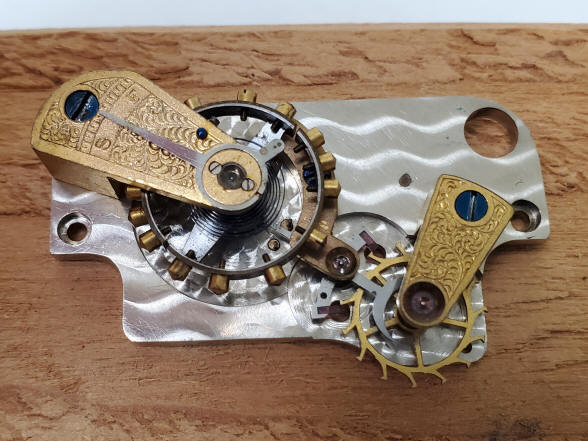
The platform escapement assembly is now cleaned, oiled reinstalled and is running well. Escapement wheel has good amplitude. It is not always necessary to open the rest of the movement between the plates if they are fairly clean, ( I did, however open this one as it was very dirty). These movements are only for demonstration and those wheels move slowly compared to the parts within the platform. Yes, this is a shortcut and would never be considered in watch or clock that was meant to give full time service. If one goes this route be sure to never oil the pivots of those wheels that have not been removed. These pivots are not perfectly clean but are dry. Oiling will turn whatever is present into a grinding paste. Dry pivots on a movement will not cause harm as long as it is only run briefly for demonstration.
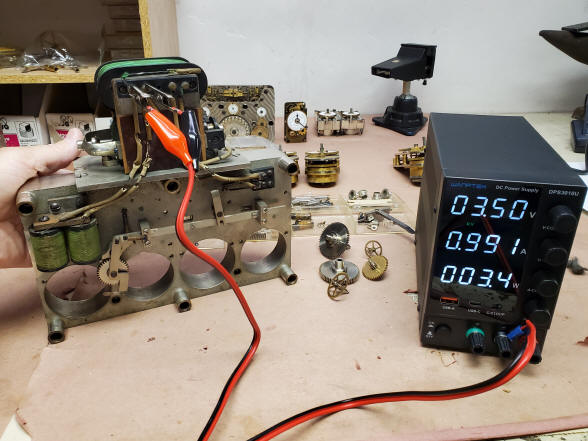
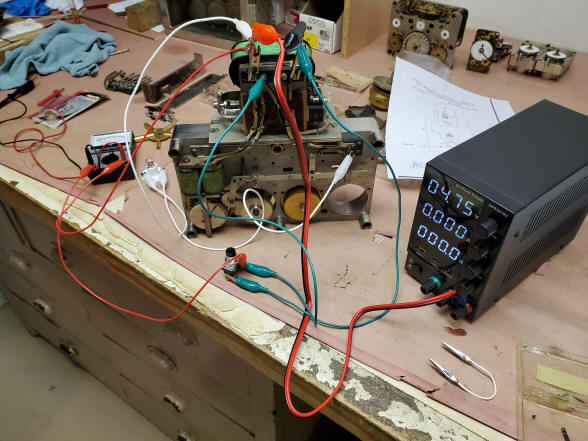
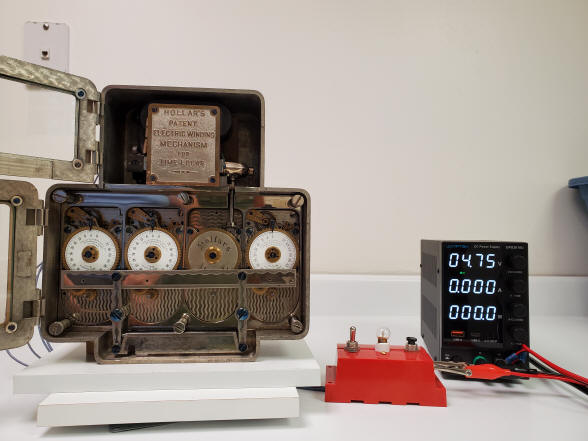
The first photo shows the initial electrical test to see how the motor, solenoid coils and wiring works. Next a test of the system complete with a control panel prototype consisting of a switch and light.
Initial demonstration of the electrical components. They run on 4.5-4.75 VDC at about 1 amp. One can see that the wiring is functional.
Overall the case cleaned up well except where it was below the water line.
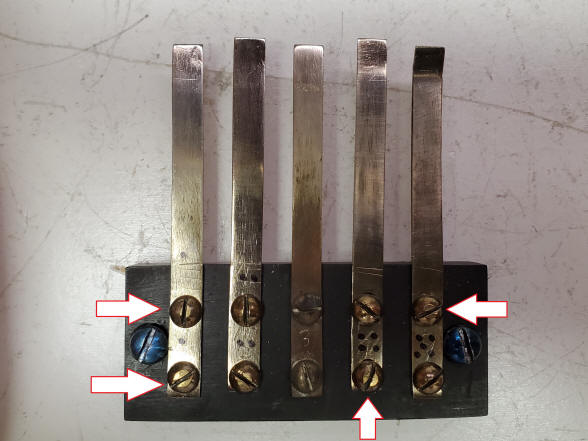
Before and after photos of the case contact block. Note carefully in the second photo the arrows pointing to screw heads that have been filed down. This ad hoc attempt to make the case contact block fit behind the time lock contact block area is another possibly fatal design flaw that could cause the electrical systems to fail.
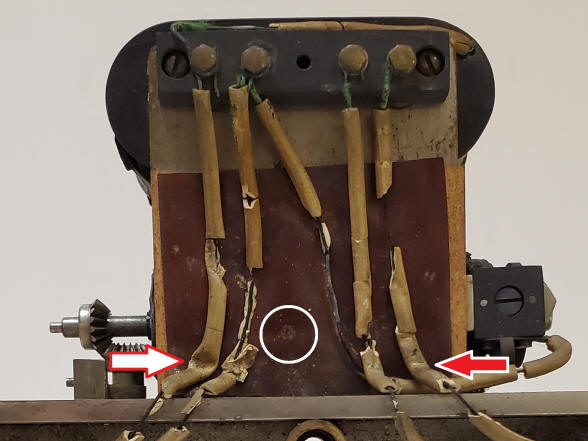
The first photo shows the case electrical contact block test positioned to the time lock contact block. The design issue mentioned above is shown in the second photo where the edge of the case contact block has crimped the wires shown by the arrows; the circled area shows the imprint of a screw head on the back of the motor insulation pad. The filed screw heads were an attempt to mitigate this clearance issue. This is a wholly unacceptable flaw in a mechanism that is critical to the functioning of the time lock.
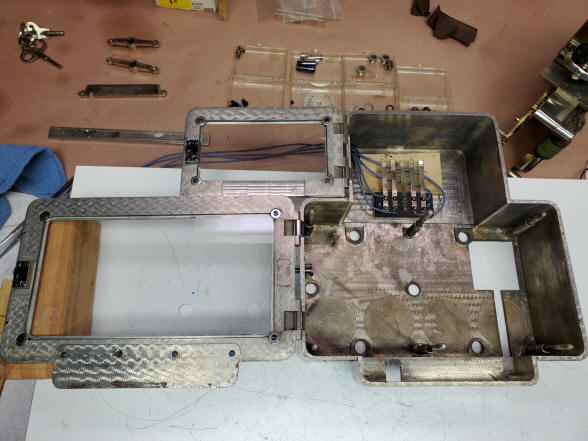
The case contact block is positioned on the rear of the case. Next the careful mating of the case and time lock blocks as the lock is moved back into the case.
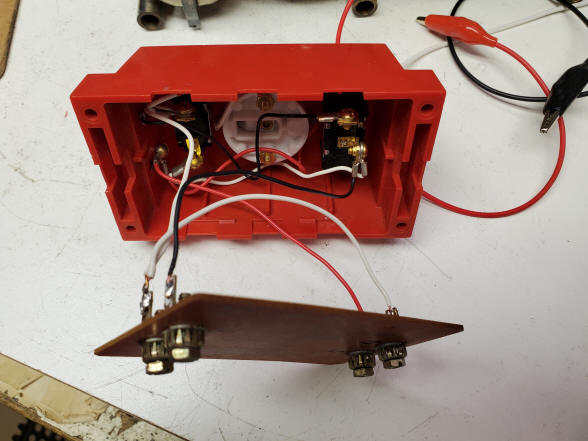
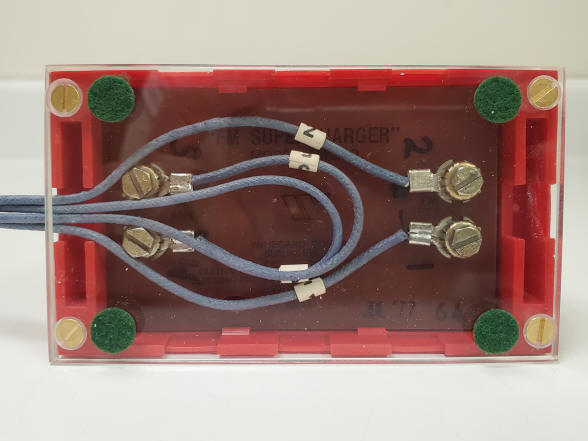
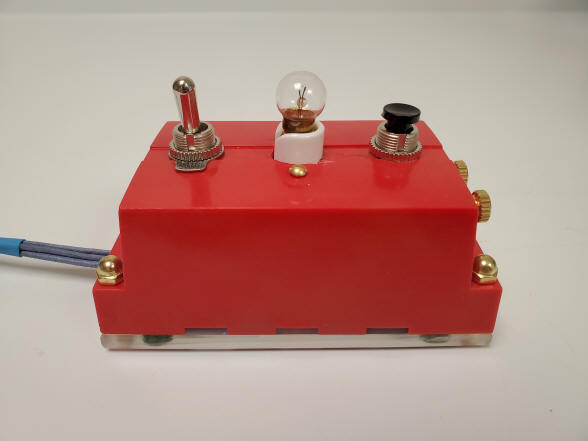
The control panel was created and the way it interacts with the time lock is explained on the main page for this lock
The completed control panel. I tried to give it a bit of a retro, 'steam punk' look. Next the restoration and setup is complete. Holler's time locks operated Yale's Model 1 bolt motor, their largest and most powerful. This is the largest and heaviest time lock this author has encountered; weighing in at 27 lbs. Upper and lower cases #78, movements #771, #772, #784 (#784 has a dial marked 915-M). No serial number on the third dummy movement. Time lock with second case, 9.5"w x 8.5"h x 4"d. file 361
|




Above are photos of a vault door built by the Hall Safe Co. with the Hollar Model
2 configuration.
But at some point in time all of the original 72 hour movements were
replaced with longer 120 hour duration movements. The third dummy movement of the time lock
which had the reduction gearing was replaced
with a normal M-sized movement and the winding mechanism disconnected
(smaller case mounted above the time lock). These photos show a round door style that was
designed by Hollar but built by the Hall Safe and Lock Company. The close up
in the third photo details the separate electric controller on top of the four
movement Quad N style case. This unit contained the motor that did the remote winding of the
original Hollar time lock and has since been stripped of the components
within this case leaving only the name plate.
A close look at the snubber bar in the third photo shows that it may only
have the original three studs that were each pushed by the dial pins of the three time lock
movements as they wind down to zero (the fourth movement was the dummy that
had the reduction gearing). There is no stud where the third movement is
installed just as there was none originally since that area was not occupied
by a time lock movement. There is also a small button that protrudes
from the left side of the case in the same area as the example shown proving
that the case is an original Hollar. Unless a new stud was invisibly
attached for the third movement it is merely there to make
the lock look complete. This is the same reason why the now unused winding
mechanism case is still present with the front name plaque carefully retained. Missing pieces on a vault door would not instill
confidence if it could be seen by the customer! The lock now operates like a
Yale Quad N. But in other circumstances the owner did not care, see below.
Most complex or otherwise esoteric time locks like the Hollar, Holms, and
Hall/Consolidated have either been modified or replaced as time went
on and their reliability or serviceability became problematic. In the case
of Hollar it was especially easy to convert the lock to a Yale Quad N (but
with three movements) by disconnecting the winding mechanism, or even just
disconnecting the electrical supply. One could replace the third winding mechanism with a regular third movement and the Hollar snubber bar with the Yale counterpart
making it a regular Yale Quad N, so few unaltered examples of
the Hollar survive. The few that do are no longer called upon to operate.
This is the case with any pre-Great depression unaltered time lock mounted
to a safe that is still in commercial use. The movements are no longer
serviceable to the degree that they can ensure their absolute reliability.
The Hollar time lock uses a
Yale automatic bolt motor. What's interesting is the fact that Hollar makes
sure by prominent signage that they are the designers of this
vault. Hollar like Yale was involved in safe and vault design but did not
actually fabricate them. Hall, Diebold and Mosler are examples of time lock
makers who were not only designers but also builders of safes and
vaults.
This photo shows an especially sad example of an older, quite rare time lock
(Hollar Model 2) altered to continue serving its function


In any other field of horology such alterations would elicit scorn and ridicule. But one must remember that in the case of a time lock that must still function reliably to ensure there is never a lockout due to its failure, such alterations are inevitable. Parts must be substituted to ensure current reliability and reasonable servicing. The last Hollar movement made was around 1902 so it would be negligent to entrust a vault door's security to a time lock movement over 220 years old.
A similar argument is often made for tower clocks that can be hundreds of years old. What alterations such as automatic winding are permissible? A great controversy was recently involved with the historic clock in St. Mark's Square in Venice (which this author was a part of). But in the case of an antique tower clock, the weight of opinion falls squarely on the side of not altering anything unless absolutely necessary, and if there must be as with auto-winding, this must be reversible and not involve any permanent violation of the original movement. But a tower clock, should it fail, merely shows an inaccurate time, not so with a time lock! So allowances must and are made. This fact makes obtaining a rare or an unusual time lock in original condition a special event.


In these two photos we see the Hollar advertisement, but as with all other safes equipped with a Holler time lock the lock was made with the cooperation of the Yale and Towne Manufacturing Co., and the vault was made by another company, in this case the Damon Safe and Iron Works Co. Boston MA. The Hollar company were only designers of safe, vault and time lock technologies.
1. Photo curtsey of Michael Schiavone, Aspire Safe and Lock.