| Hall and Consolidated Time
lock Company, Cincinnati, Ohio - 1875 through 1927. Introduction |
|
 The Hall's Safe & Lock Company began time lock manufacture in 1875 and received this award the same year in recognition of the company's unique design where the time lock was mounted onto and acted directly upon the combination lock to perform its function (hence the reference to the double chronomatrix attachment engraved on the medallion). In contrast, S&G first started making time locks in 1874, and then Yale in 1875, that acted apart from the combination lock and instead upon the safe boltwork by blocking its movement when the time lock was on guard. Hall chose the route of having the time lock act upon the combination lock's fence, preventing it from falling into the tumbler's gates when the correct combination was dialed in while the lock was on guard. This design made sense for Hall because his company was already a leader in the manufacture of combination locks. S&G and Yale also made combination locks, but were not as dominant as Hall. Hall's time locks were also much smaller than the competition because they did not need the bolt dogging mechanism and could be mounted directly on top of the Hall combination lock making his product ideal for smaller safe doors where space was at a premium.  A business card for the Consolidated Company. Note the names at the top of Joseph Hall the company owner and Milton Dalton, probably their most valuable employee. The card refers to their "Non-Lock-Out Devices" which probably was their "Infallible Lockout Protection System" created to make what otherwise would be an unacceptable risk using a single movement time lock and made it as reliable as the standard pair of redundant movements; giving the Hall product a great cost advantage over their competition. The Dalton permutation lock was a type of combination lock that was incorporated in Consolidated's Dual and Triple Guard time locks. 
 Hall's time locks were based on Henry Gross' design for which he received a patent on February 8, 1876. This was probably not the first patent issued Henry Gross since it is dated in early 1876, about six months after Hall introduced its first time lock. But one can see all the elements that the Hall and later Consolidated time locks used in their designs in this patent application. The unique shape of their dial lever actuators as well as their drop down lever to hold the combination lock's fence were all spelled out in this patent. One of Hall's most successful products was its line of Hall Premier combination locks which were also the design of Gross and patented in 1869 several of which are included with a time lock in this collection. Another key employee, Milton Dalton was awarded many patents for combination and time locks from 1873-1890. His penultimate creation being the Permutation lock used in the Dalton Dual and then Triple Guard time locks, the latter being the most complex and expensive ever made. The first model Hall introduced was his dual movement time lock around the same time as Yale's Model #1 in 1875, the Double Pin Dial, and wholesale prices for both were similar according to production ledgers of the E. Howard Co., with each movement set at $17.50 for a total of $35.00. It seems hard to believe given how much larger and more complex the Yale design was compared to Hall's. It is unclear whether these prices were for the movements alone, which would seem more plausible, or the complete time locks. At this time Howard made not only the movement but the complete time lock for Yale whereas Hall made the remainder of the time lock, case and other parts in house. Hall attempted to gain market share by introducing a less expensive alternative to the dual movements of S&G and Yale. Their innovation was a single movement time lock, but equipped with what they call the "Infallible Lockout Protection System™". Should the time lock become disabled due to the failure of the single movement, a very real possibility and the foundation of the redundancy provided by two or more movements, a "secret combination" could be dialed in to open the lock. This, of course obviated the entire purpose of the time lock which was to prevent anyone from opening the safe under any circumstances. The illustration below shows how their competitors S&G and Yale countered this feature from an 1883 catalog, (note the plaque above the safe indicating the deficiency of and alluding to Hall's Infallible Lockout System and the resulting threat to the safety of bank personnel). Indeed, the physical threat to the person who could, in the absence of a time lock, open the safe was a primary motivation for acquiring the device. However, the difference in cost gave Hall a significant market niche in the time lock business, especially where space was limited on the safe door and their small single movement time lock would fit where their competitors' time locks could not.  This is an interesting illustration. S&G and Yale shamelessly exploited the Hall lockout feature with a plaque on the safe that would never actually be there. Without that, how would they know what type of time lock was inside the safe? And even if the scenario was accurate, the owner had to telegraph the correct combination to the Hall company to then get the alternate combination and this, presumably, has to be done during business hours when a masked robbery would not have taken place. 
 The Hall Company had two significant innovations. The first was their "Infallible Lockout Protection™" system. Which allowed the company to safely use a single movement time lock, where redundancy of two by other makers at were necessary (and later three or more as time went on). This gave Hall/Consolidated a significant cost advantage over their rivals, the second was their "Infallible Chronometric Attachment™" which allowed the user to set the time lock but delay the operation of the lock going on guard for a preset time so as to be able use the safe until closing time. This device was simple and effective and while other makers made similar devices, no one else was ever able to duplicate its elegant, patented, design. Hall's serial numbering of time lock movements began at 1001, but did not proceed sequentially. For example, a February 1890 order requested that one hundred single-movement time locks be numbered 3676-3699 and 4926-5000. Rather than sequential numbering, Hall seems to have set aside blocks of numbers for particular styles. Double movement time locks marked "Joseph Hall" seem to be numbered from 1001; single movement "Joseph hall" time locks from 2001; single movement time locks marked "Consolidated" from 2501; double movement "Consolidated" time locks from 3001; Consolidated time locks with movements labeled from the Harvard Clock Co. are known to be numbered over 3600, possibly starting around 3500. The Harvard Clock Co. was founded in October 1880 and became the Boston Clock Co. in May 1884. After Boston Clock failed in 1894, Joseph Eastman (later of Eastman-Kodak) tried to revive the company in 1895, but creditors foreclosed on the firm in 1896. Some unlabeled movements numbered in the 6000s are thought to have come from Boston Clock for their escapement and movement structure are clearly not from E. Howard. As a consequence, movement serial numbers are only partially helpful in determining the production date of time locks made by Hall or Consolidated. Based on an analysis of Hall's non-sequential numbering scheme, it is suspected that two hundred to three hundred of these earliest double movement time locks were made between 1876 to 1881; fewer than thirty are known to survive. Joseph Hall formed the Consolidated Time Lock Co. in January 1880 to insulate his successful safe and lock business from yhe risky and untested time lock business, but the name Consolidated Time Lock Company did not appear anywhere on a time lock (only "Joseph L. Hall") prior to 1882. Around this time Consolidated stopped including "E. Howard" on the enamel dials, replacing it with Gothic type-face embossing on the face plate behind the dial to obscure it from view. This may have been an attempt by E. Howard to avoid further litigation after a Yale lawsuit for using a Holmes time lock in its safe. Such lawsuits may have been a factor in Consolidated's use of frosted door glass in some of their time locks. (1) Some makers like Sargent & Greenleaf and Yale used fairly consistent serial numbering systems across their model lines, this was especially true during the early portion of each model production run and before the introduction of modular movements. At that time the serial number of the case and the movement were either a match or quite close. After the introduction of separately serial numbered modular movements this became impossible as the single serial number for the case would immediately begin to fall behind the multiple numbered movements. It appears that the numbers appearing on the inside door frames of the Hall and Consolidated time locks had no correlation to the movement numbers. Hall was already in the business of making safes, it would not have been difficult for them to have made the time lock cases on a separate assembly facility and only used E. Howard to produce the movements. This would explain the irrelevant case-to-movement numbering system. To support this theory the matching movement number was usually hand-stamped in small font on the rear of the case but not always. If the numbers were present and did not match, then one could assume the movement was swapped out of the case at some point in time. So it appears the cases were never made in a contemporaneous fashion with the movements as was done with S&G and Yale. Only after the movement was mated to the case did the company stamp the rear of the case with the movement serial number. Of course S&G made their time locks in house so they controlled the entire process whereas most other makers, Hall and later Consolidated included, used outside vendors to make their movements and often the entire unit. But early movement serial numbers tend to have lower serial numbered doors. For these reasons along with the movement number I have included the number on the case door, and when available the number stamped on the rear of the case, if available. Yale was not a maker of safes and left the entire production of their time locks, movement and case to E. Howard. Later they, too tried other designs to allow for other makers for their time lock movements but was largely unsuccessful. Hall, on the other hand used at least two other alternative makers to those previously noted, Harvard and Boston Clock Company. The first was an early single movement design and the second was in connection with their first foray into modular movements. but also there is evidence that at least two more makers were tired before the advent of the company's adoption of modular movements. Before the introduction of modular movements Hall used integrated, paired lock movements as did S&G and Yale. From the front they appear to be independent movements, but these movements had a shared rear movement plate. To prove the point both movements had the same serial number on their dials. Many other lesser known makers at this time, Holmes, Stewart, Lillie and Pillard also had dual movements between full front and rear shared movement plates. In either design if one movement needed servicing, the entire set either had to be changed out or a professional watchmaker would have to perform service on the spot. By 1902 Consolidated introduced modular movements. Introduction of interchangeable movements allowed for a technician to simply swap out the defective movement for a replacement, no specialized skill required. Consolidated was a bit late to this design innovation as Sargent & Greenleaf had introduced in 1888 the first modular movement design in their Triple A model. While these movements were independently removable they were still not truly interchangeable until 1895. Before the shift to modular movements Consolidated mounted their time lock movements directly to the case with no anti-shock devices. These devices were commonly a set of springs to allow either the individual movements or a plate to which the movements were attached to resist shock due to external forcing of the safe through percussion or explosives. Even a severely careless slamming of the safe door could cause damage. However, Consolidated was not alone as Sargent & Greenleaf never felt the need for any anti-shock provision within their time locks throughout the life of their production. 
 These two time locks span the entire history of the Hall's-Consolidated and then back to Hall history of time lock manufacture. The first photo is of a two movement lock c. 1875 with a serial number of 1105, this is only 104 locks after the first numbered 1001. The second is from 1927, the year Hall declared bankruptcy. The highest serial number on a movement on this lock is 10019. However as noted above one cannot read too much into the serial numbering system of this company. Production from 1875 to 1901-prior to introduction of modular movement design Case design and finish: Unlike Hall's main competitors, S&G and Yale, the company did not employ a wide range of case designs and finishes. Nearly all of their cases had a bright nickel finish and employed a countersunk, pin-hinged door. The door locks were all small 'handcuff' style keys, however, some earlier models did use cut keys that operated a three lever lock, but as with their serial numbering system, there were exceptions and some later locks were provided with lever locks. Around 1890 a simple blank key moved a spring-loaded latch. All but a few of the very earliest locks used a full glass door with rounded corners. The few early locks had scalloped corners (see first photo above). It appears that the Hall / Consolidated Company had problems with the nickel-plating process since many if not most of the surviving examples have a poor, dull finish with some even having the plating flaking away. It also seems that the plating was too thin as many examples have the plating worn away with the base bronze metal case showing through. The door glass was secured to the door by sliding into a milled slot in the door's interior. The area where the glass slid into the channel was then covered by the door lock panel that completed the glass enclosure. The channel required a very thin glass, about 2/3 the thickness of a standard single-strength glass, about 1.65 mm vs. 2.5 mm (0.065 vs. 0.098 inches). This arrangement required the glass to be made to exacting dimensions and replacement is more difficult on the Hall / Consolidated locks than other time locks. One cannot buy the thin glass needed from a standard hardware store, but it can be found in cheap, Chinese-made picture frames that will fit into the slot. There are five models that had a different case configuration, an experimental automatic lock, an Ely Norris automatic lock, the Dalton Dual and Triple Guard and the very last model made in 1927, see second photo above. Most of the glass was plain, but some were acid-etched with the Consolidated name. There are no known examples of the Hall name etched on door glass. Other makers had the glass as an insert into a milled channel around the interior door window aperture; either glazed into that channel which was only done by Yale or held by small screwed in tabs as in most other makes. It is far easier to measure and fit standard glass into these types of doors. Characteristics of Hall / Consolidated time locks
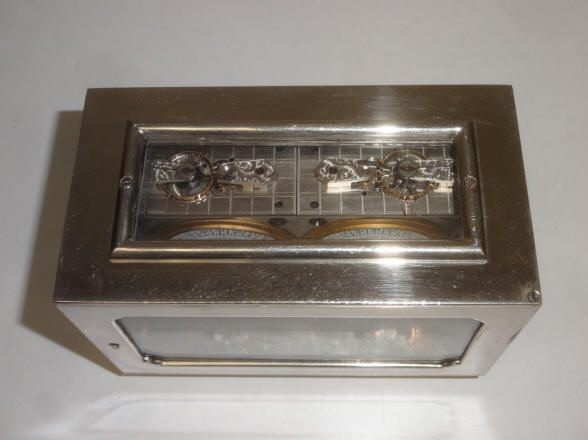
The first time lock model by Hall's in 1875 employed a pair of time lock movements. These were not independent of each other and were not modular. From the front and top it looks like the movements are split because the front movement plates and platform escapements are separate, but the movement pair is mounted to a single rear plate. To drive this point home both movements always had the same serial number. The case designs had a solid rectangular window covering the twin platform escapements and the door had scalloped corners (see first photo above). A very few also had porthole type openings in both sides of the case to reveal a specially decorated wheel that had a ring of holes in the wheel rim. The earliest cases had no engraving, but were a smooth, polished nickel surface.
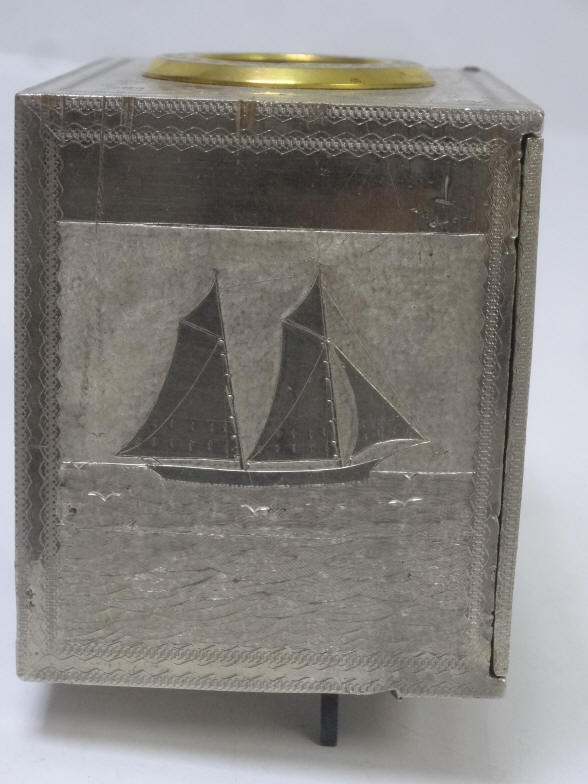
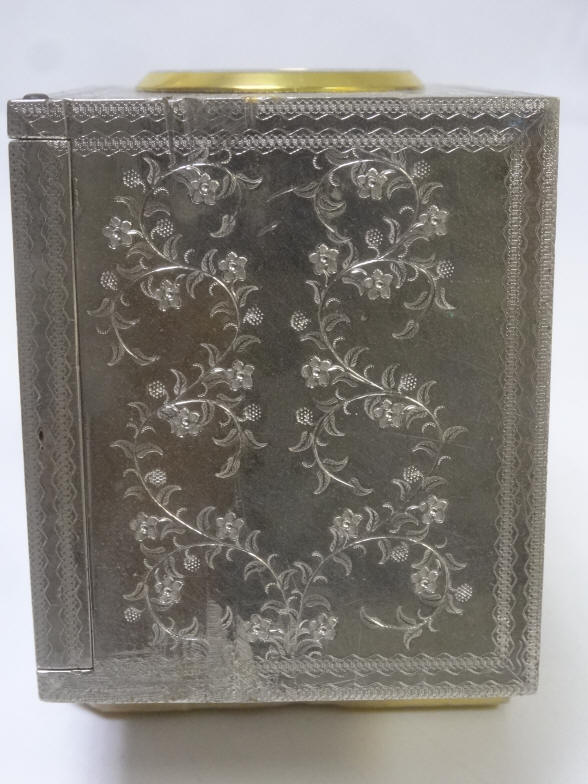
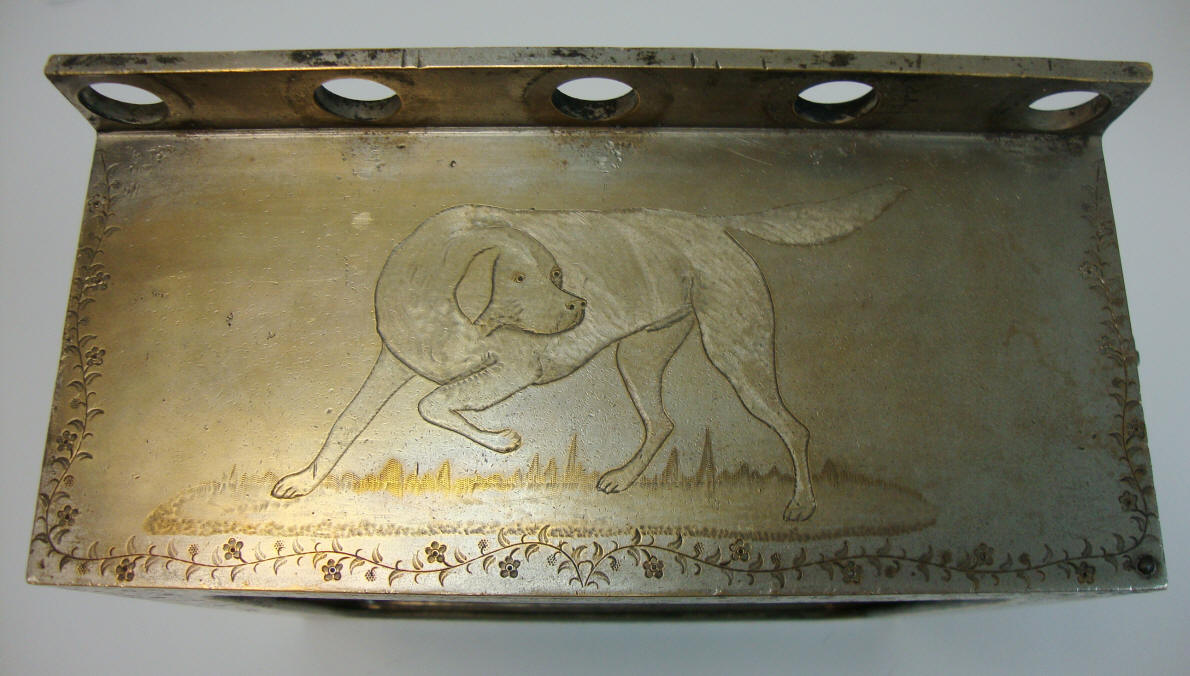
The single rectangular window was soon replaced by a pair of stronger, thick, bevel glass portholes with a decorated bronze bezel. Clearly this was a more expensive design than the single glass and may have been seen as necessary to protect the escapements from explosion. But this seems hard to believe given that the large glass door had a very thin piece of glass. Case decoration: Case decoration is where Hall's expressed a diversity of design. Nearly all of their cases had a machine-milled guilloche (Spirograph™) design on the sides and often around the glass porthole on the top with a design running parallel to the edges of the case (excluding the rear and bottom sides). The porthole bezel was decorated with flowers that had a daisy petal design. All of these features were highly individualized, it is hard to find two cases that are exactly the same in all design styles. On rare occasions the cases had naive folk art style. Mr. Hall must have been an outdoorsman because these all depict outdoor scenes of sailing, fishing or hunting as well as those of game birds or dogs. These were also often paired with flowering vine designs as well as what would be termed patriotic symbols of a shield with the stars and stripes. It seems that the cases that had this extra decoration are also found with case plating in a better condition; either the plating process was more carefully, done or the locks had been better cared for over the years than those without the art decoration.
These first three photos show typical machine-milled guilloche designs. The third photo shows a common edge design with the fourth photo having the design around the porthole bezel as well as a more unusual edge decoration.
All of the porthole bezels had a similar but slightly varying daisy petal design. In this example one sees the depiction of flowering berry vines. Here too this design varies slightly but remains largely the same.
This lock has a folk-art depiction of a twin mast sailboat and on the other side the berry vine design.
This example has the berry vine combined with what appear to be a group of roses in the center. On the other side is a profile of a dog's head within a star.
Here one side has the depiction of a "stars and stripes" shield. The other side has an interesting collage of berry vines, sailboat and what may either be a bridge or board walk overlooking the sailboat.
This case has a bird on one side, on the other a shield (less the stars) with a slightly different vine design substituting berries for fronds, but still keeping the five petal flowers.
Here we have a hunting dog. Movement plate decoration:
The concentric circular damascene was the earliest movement plate design. The second photo, shows one of the more common patterns, a two concentric circle diamond pattern; this one shown on a large format design.
These photos show a couple of less common patterns. The second photo is possibly unique, where each movement is divided into four sectors, each with its own unique pattern. The other interesting feature of this lock is the door lock is an older version deadbolt type lock requiring a two lever key as was used on the earlier lock versions before a simple handcuff key was used with a spring loaded latch bolt. The movement and case number stamped on the back are 6091 fairly late in the production run.
These two photos show single movement models with two fairly common movement plate designs; the second with the two concentric diamond circle design. Door glass:
Small case size for single movement time lock.
Medium case size for dual movement time lock.
Large case size which can contain either one or two movements. The larger case size was unnecessary; it was a marketing tool and was used where the style within the safe door demanded a larger time lock to look appropriate to the design. "Upsizing" a time lock for aesthetic reasons was common practice in the industry; this also included increasing the number of movements within a lock even though the reliability of the lock did not grow much beyond two movements. For all case sizes where there was an acid-etched glass logo, the name "Consolidated" appeared in a semi-circular pattern above the words "Time Lock Co." in block lettering with the words "Cincinnati, O." appearing below on the third line in a stylized, backward-leaning script. The etching was applied on the exterior side of the glass, as were S&G models that had a logo unlike Yale's logo on their model 1 which was on the interior side. Case numbering:
Unlike most other makers, Hall's / Consolidated did not make their cases to be individually matched to the movements at the time of manufacture. The proof of this is the fact that the case numbering found on the door never matches the serial number on the movement dial. The first photo shows a serial number 591 on the case door with the serial number on the movement of 3254. After the movement was slated for a particular case the serial number of that movement was stamped in a small font onto the rear of the case, second photo. If one looks closely at the case number it is obvious that the numbers were stamped with individual number dies by hand as they do not perfectly line up. In the time locks of Sargent and Greenleaf and Yale there were numerous components that were not integral to the movements themselves; drop bolts, snubber bars and bolt dogging devices to name a few. These all had to work in conjunction within the case to which they were mounted as well as the movement. Most if not all of those components had matching serial numbers to the case. In their early time locks, those that used integral movement plates which contained a pair of movements the movement serial numbers either matched or closely matched the case numbers for the early runs of those models. As time went on, the numbers began to diverge. Prior to the introduction of modular movements in 1902, the movements of the Hall / Consolidated time locks contained all of the necessary components for the time lock and did not depend on any external parts connected to the case; so there was no need for the case to be closely matched to the movement to ensure functional integrity. Movement design:
Close up of typical platform escapement mounted horizontally on top of the movement in the manner of a carriage clock style, a type of clock popular at the time. However the reason for this configuration was not for style but to allow the movement to have a narrower vertical profile. One of the selling points The Hall's / Consolidated company had was the fact that their locks were generally smaller and better suited for smaller safe doors with limited space.
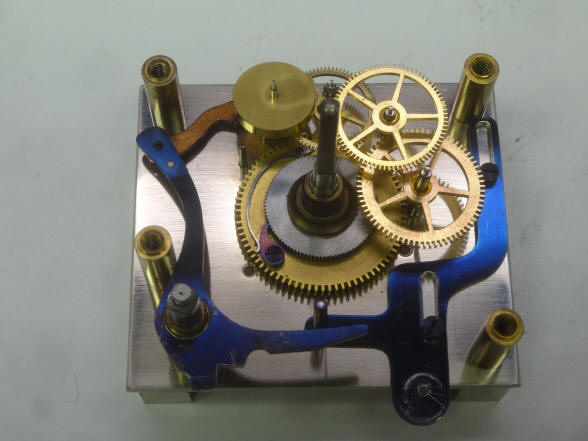
The first photo shows the rear of a typical single movement. Next the same movement with the front plate removed revealing the wheel works within. The blued lever work is what acts upon the combination lock's fence which is located directly below. The Hall Infallible Lockout Protection™ system:
The second photo shows a close up of the permutation bypass fence. Here one can see the row of five screw studs as well as another row of empty, threaded holes. If someone was familiar with the construction of the Hall Premier lock equipped with the Infallible system it would be possible to deduce the secret combination via a subtractive formula derived from the regular combination. In this example, in order to make the lock manipulation quick and easy, the combination is 60, 60, 60, 60, 60. The secret combination is 40, 40, 40, 40, 40. So knowing this one could use the subtraction of 20 from the regular combination to deduce the secret one. This fence, as illustrated in Flint's patent, allows one to move the five studs so as to add a lot more guess work to that formulaic deduction since it is no longer a simple subtraction of a single factor from the regular combination. The movement of a stud changes the combination by 2 digits. Remember, that if someone is trying to bypass an intact, running, time lock, the automatic reset system, which is also a part of Flint's patent, puts the time lock back on guard between five to ten seconds after the bypass combination is dialed in, preventing one from entering the normal combination in time to bypass a working time lock. This fence makes it nearly impossible to do so in time unless one knows the configuration of the studs as well as the subtractive formula. As shipped from the factory all the five studs are left in-line. Any qualified service tech can change these locations so the secret combination is altered and is thus only known to the safe's owner, completely eliminating the possibility of collusion between an employee of the Consolidated Company and one who knows the regular safe combination. Along with the automatic reset found within the Infallible System the time lock was extremely reliable and secure even with only a single time lock movement. The Infallible system was so reliable and effective that it became the basis for a large segment of Hall's time locks. The cost of time lock movements was the single largest cost component of a time lock. So having a reliable time lock that could utilize only one movement and still be reliable gave the Hall / Consolidated Company a cost advantage over other makers that used two movements; and they all did. Of course these single movement time locks could only be used with the Infallible system and this was only found within the Hall line of combination locks. However, Hall was the dominant maker of combination locks. But as time went by the redundancy provided by two or more movements did supplant the single movement Infallible system. One reason was the fact that these had to be used with the Hall line of combination locks, whereas later designs generally worked on the safe's bolt work, allowing those to operate across all lines of safe configurations. Another was the cost of movements declined, the advent of modular designs and the fact that redundant movements were easy to understand in the context of security. See video below for a demonstration of the Infallible Lockout Protection System™.
Video demo of the Infallible Lockout Protection System™. Typical lock configurations:
The first lock is a single movement time lock mounted to a Hall's Premier five tumbler, size #2. The second a twin movement mounted to Hall's largest single dial five tumbler size #5
This photo shows the front plate removed from the Hall Premier size#5 showing the beautiful casting and damascening inside. Specialty time lock products: the Dalton Dual Guard, Dalton Triple Guard, Triple Concussion and Triple movement combo (2+1) models
The patent issued to Milton Dalton, 221,789 on November 18, 1879 at 28 pages, is to this author's knowledge, the longest in terms of pages and drawings (14 drawing sheets, 14 explanatory pages in all). On the same day Dalton was also issued patent 221,790 for his Permutation Lock which appeared along with the Dual Guard in Consolidated's tour d' force time lock, the Triple Guard.
The Consolidated Dalton Dual guard.
Interior view of the Dalton Dual Guard, note the small permutation (combination) lock as represented by the wheel to the right of the center dial..
The Dual Guard was first produced in 1884 and was a successful product being sold for use with combination locks made by MacNeal & Urban as well as by Hall Safe & Lock. The Dual Guard used an unusually expensive E. Howard movement and, at $55 wholesale ($1400 in 2017, and retailed for about ten times that amount or $14,000 today), and exceeded that of the Yale Double Pin Dial. The Dual Guard was equipped with its own internal combination lock, allowing the Infallible mechanism to be opened with from one to four numbers by shifting the pin visible below the time lock dial. Since the Dual Guard was intended for use with locks other than Hall's Premier, it used a gear on the case back to connect its miniature combination lock to the main combination lock rather than the armature found on Hall's Premier. Two styles of the Dalton Dual Guard were made: one that engaged the bolt with a plain hinged armature and a second that used the wound spring mechanism seen here on the outside of the time lock case. (2) This video is a description of the Dalton Dual Guard time and combination lock introduced by the Consolidated Time Lock Co. in 1885. It was the most complex and expensive stand-alone time lock until it's incorporation into the Dalton Triple Guard in 1888. While this lock is based on the patent awarded to Milton Dalton, the design described in the patent is quite different from the production model to the point that it was only marginally helpful in ascertaining the functionality of the lock. Fewer than 500 of the Dual Guard were made with less than ten known to survive. A circular from the Consolidated company of 1884, below, describes the incredible features of this lock. After reading it, one wonders if it can also serve up breakfast! It can unlock when the specified hour arrives without the setting of any combination; or if desired setting the combination at that hour may be required. It permits one, or may require two persons to set up the combinations and unlock after the timer has released its control. It is wound until a stop is felt; this sets it exactly right even in the dark; over winding is impossible. It will permit unlocking on Sundays or holidays at any selected hour, and for two hours after, and then will resume its guard automatically; or it can prevent any unlocking on these days. It can assume its control immediately after closing, and prevent unlocking; or it can automatically assume this control at any desired hour after winding. No other lock is required on the door, as it performs all the functions of both a timer and combination lock. The Dual Time Lock can be used as a time attachment if desired, controlling any combination lock. The Dual Time Lock can be applied in such a manner as an attachment to a combination lock, as to prevent unlocking by the cashier and his assistants in charge of the regular combination, until the specified hour; but by means of a second combination, secretly in possession of the proprietor, unlocking at any time may be effected in case of a conflagration or other great emergency. With this lock you may instantly reduce its power (by moving a button) from four combinations to three, two or one, or may cut off all combinations, making the lock only a slide bolt. Should the time movement stop, break or from any cause act improperly, the banker is not permanently locked out, but has a means of access by the combination mechanism, which can be used after the predetermined hour. It can be arranged that in a case like this the cooperation of two, three or four persons is necessary in order to unlock. Of course this combination mechanism is not effective except when the timer is off guard, or in case of a lock-out. Should the combination mechanism break, or by any means become inoperative, the banker is not permanently locked out, but has a means of access by the timer mechanism, which will automatically unlock from four to ten hours (according to its setting) after the predetermined hour, even though the combination parts have been rendered useless and without power to act. But aside from this protection, premature stoppage does not unlock, for the combination numbers must first be set up; but when the banker sets his lock for opening, he does not need or desire the knowledge of the combination numbers, and it remains a secret in the maker’s hands or with a neighboring banker. The banker can, if he desires, be saved the trouble of setting up his combination numbers to unlock. This lock can be set to do its own unlocking at the specified hour. Should the timer stop when set for automatic unlocking, entrance can be had after the specified hour, but only by setting up the combination numbers. It can be set so as to permit unlocking on Sundays or holidays at any selected hour, and for two hours afterward; after this period the timer resumes its control without any assistance from the banker, and prevents unlocking until the selected hour the next day. So that if the banker finds that there is no occasion to unlock during these two hours, he is not obliged to go to the bank to reset the timer, for he knows that it has already been set to automatically resume control. (3)
As if the Dual Guard was not complex enough below is described the Triple
Guard incorporating both the Dual Guard time lock and an additional permutation lock. It was the most complex,
expensive and had the largest footprint of any time ever made. At the time
it sold for $750.00, worth over $15,000.00 today.
  Interior view of the Triple Guard lock, incorporating both the Dual Guard time and permutation lock, already the most complex time lock made, as well as a separate permutation lock. 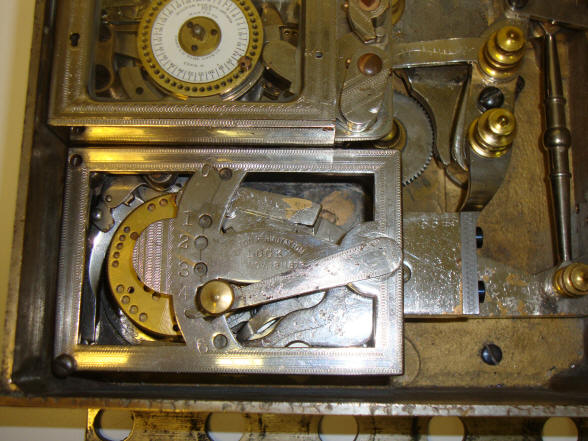
 Two close up views of the additional permutation lock within the Triple Guard case. Dalton Triple Concussion Timer  Dalton Triple Concussion Timer, c. 1887  The purpose of the concussion unit, mechanism below dual time lock movements, was to offer a way to override the time lock in case of its complete failure. Given the reliability in the redundancy of two movements this would only occur in the event of severe forced entry or explosion. It allows for an override of the time lock using a ratchet to advance a wheel that will allow the timers to be overridden and the safe to be opened with the correct combination. The key to this system is the very high gear ratios as represented through the use of multiple worm gears resulting in the input wheel needing to be rotated thousands of turns to reach a single rotation of the output wheel. It takes a very long time to effectively accomplish this. Therefore it is unlikely that any unauthorized personnel could use the override before being discovered. It is rare to find an override system with a lock that has the redundancy offered by two movements. Holmes is another company that employed an override with two movements. The Hollar Company used the opposite philosophy which was to keep a time lock wound indefinitely past the time it would normally be set to go off guard in case the owner would want to keep the safe closed, say in the case of civil disturbance.
This video is a demonstration of the Consolidated company's Milton Dalton time lock model Concussion Triple equipped with a special override mechanism. Concussion timers were a very small genre of time locks with few examples extant. It shows how the override mechanism works and the key to this design is the multiple, very high ratio gearing that requires the person using the override to turn the input gear many thousands of turns to wind the output dial to the point where it overrides the time lock. In this example there is an eighty ratchet toothed wheel meshing with an eighty toothed wheel resulting in a 6400 output times a 2.66 x 6 wheel for a total of 102,144 clicks to turn the output wheel one revolution. Assuming one second per click this would take 28.37 hours, more than the number of hours on the concussion dial. Furthermore there is an adjustment to the input lever to make it less efficient. Adjusting the lever to its most restrictive would cause the time to lengthen by four equaling nearly four days. Assuming one could click the ratchet four times a second for a full 24 hours, one might be able to disable the lock in little over one day. Trying to click the lock faster will not make it open earlier. Consolidated's last model using integrated movements
This three movement model, what I call a Triple Movement
Combo (2+1), c. 1892 was Consolidated's effort to compete with S&G and Yale
as the industry began to move toward three movement designs with the
introduction in 1889 of S&G's Model A and in 1892 Yale's Model Triple L. It
looks like and was a sort of cobbled-together effort. Consolidated had a
disadvantage in their design with regards to the expansion of the number of
movements. The next section explains why this was so. Post 1901 models, the introduction of modular movements
Consolidated was late to the development of the independent, modular movement design. This is a rare example of their first attempt; an experimental transitional time lock produced for about a year, c. 1902. Apparently the company continued their dial serial numbering from their prior carriage clock movements to this new movement design; the numbers are 7556 and 7557, the highest numbers known before the change to the new dial format. Beginning in 1887 Yale introduced the first production lock with the feature of semi-interchangeable, modular time locks. Yale used Waltham Watch Co., Waltham, MA, movements in their Type B through EE series of locks. In 1888 Sargent & Greenleaf introduced their concept of modular time lock design with the introduction of individually removable time lock movements of their own manufacture in their model Triple A. Although these movements were not yet truly interchangeable, that would come by 1895. Up to this time any time lock that had more than one movement had these incorporated into one movement plate or were made as matched pairs requiring the change out of both movements, or repair on the spot by an experienced technician; a more expensive proposition. Modularity allowed a simple swap out requiring far less training. This example was Consolidated's first attempt at this problem. The fact that E. Howard exited the time lock business in 1902 when they were acquired by the Keystone Watch case Company may have also played a role in the decision to explore a new design. Prior to this all of their twin movement time locks were combined as matched sets and not interchangeable. To prove the point, both movement dials always had the same serial number marked on both dials. One can see in this example that they abandoned the horizontally mounted 'carriage clock' style platform escapement made by E. Howard for the more a conventional configuration where they are positioned on the same plane as the rest of the movement. However, the balance wheel and escapement cocks are mounted directly to the top of the front plate and are not removable as a modular platform unit as they were in Yale's design. This was actually a step backward as far as servicing was concerned. In their prior carriage clock design the top plate could be removed as a unit similar to a conventional platform design containing the entire escapement; the balance wheel, lever and escape wheel. The movements are not signed, Mr. John Erroll thought they were probably made by Seth Thomas. That company took over most of the time lock movement business after the exit of Howard. One can see that Consolidated still clung to the same dial and lever actuator design that connected to the newly introduced snubber bar. In this example, operating an automatic bolt motor. One might wonder why Consolidated did not simply take their existing single movement design and gang those together. The reason is that Consolidated chose to make their time locks work upon the fence of the combination lock and not on the external bolt work as had most other makers. This meant that they had all of the parts necessary within either a single or dual movement to perform this function. Locks that operated on the bolt work had the dogging and release functions controlled by a mechanism known as a snubber bar and bolt dog that were used by S&G and Yale. This mechanism was independent from the movements and was mounted to the case and was easily adapted for multiple, independent movements. One can see that in this example Consolidated also adopted a similar design represented by the sliding bar that interacted with the curved dial lever. It connected to an automatic bolt motor, but later a base adaptor would allow for manual bolt work operation.
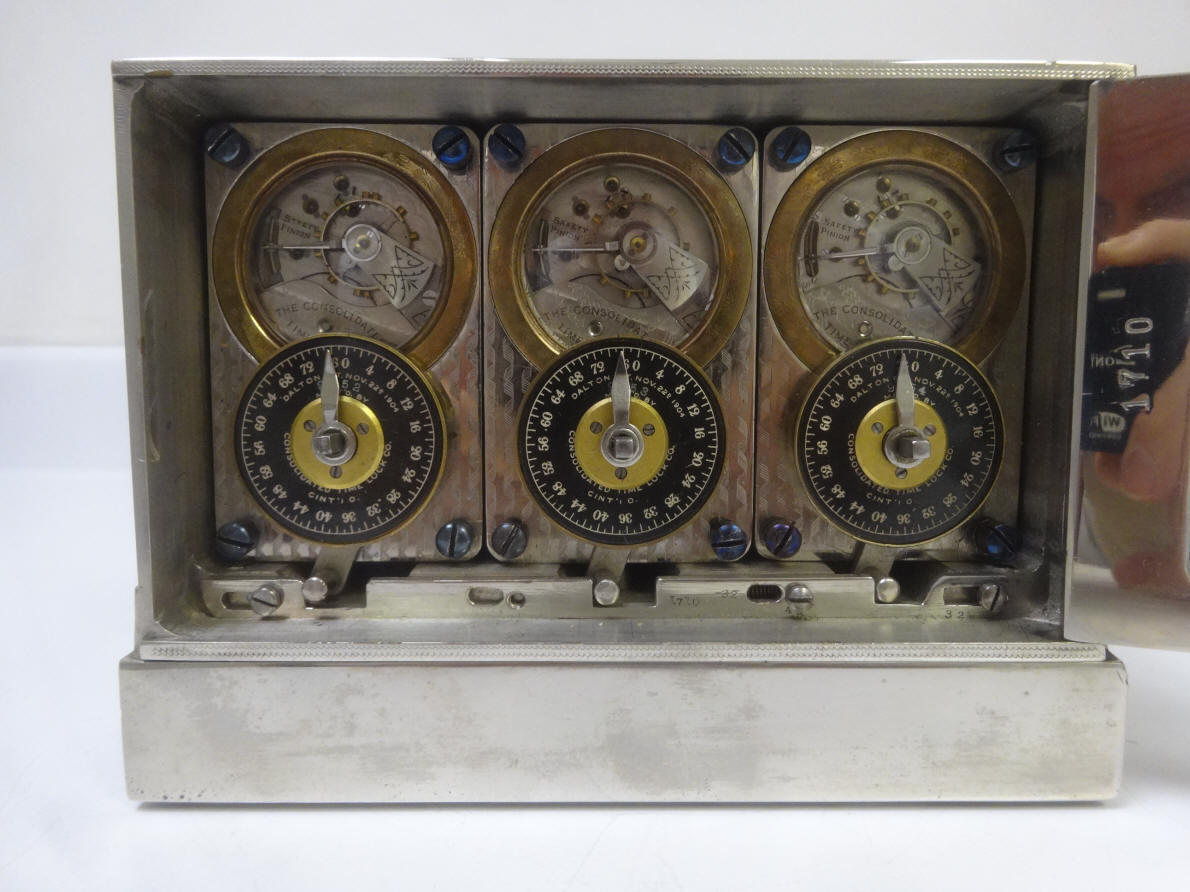
Harry Dalton's patent of November 22, 1904 marked a significant innovation in time lock movements. While he was not the first to use pocket watch movements within a time lock; that distinction belongs to Yale with the introduction of their Type B model in 1888. However that design incorporated three watch movements within one unit, each acting in concert to operate the lock. Yale's time lock was the first to introduce modularity in a production run time lock. Dalton's innovation as reflected in this patent was to take that a step further and make each pocket watch movement a self-contained modular time lock movement. He claims several advantages. The first being that this design can use any common watch movement allowing freedom from being bound to one maker. This was fresh in the minds of the time industry as E. Howard had recently exited the time lock business in 1902 leaving many firms to search for alternatives. Second a pocket watch, even a common class variety will generally have a finer escapement than that found on a special-purpose time lock movement, although how useful this is in the application of a time lock being reset each day or over the weekend is questionable. Third, he claims that by using 'off the shelf' watch movements he can produce movements at less cost than would be from a special purpose made time lock.
This example is one of the first made about 1904 with a new modular movement design utilizing "off the shelf" pocket watch movement by the Elgin National Watch Co. with white dials. The first few in production had watch movements that displayed the original Elgin logo. Shortly afterward a plate with the consolidated logo was screwed on top of the location of Elgin's name. The movement numbers in this example are 22 and 23 and at this point the company continued their serial numbering on the dials. By this time Consolidated abandoned the folk art case designs. Here is a simple diamond cross-hatch and squares for the case sides and door. The snubber bar had been reconfigured to accommodate the new movement design and like the prior example was designed to operate an automatic bolt motor.
This example has black dials and occurred with their change of watch movement suppliers from Elgin Watch Co. to the South Bend Watch Co. around 1905; the dials refer to Dalton's patent of November 22, 1904, (see illustration above). It is interesting that their first production run using the Elgin/white dial arrangement did not note the patent information, but had PATENT APPL'D. FOR on the dial. This model also shows Consolidated's answer for their locks to operate upon manual bolt work. The lock was attached to a separate base with the bolt dogging device. Other than a small change in the snubber bar to allow it to attach to the dogging device, the time lock remains unchanged from its automatic bolt motor configuration.
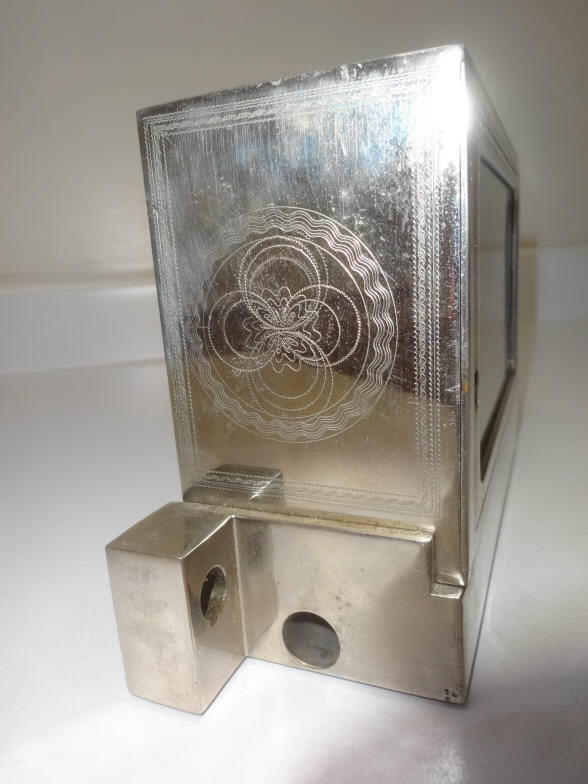
These two photos show the separate base to contain the manual bolt dogging mechanism. An interesting innovation is the fact that the bolt could be blocked from either side, allowing the lock to be either a right or left handed installation, something that other makers did not have and was not generally available until well after WWII. However one can see from this design how Consolidated, even at this point in time, never fully embraced the idea of their time locks acting directly to block the bolt work vs. acting upon the combination lock, even though the former was almost universally the recognized method. They never made a lock that was dedicated to this concept and this probably had to do with the fact that Hall was the premier maker of bank locks and it was a natural fit that their time locks would act in concert with their bank locks. What was recognized by their competitors was that all safes and vaults had bolt work and making time locks to operate on those mechanisms made them far more universally accepted. Consolidated did, however, pioneer the practical use of standard pocket watches within a modular movement design to replace purpose-built movements in time locks. Watch movements were later adopted by Victor Safe Co's. Banker's Dustproof time lock division after their acquisition of the Consolidated Time Lock division in 1906 from the Hall Safe & Lock Co. (According to John Erroll in his book this is not a certainty and it is not proven that Banker's acquired Consolidated). (4)And the short-lived Ohio Time Lock Co., used them (1914-1916); both companies were acquired respectively in 1915 and 1916 by Mosler, who then became the only user, but on a large scale, of pocket watch movements exclusively in all their models until they exited the business in 2001.Twilight of the Hall Safe Company There is no record of any time locks produced by the Hall's or Consolidated entities after the sale of Consolidated Time Lock Co. to Victor Safe Co. But here was one model made briefly in 1927, the same year the Hall Safe Co. went out bankrupt.
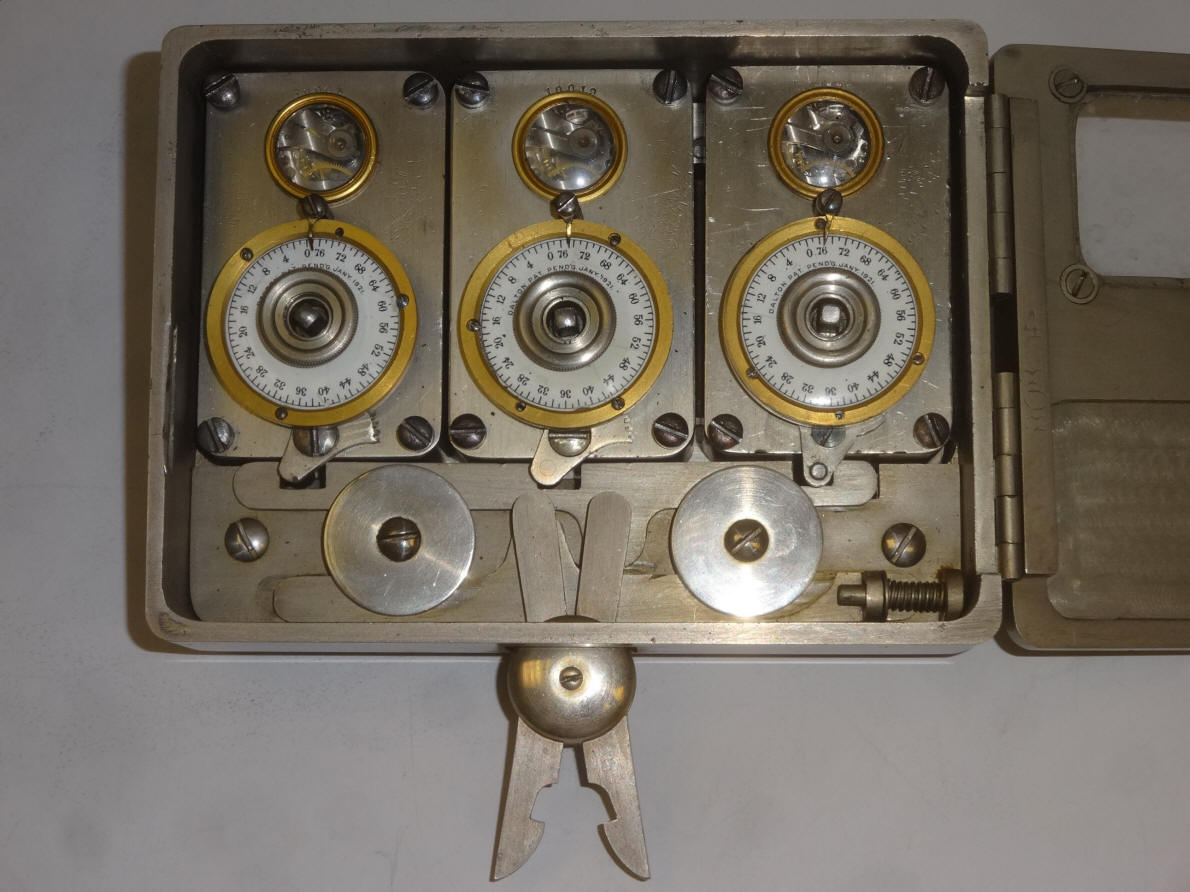
The logo on the door is Hall's Safe Co. but it is not the same company as Hall's Safe & Lock Co. The latter was started in 1867 by Joseph Hall and the time lock business, Consolidated Time Lock Co. was created as a separate entity in 1880 to protect his safe and lock business from the rampant litigation that surrounded the time lock industry at the time. Consolidated may have been acquired by Victor Safe Co. in 1906, but this is not proven. It is unclear if this lock was made under the Consolidated firm. The name does not appear anywhere on the movement dials as it did on all prior examples but the case has the Hall Safe Co. name and a reference to Milton Dalton, an important employee of the Consolidated firm is seen on the dials as "DALTON PAT. PEND'G JANY 1921". It is unknown if this lock was originated by Hall or if the company was a subcontractor for the inventors W.T. Benham whose patent is illustrated above. That patent is dated June 24, 1927 and it is unclear what Dalton's earlier patent of January 1921 has to do with this design. The author has been unable to locate the Dalton patent for verification. Time lock production ceased after the bankruptcy of the Hall Company in 1927.
(1) American Genius Nineteenth Century Bank Locks and Time Locks, David & John Erroll, pp. 166-168. (2) American Genius Nineteenth Century Bank Locks and Time Locks, David Erroll & John Erroll, pp 234-235 (3) The Lure of the Lock, John M. Mossman Collection, pp 163-164 |






.JPG)
.JPG)
a.JPG)






.JPG)

.JPG)


.JPG)








(4) American Genius Nineteenth Century Bank Locks and Time Locks, David & John Erroll, pp. 314-317.