|
Debugging completed, wood sub base surround finished, final photography and videography finished, NAWCC Zoom presentation. October 2021 In recognition of the completion of the project two detailed video montages as well as photos for future articles in the NAWCC Bulletin are included in this installment. The front and rear cover issue of the September Horological Journal featured an eight page article, and an additional three-part series is being published in the Bulletin beginning with the current November/December issue and explores what has been documented since the last article that appeared in the March/April 2017 issue.
The Sun and Moon rise and setting dials. This one dial has 15 complications that can be read off the dial. This serves as an example of my wanting to maximize the number of complication while minimizing the number of dials, in this way the machine comes to the fore. Other clockmakers have tried to maximize the number of dials so as to be sure the observer knows that the clock has numerous complications, but to me this looks cluttered and reminiscent of a prior generation jetliner cockpit with the dashboard coved with analog dials.
The tellurion. This can when used in conjunction with the third-order perpetual calendar, show when in the past and predict when in the future a solar or lunar eclipse has or will occur. It can also show where those events will track across the globe.
This photo shows the true color of the Citrine rutilated quarts Sun.
The solid pair of dial work below the earth globe shows sidereal and synodic months. The sector dials that appear below and just adjacent to the red planet of Venus are the indicator for descending and ascending lunar nodes (which are the uppermost and lowermost areas of the Moon's slightly tilted orbit in relation to the ecliptic. The outer sector dial is the eclipse window when one would expect an eclipse when the window aligns up with the node. I know of no other device in horology that can display past and future solar eclipse times and paths across the earth for a total of 800 years.
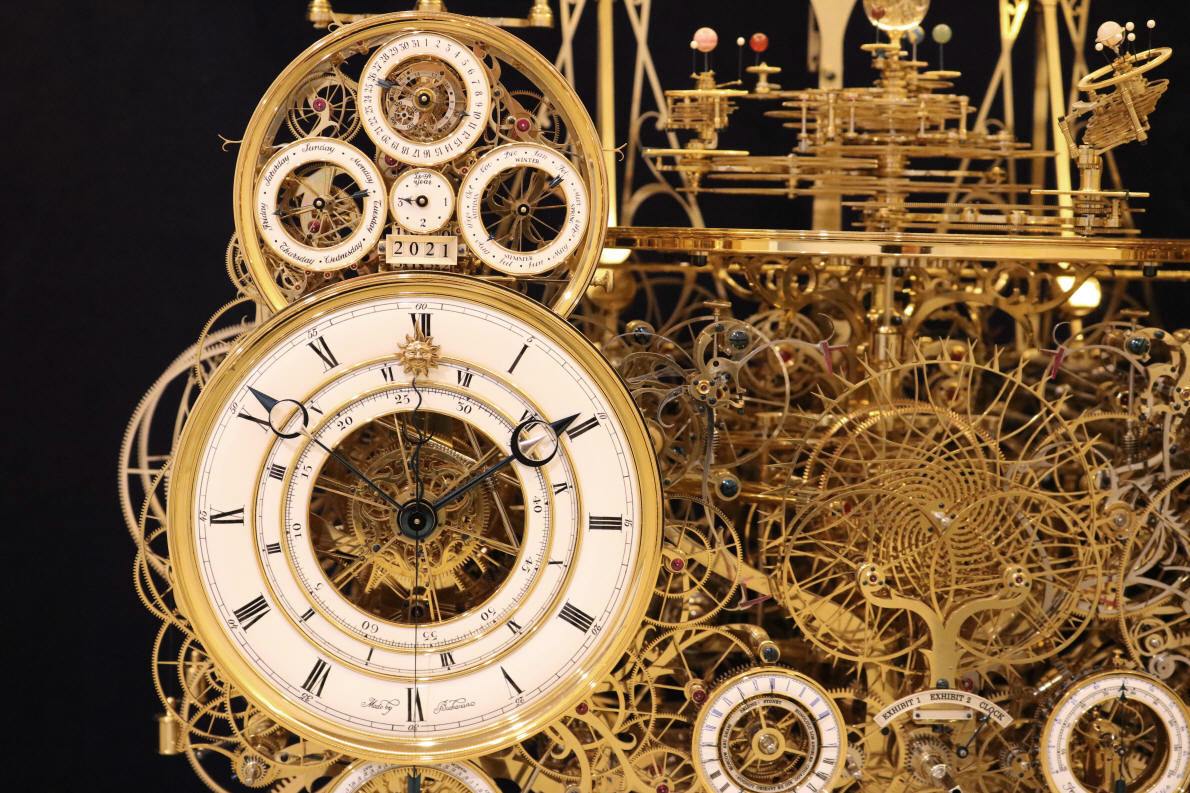
The third-order 400 year perpetual calendar. In horology a simple calendar is the type that does not take into account the different number of days in the months. A perpetual calendar, a (first order) is one that takes into account the quadrennial leap year, adding an additional day to February every four years and takes into account the varying days of the months. A second-order calendar takes into account the 100 year exception to the quadrennial rule used in a first order calendar. A third-order calendar also accounts for the 400 year exception to the 100 year exception of the second-order calendar.
The main time dial. It tells mean solar time, what we all know as 'normal' time. It also shows sidereal time read off two retrograde inner dials, and solar time. Solar time is also known as the 'equation of time'. To the best of my knowledge this is the only example where all three are read off one dial.
A close up of the escapement module consisting of dual Harrison escapement wheels and escapements mounted upon a set of anti-friction wheels. Just below, is the celestial selector that allows one to demonstrate the celestial functions of the clock in fast forward or reverse, disconnect the orrery from the rest of the machine and demonstrate it in a faster speed so one can observe the very long orbital cycles of Jupiter and Saturn, and finally to reset the celestial display to be run in real time, 'clock time'. To the left is the world time 24 hour dial and celestial display winding arbor where the operator inserts the hand crank. To the right the thermometer.
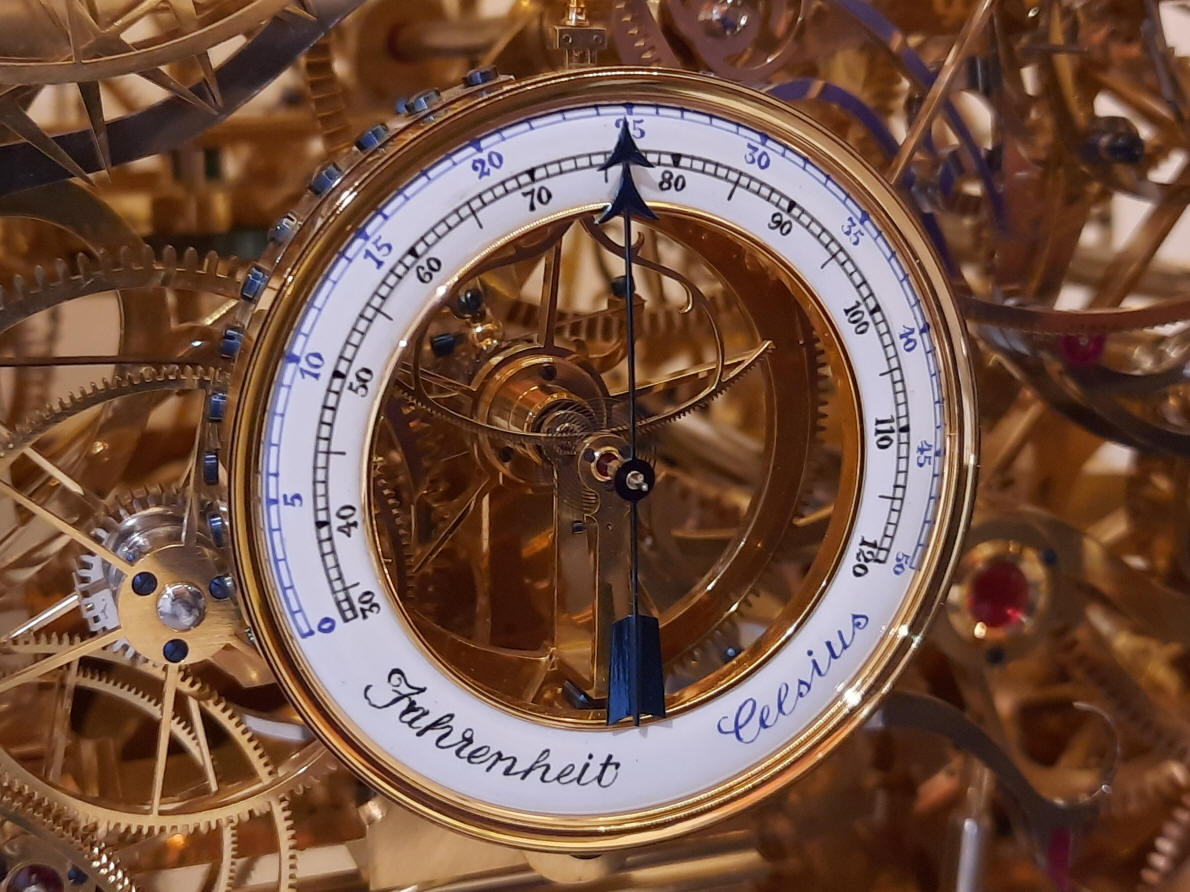
The thermometer.
The world time dial and celestial demonstration crank.
Equation of time calendar dial. Kidney cam with sun ray spokes can just be seen behind the dial.
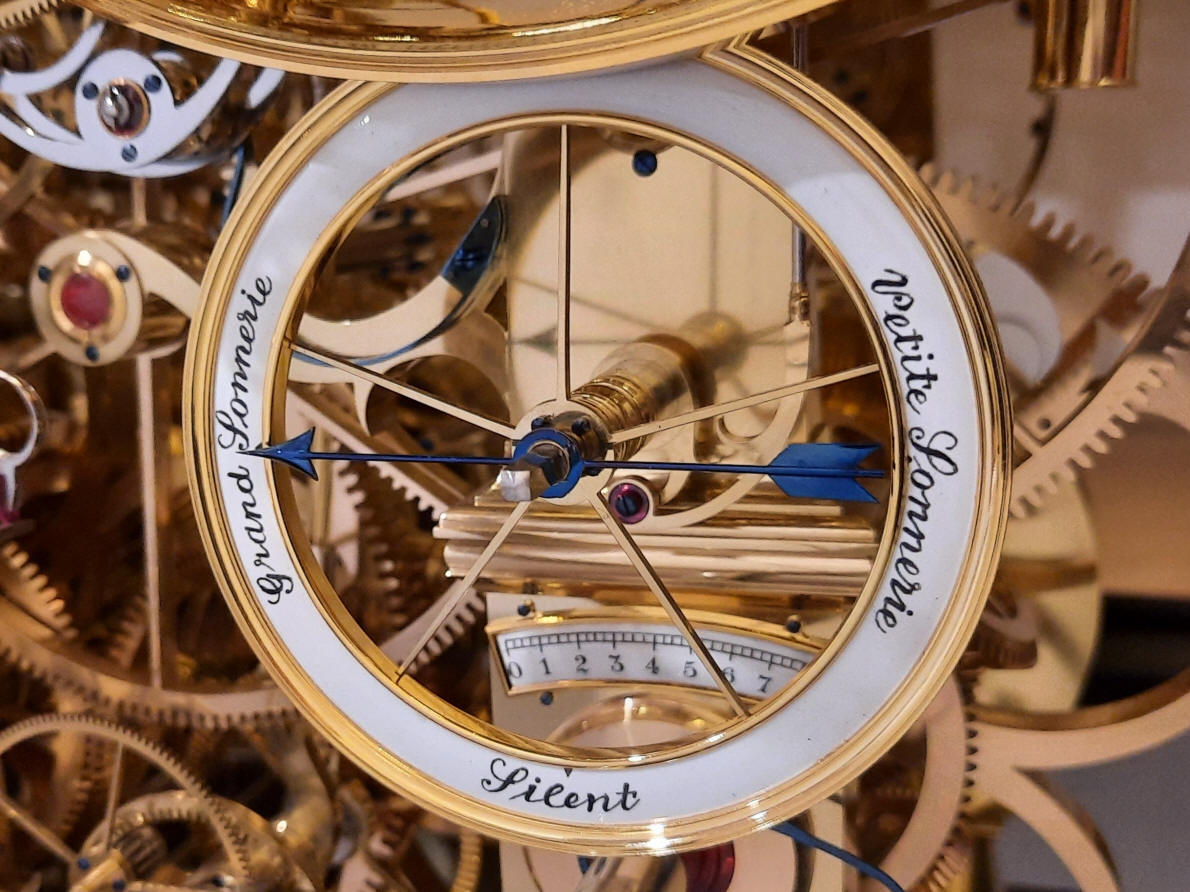
The strike selector dial. Unlike most clocks that have repeat on demand, this clock has in addition to quarter repeat on demand in both Grande and petite sonnerie, but can also operate as a normal striking clock. Repeat is activated by a pull of a chain.
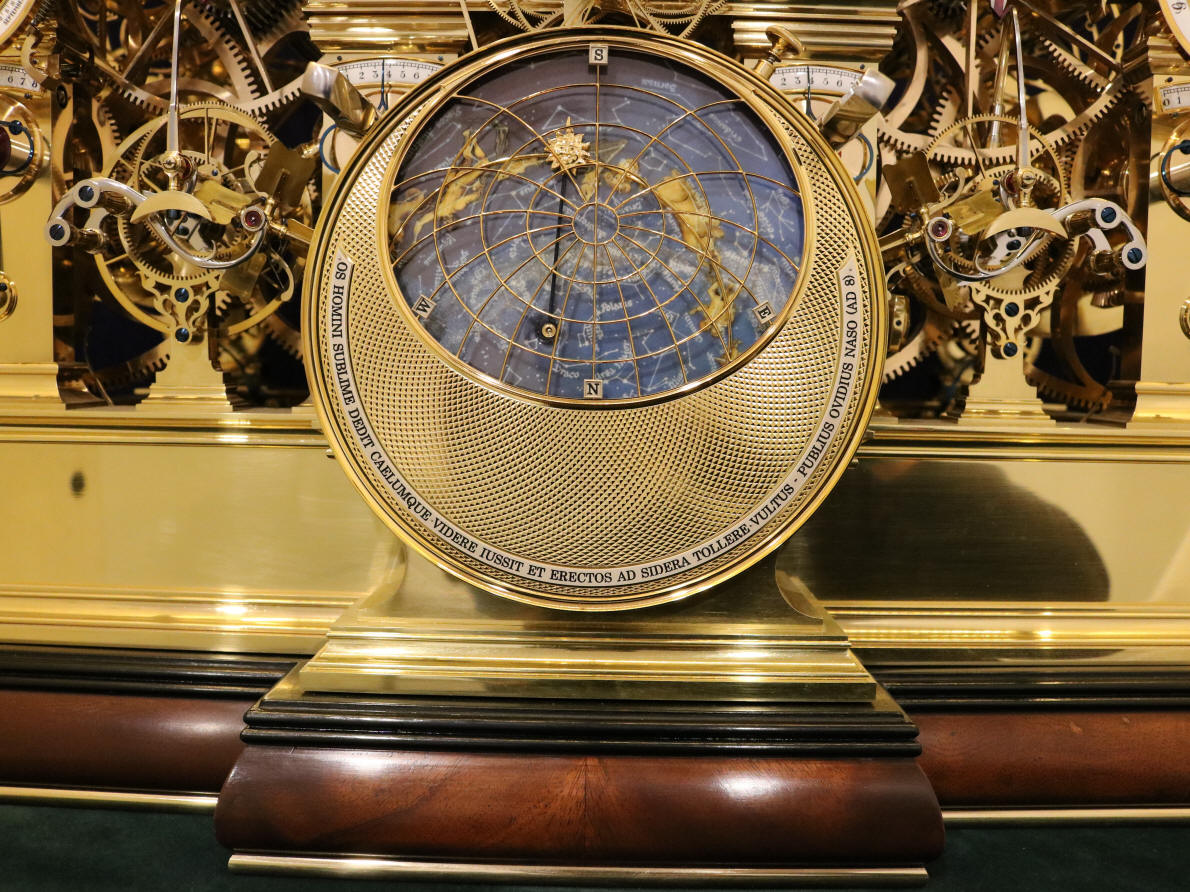
The planisphere. Note the flame mahogany surround below the brass clock base. This surround hides a 2.5" (64 cm) thick block of aluminum that supports the brass base. This is needed because the brass base is made of several pieces and could, just in case the clock should ever rest upon an uneven surface result in movement causing racking of the movement pillars and resulting in catastrophic lockup and failure.
The planisphere mask and spider web is made from one piece. |