|
Complete finishing of the calendar module - August 2020 This month Buchanan completes the finishing of the calendar module. We have provided a video that should please even the most "hard core" gear -head, be sure to view it at the end of this segment.
The first photo shows the parts finished, the second parts yet to be done.
First photo shows the three main drivers for the logic levers. The ends with the leaf springs are moved by the rotating timing logic cams in the calendar trip area (see last month’s installment). Next show the beginning of the jewelling of the digital year readout. This is part of the debugging process. The gears that drive the the digital wheels as well as the wheels themselves required jewelling for less frictional rotation. The second photo shows the jewels as they came from the supplier with a smaller, resized jewel that Buchanan has made for this application, reducing the original diameter of 3.0 mm to 1.5 mm.
The additional fifteen jewels are shown with the parts ready for them in the first photo, next a comparison of a cog count wheel with a jewel on the left, and with the original design on the right.
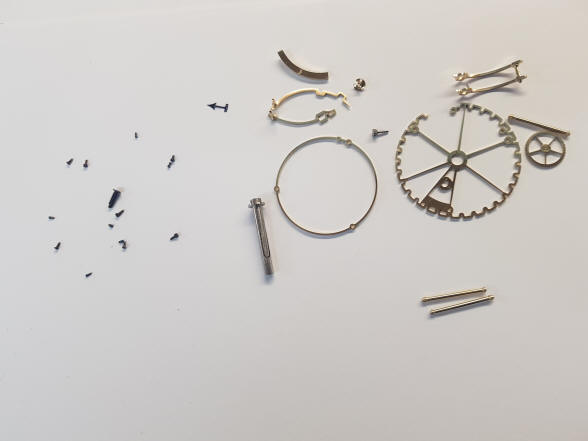
This photo above
beautifully illustrates Buchanan's fretwork, the curvilinear style, sharp
ivy tips. Note the tiny pair of holes barely held by a drooping ivy tip just
to the left of the center disk.
The wheel used as a
detent on the star cam wheel is actually a left-over part from our original
escapement design in January 2009. That escapement had four of these wheels
and was eventually was scraped for a better design. It was one of the very
few times Buchanan had gone down a blind design alley. Waste not want not!
Another view of the wheel and star cam controlling the flip of the digital display. Next a close up of the year display clutch controller. This operates once per year to activate the year counter. Buchanan now
begins the finishing of the calendar calculator cam module, the processing
and storage components of the analog computer that is the perpetual
calendar.
The calendar calculator module
Compare the finish of the cam module and dial work in this photo to those of the module finished below.
The six photos above show the dismantling of the cam module.
These photos show the finished date index wheel, surprise pieces and cam cage surround. Notice the tiny beautifully shaped and blued indicator hand for the 20 year cam dial and crenulated date index wheel.
The components in this photo show the finished date index wheel, surprise pieces and cam cage surround in the center; contrast the pre-finished and tarnished month cam, left, and right, the compound 20, 100 and 400 year cams, have yet to be disassembled.
The month section of
the cam module is finished, excepting dial work.
The first photo shows the main frame for the 20, 100 and 400 year
cam work, next the 400 year Geneva cam indexer (on finger) with the Geneva
cam and cam frame in the background.
A small drive wheel, left, upon which the 400 year Geneva cam is mounted.
The various setting
dials for the cam module from left, month, 20, 100 and 400 year dials. Above the
year readout digit wheels and dial mask. These parts are now finished in a
French silver matte finish.
The parts for the calendar calculator cam module are finished and ready for
reassembly.
These two photos show the build-up of the main assembly with the 20 and 100 year cam work and the 400 year cam work sub-assembly.
Components ready for final assembly, next photo the month cam work placed upon date index wheel. Note the three 'surprise pieces' at the top which account for the differing number of days of the months from 29, 30 and 31. The term surprise piece is the nomenclature used for parts within a watch where those parts perform the same function for calendar, chime repeating work and other horological complications. The parts are designed to move in a calculated way to create a different output at the appropriate time.
Completed module from below.
Completed cam module showing the main components controlling the temporal functions from bottom to top: the main module toothed drive wheel, next the the crenulated daily index wheel, next the month cam, next the 20 year cam, next the 100 year cam and on top the 400 year cam. In the background one can see the three 'surprise piece' levers.
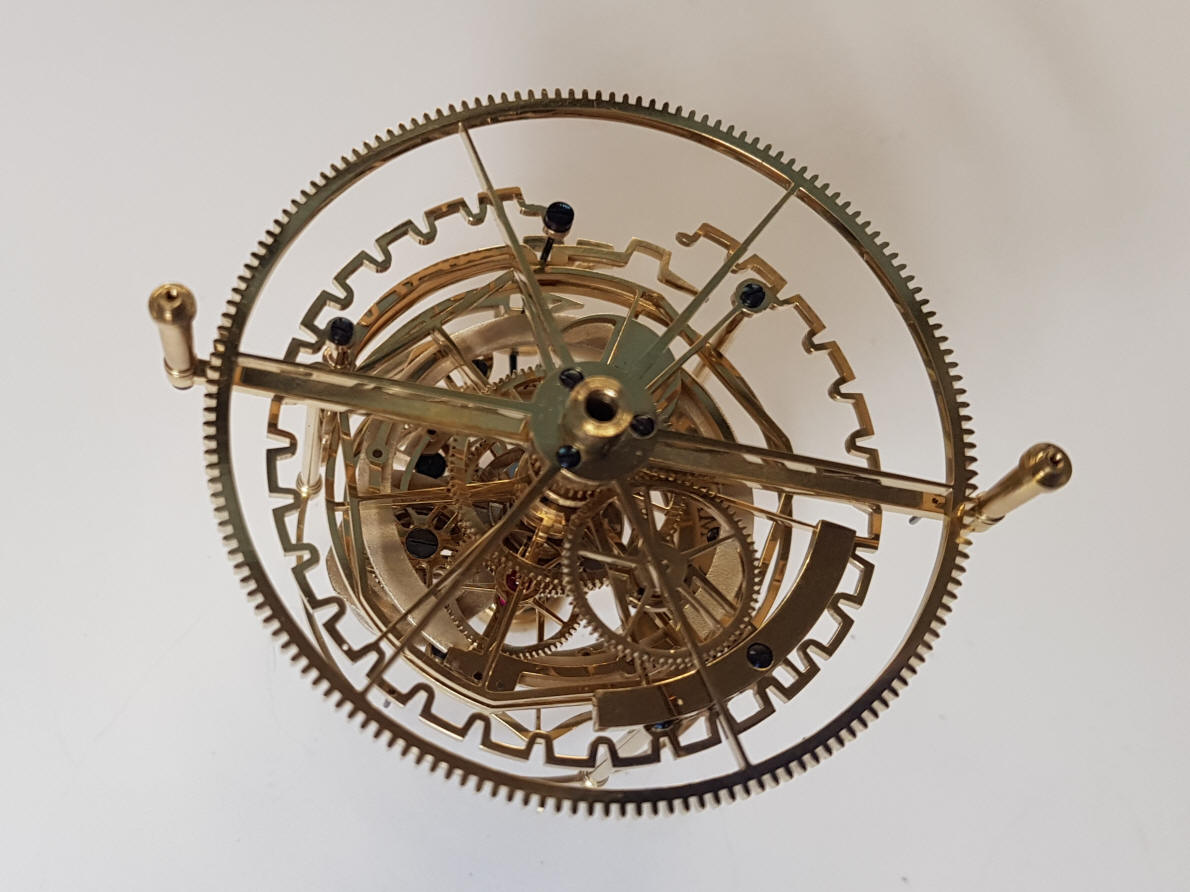
The calendar module installed within the rest of the machine. Notice the beautiful bronze gearing within, contrasting with the other brass wheel work.
And now a treat for the hard core gear head. This video shows the movement freewheeling and is achieved when pendulums, escapement pallets and all astronomical components are removed, all of the four main trains, time, celestial, quarter and hour trains are in freewheel. The time train is running 24x normal speed, strike trains are at normal speed due to the fly governors; this difference puts the strike trains in near constant activity as they are being continually tripped by the speeding time train.
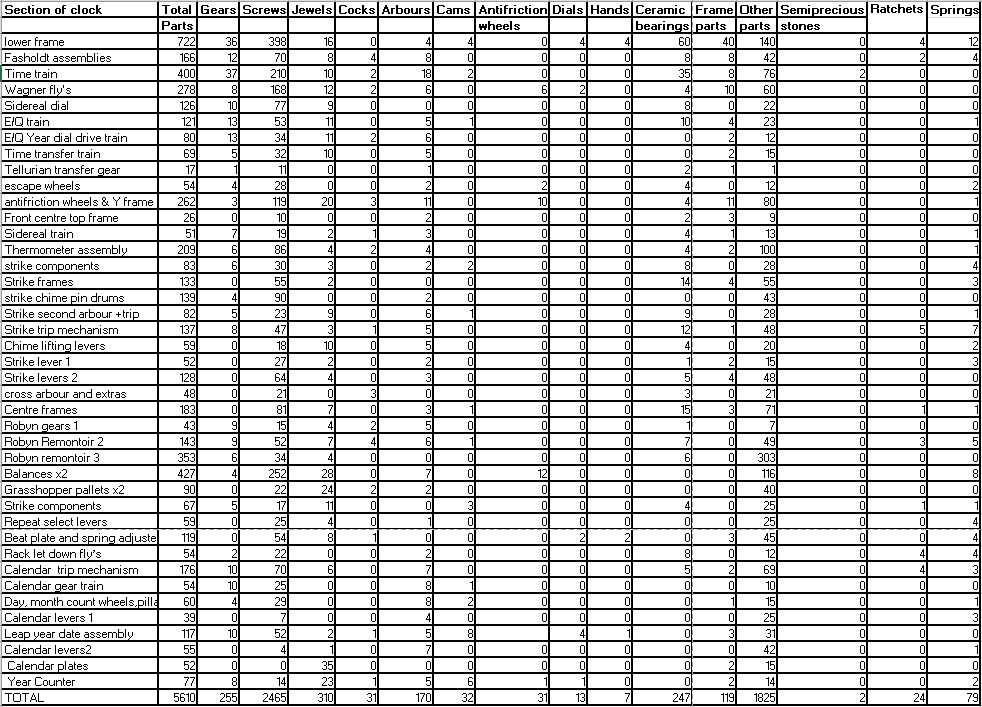
Parts count to date: 5610 |